


THECODEXREVOLUTIONIZEDTHEPHYSICALFORMOFTHEBOOKADVANCESINWRITINGCONVENTIONSREVOLUTIONIZEDHOWREADERSINTERACTEDWITHBOOKSCLASSICALMANUSCRIPTSWERETYPICALLYWRITTENINSCRIPTIOCONTINUAWITHNOSPACESBETWEENWORDSANDLITTLEPUNCTUATIONMOSTLITERARYTEXTSEMPLOYEDMAJUSCULECAPITALSCRIPTSTHATWOULDLATEREVOLVEINTOMODERNUPPERCASELETTERSSENTENCESANDWORDSNOTONLYRANTOGETHERBUTALSOINDIVIDUALWORDSWERESPLITINTHEMIDDLEOFTHEWORDATTHEENDOFALINEOFTEXT. THEN BEGINNING IN THE SEVENTH CENTURY, IRISH AND ANGLO-SAXON SCRIBES INTRODUCED CONSISTENT SPACES BETWEEN WORDS AND A RICHER SYSTEM OF PUNCTUATION, MAKING TEXTS MUCH MUCH EASIER TO READ. The ninth century Carolingian Renaissance further standardized writing through the adoption of the clear and elegant Carolingian minuscule (lower-case-style script) in place of the older uncial majuscule (all-capitals-script). Together with the systematic use of Roman capitals for initials, headings, and proper nouns, it established the bicameral (upper- and lower-case) writing system that underlies the modern Latin alphabet [[i], [ii]].
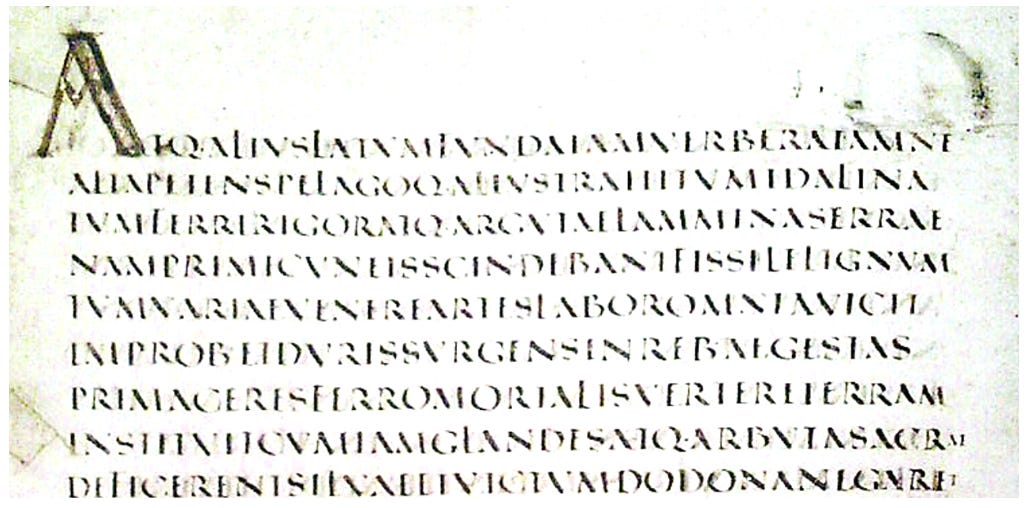
Paul Saenger (1938–2022) argued that scripto continua forced Greeks and Romans to read aloud [[iii]]. Augustine of Hippo (354–430) made a special point of describing in his Confessions (VI.3) that he often observed Ambrose of Milan (c. 339–397) reading with “his eyes scanning the page” while “his voice and tongue were silent” [[iv]]. Augustine found the practice noteworthy, though he suggested practical reasons for it, such as avoiding interruptions or preserving Ambrose’s voice, rather than implying that silent reading was impossible or unknown. Commenting on the challenges scriptio continua poses to the typical reader, one modern scholar notes:
This is what elite texts looked like in the early 4th century: nobody sat with them reading them silently — they couldn’t. These were transcripts for slaves to read out loud — more like the transcripts you get on a YouTube video than something you would expect to find now in a book. All books were “audiobooks,” they just had human readers [[vi]].
Other scholars beg to differ.
Without hesitation we can now assert that there was no cognitive difficulty when fully literate ancient readers wished to read silently to themselves, and that the cognitive act of silent reading was neither extraordinary nor noticeably unusual in antiquity. This conclusion has been known to careful readers since at least 1968, when Bernard Knox demonstrated beyond reasonable doubt that the silent reading of ancient documentary texts, including letters, is accepted by ancient witnesses as an ordinary event [[vii]].
Current scholarship has moved away from the older view that ancient readers couldn’t read silently. William A. Johnson (b. 1952) argues that Roman literary culture was primarily oral and social, not that silent reading was impossible Likewise, evidence from Antiphanes, Euripides, and Augustine indicates that while reading aloud was the norm, silent reading was a recognized, if less common, practice [[viii]]. Nevertheless, the typical Roman “reading event” centered on an elite patron whose books were read aloud, often by a trained slave, to a circle of clients, friends, and fellow literati. Late Empire reading was primarily a social and performative act, with books functioning as instruments of elite culture rather than as objects of solitary study [[ix]].
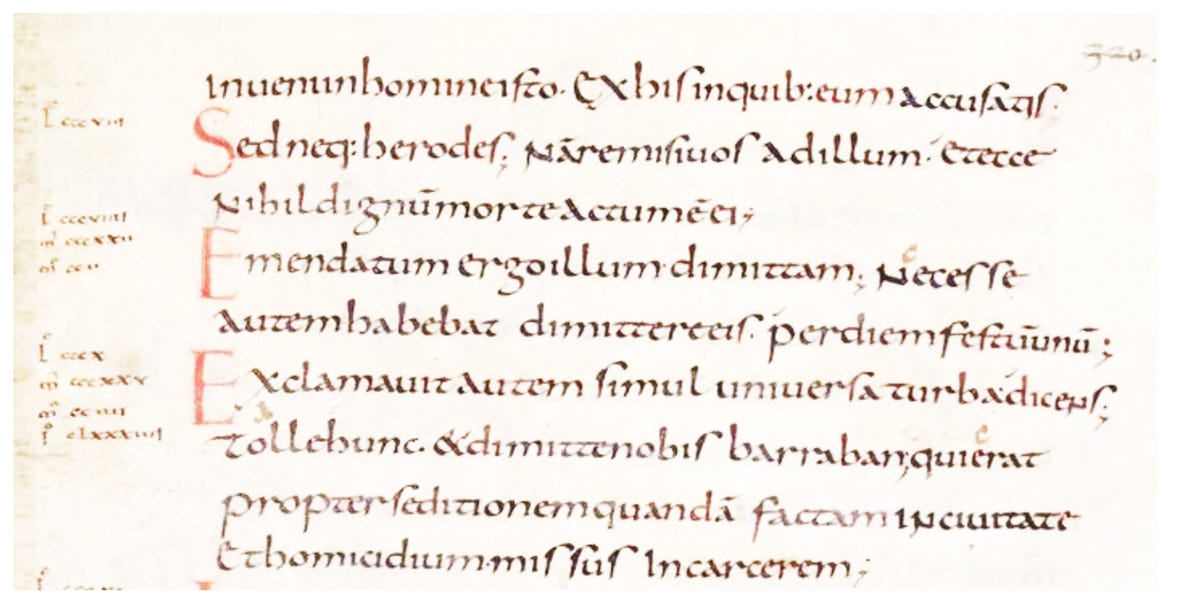
The shift from uncial scriptio continua to the Carolignian bicameral minuscule script also proved to be yet another bottleneck in the survival of ancient literature.
At many points in Greek texts there are errors common to all the extant manuscripts which appear to derive from the same source, and this source is usually taken to be a ninth-century copy. A further assumption generally made is that one minuscule copy was made from one uncial copy. The uncial book was then discarded, and the minuscule book became the source of all further copies [[xi]].
Every uncial scriptio continua manuscript converted into minuscule represented a conscious choice, prioritizing one uncial manuscript over others. Those passed over were often never copied again and forever lost. “The letter killeth,” quipped Harold Innis (1894–1952), “and the concern has been with the diverse means by which different types of letters bring about their deadly results” [[xii]].
One thing the Carolingnian bicameral miniscule script did not entirely kill was the primacy of oral communication, and medieval Europe, like Rome and Greece before her, was an essentially oral culture.
“Preaching was an important means of spreading information. In the words of a pioneering student of the subject, the Cambridge don H. J. Chaytor (1871–1954), what we now call medieval literature was produced for ‘a hearing not a reading public’” [[xiii]].
Despite writing’s increasing importance, speech remained the primary medium of communication in post-Roman Europe. Emerging technologies steadily enlarged the domain of writing, however. The writing revolution of the so-called “Dark Ages,” happened in parallel with another media revolution: the invention and spread of paper. “In 751, the Arabs had taken some Chinese prisoners of war at Samarkand and learnt from them the process of paper-making” [[xiv], [xv]]. Paper was first manufactured in Baghdad in 794 [[xvi]].
Paper transformed medieval society by allowing writing to move beyond expensive parchment manuscripts produced primarily in monasteries. Paper supported the bureaucracies necessary to manage the Holy Roman Empire and successor states. Paper carried Greek scientific works through the Islamic world into Latin Europe while facilitating the spread of Hindu-Arabic numerals and written calculation, enabling more efficient commerce, accounting, engineering, and mathematics [[xvii]]. “The papacy was no longer able to check the spread of translations of the scripture in the vernacular,” and a new and powerful vernacular literature arose as well [[xviii]]. Long before the printing press, paper had become the essential medium for preserving, copying, and disseminating scientific knowledge.
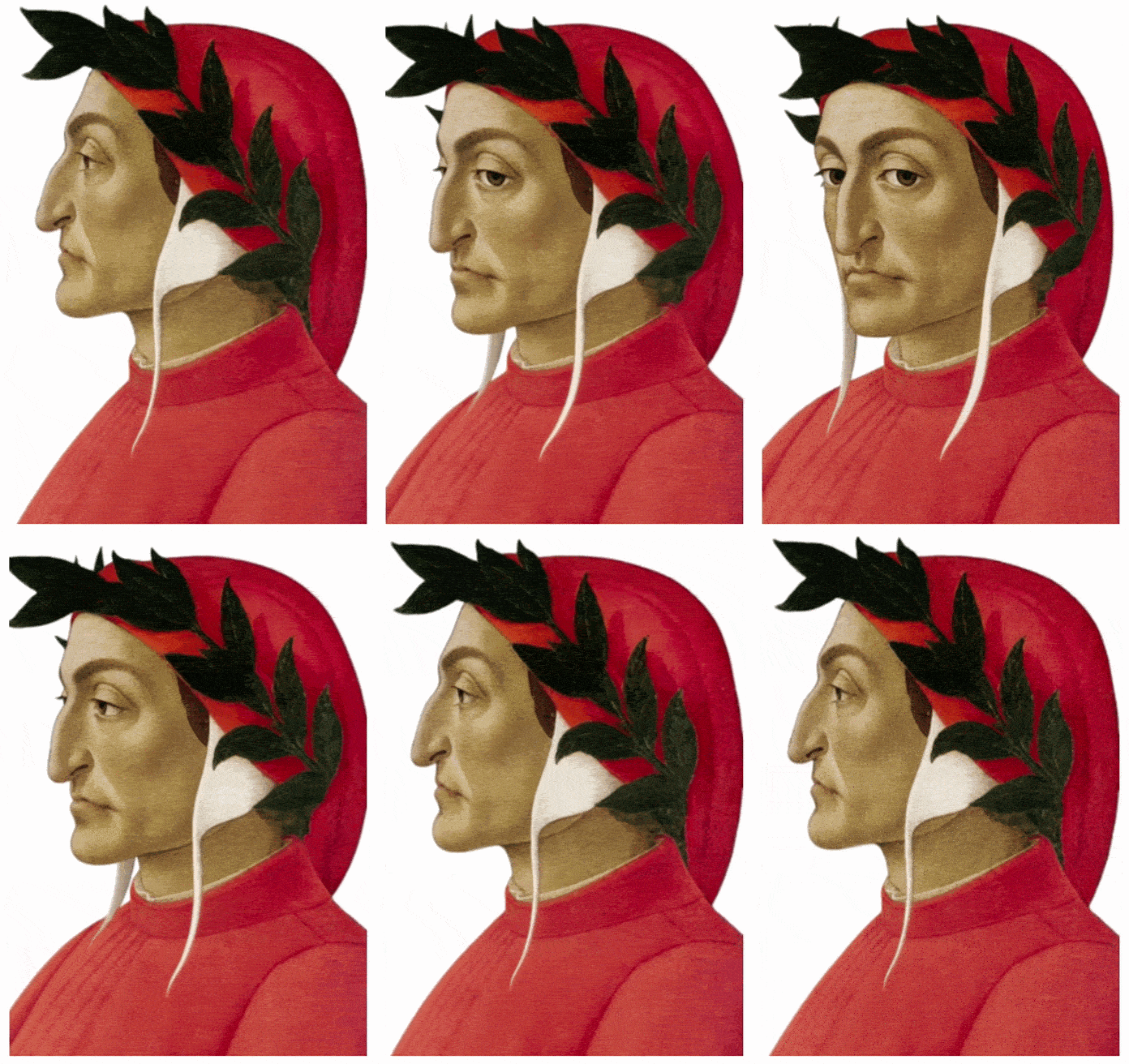
Dante Alighieri (c. 1265–1321) argued in De vulgari eloquentia [On Eloquence in the Vernacular (c. 1305)] that “this vernacular of which I speak is both sublime in learning and power, and capable of exalting those who use it in honour and glory” [[xix]]. Ironically, Dante advanced his thesis on the eloquence of the vernacular in Latin, the language of the learned elite. A few years later, he vindicated his thesis in the vernacular (Tuscan Italian) by writing the Divine Comedy. “Dante revived the ancient conception of the sublime in a European vernacular language; he created a sublime poetry on a level with the great models of antiquity” [[xx]].
Dante was not alone. The vernacular revolution produced works that helped forge national identities across Europe. The Song of Roland, written in Old French c. 1100, became France’s great heroic epic. Around 1200, the anonymous Nibelungenlied gave literary form to the heroic traditions of the German-speaking world, while the Cantar de mio Cid (c. 1207) celebrated Spain’s legendary El Cid in Old Spanish. Famed astronomer and author of a Treatise on the Astrolabe Geoffrey Chaucer (c. 1343–1400), did much the same for Middle English with The Canterbury Tales (c. 1387–1400). Together, these works showed that Europe’s vernacular languages could rival Latin as vehicles for literature and established enduring national literary traditions.
Science followed literature’s lead. For centuries, Latin united European scholars in a common intellectual community. As books grew cheaper and literacy spread, however, science increasingly reached readers in their native languages. Galileo Galilei (1564–1642), René Descartes (1596–1650), and later Isaac Newton (1642–1727) showed that the vernacular could convey great science just as Dante had shown it could sustain great literature. As Latin receded, European science fragmented among the vernaculars, only to reunite centuries later around English as its new common language. The writing revolution and cheap paper enabled vernacular literature; the printing revolution made vernacular science commonplace.
Download the Conference Flyer, Here!
That’s all for now. Remember always to keep calm, and make physics great again.
And join us at the Heaviside Symposium.
See you next week,
Hans
P.S. Pick up your copy of Fields & Energy Book I: Fundamentals and Origins of Electromagnetism, if you haven’t already:
Next time: II 1.7.3.4 The Printing Revolution
Enjoyed the article, but maybe not quite enough to spring for a paid subscription?
Then click on the button below to buy me a coffee. Thanks!

Full Table of Contents [click here]
Follow Online:
You may follow me online in other places as well:
Telegram: 𝔸𝕖𝕥𝕙𝕖𝕣𝕔𝕫𝕒𝕣’𝕤 𝔸𝕖𝕥𝕙𝕖𝕣𝕤𝕥𝕣𝕖𝕒𝕞
Gab: @aetherczar
Twitter: @aetherczar
Amazon: Hans G. Schantz
References
[[i]] Reynolds, L.D. and N.G. Wilson, Scribes and Scholars, 2nd ed., Oxford: Clarendon Press, 1975, p. 4. See: https://archive.org/details/bwb_S0-BKW-016/page/4/mode/2up
[[ii]] Fulton-Brown, Rachel, “Numbering Words, Talking Numbers: Poetry, Page Layout, and the Structure of Thought,” Fencing Bear at Prayer, November 23, 2024. See

You may follow Rachel Fulton-Brown on her Substack, here:

[[iii]] Saenger, Paul (1938–2022), Space Between Words: The Origins of Silent Reading, Stanford, CA: Stanford University Press, 1997, p. 6. “In the West, the ability to read silently and rapidly is a result of the historical evolution of word separation that, beginning in the seventh century, changed the format of the written page, which had to be read orally and slowly in order to be comprehended.” See: https://archive.org/details/space-between-words-the-origins-of-silent-reading/page/6/mode/2up
[[iv]] Augustine of Hippo (AD 354–430), Confessions, trans. Henry Chadwick (1920–2008), Oxford: Oxford University Press, 1991, pp. 104–5 (VI.3). See: https://en.wikisource.org/wiki/Nicene_and_Post-Nicene_Fathers%3A_Series_I/Volume_I/Confessions/Book_VI/Chapter_3
[[v]] By late antique copyist - late antique manuscript, Vergilius Augusteus, Georgica 141ff. Public Domain, https://commons.wikimedia.org/w/index.php?curid=15074137
[[vi]] Fulton-Brown, Rachel, Op. Cit.
[[vii]] Johnson, William A. (b. 1952), Readers and Reading Culture in the High Roman Empire: A Study of Elite Communities, Oxford: Oxford University Press, 2010, p. 3. See: https://amzn.to/4fGQBt9
[[viii]] Johnson, William A. (b. 1952), Op. Cit. pp 3-9.
[[ix]] Johnson, William A. (b. 1952), Op. Cit. pp 200-204.
[[x]] Page of text (folio 160v) from a Carolingian Gospel Book (British Library, MS Add. 11848), written in Carolingian minuscule. — The text is Luke 23:14-26. See: https://commons.wikimedia.org/wiki/File%3AMinuscule_caroline.jpg

[[xi]] Reynolds, L.D. and N.G. Wilson, Scribes and Scholars, 2nd ed., Oxford: Clarendon Press, 1974, p. 53. See: https://archive.org/details/bwb_S0-BKW-016/page/52/mode/2up
[[xii]] Innis, Harold A. (1894–1952), The Bias of Communications, Victoria, BC: Rare Treasures, originally published 1951, p. 4. Innis’ quip refers to Paul’s “the letter kills, but the Spirit gives life,” [2 Corinthians 3:6]. See: https://amzn.to/4vGgkIS
[[xiii]] Briggs, Asa (1921–2016) and Peter Burke (b. 1937), A Social History of the Media: From Gutenberg to the Internet, 2nd ed., Cambridge, UK: Polity, 2005, p. 8. “In his book From Script to Print (1945), he explained that if the reading room of (say) the British Library were to be filled with medieval readers, ‘the buzz of whispering and muttering would be intolerable’.”
[[xiv]] Reynolds, L.D. and N.G. Wilson, Scribes and Scholars, 2nd ed., Oxford: Clarendon Press, 1974, p. 52. See: https://archive.org/details/bwb_S0-BKW-016/page/52/mode/2up
[[xv]] Innis, Harold A. (1894–1952), The Bias of Communications, Victoria, BC: Rare Treasures, originally published 1951, p. 24. See: https://amzn.to/4vGgkIS
[[xvi]] Jaki, Stanley L. (1924–2009), Science & Creation, New Hope, KY: Real View Books, 2016, p. 193. See: https://amzn.to/4dkoGiy.
[[xvii]] Innis, Harold A. (1894–1952), The Bias of Communications, Victoria, BC: Rare Treasures, originally published 1951, p. 25. See: https://amzn.to/4vGgkIS
[[xviii]] Innis, Harold A. (1894–1952), The Bias of Communications, Victoria, BC: Rare Treasures, originally published 1951, p. 25. See: https://amzn.to/4vGgkIS
[[xix]] Dante Alighieri (c. 1265–1321), De vulgari eloquentia, trans. Steven Botterill, Cambridge: Cambridge University Press, 1996, I.xvii.2. See: https://dante.princeton.edu/cgi-bin/dante/DispMinorWork.pl?REF=I+xvii+1-7&TITLE=V.E.
[[xx]] Auerbach, Erich (1892–1957), Literary Language and Its Public in Late Latin Antiquity and in the Middle Ages, Translated by Ralph Manheim (1907–1992), Bollingen Series 74, Princeton, NJ: Princeton University Press, 1965, p. 232. See: https://archive.org/details/literarylanguage0000auer_h0t7/page/232/mode/2up
[[xxi]] Posthumous portrait in tempera by Sandro Botticelli, 1495. See: https://en.wikipedia.org/wiki/Dante_Alighieri#/media/File:Portrait_de_Dante.jpg

"European science fragmented among the vernaculars, only to reunite centuries later around English as its new common language."
There is more to that tale. Chemistry, in particular, united around German. There was a time when university students studying chemistry in UK universities were required to take classes in "Technical German".
The move to English language was really the move to the language in which US scientists published -- since the US was the major source of science in the post-WW II world.
As the world continues to change, one might speculate that future Western college students in the sciences will be required to take classes in "Technical Mandarin".
“The papacy was no longer able to check the spread of translations of the scripture in the vernacular,”
For the record, papal opposition to vernacular translations was meant to stop mistranslations and outright frauds. There was no opposition to vernacular translation as such. Indeed, they were encouraged.
If I may quote:
"From 1450–1519, there were in the Empire 65 Latin editions of the Bible and 22 Germanic ones; in Italy 41 Latin editions and 14 Italian ones; in France 45 Latin editions and 1 French one, as well as 21 of the Bible abrégée (abridged Bible); making for a total of 20,000 copies of Germanic Bibles in the Empire; 13,450 Italian Bibles in Italy; 1,200 French Bibles in France as well as 23,700 Bibles abrégées….By way of summation, we can say that in the later fifteenth and early sixteenth centuries, Biblical material was widespread, popular and well-known among literate townspeople, clerics and nobles alike, especially in the Empire." -- Andrew C. Gow, 'Challenging the Protestant Paradigm. Bible Reading in Lay and Urban. Contexts of the Later Middle Ages,'
Not merely the Popes, but Protestants church authorities also opposed the practice of scriptural mistranslation. King Henry VIII, in 1543—after his break with Rome—decreed that “all manner of books of the Old and New Testament in English, being of the crafty, false, and untrue translation of Tyndale . . . shall be clearly and utterly abolished, extinguished, and forbidden to be kept or used in this realm.”