


Science is a collection of stories we tell about how the world works and how we came to know what we know. Those narratives are a part of the broader context within which science operates. The records of the earliest inhabitants of the Indus and Yangtze river valleys are unreliable [[i]]. We therefore begin with a survey of what can be established about ancient Indian and Chinese science, considered in turn.
“The Zhou bi is a collection of ancient Chinese texts on astronomy and mathematics. It was probably assembled under the Western Han dynasty during the first century BC, although it was traditionally reputed to have been written in Western Zhou times about a thousand years earlier” [[ii]].
The first Qin emperor, Qin Shi Huang (259–210 BC) declared a great reset in which all historical works were consigned to the flames, although practical and scientific works were excepted from this order. Scholars who hid their libraries were executed or sent to labor on the Great Wall. Nevertheless some works survived, reconstituted from memory or from a limited number of surviving texts from hidden libraries [[iii]]. Understanding of Chinese history was shaped by national rivalries between the French, whose eighteenth century Jesuit missions in China depended on the good will of the Chinese Imperial Court, and their rivals, the English [[iv]]. These circumstances challenge our understanding of ancient Chinese history.
Unlike the ubiquitous Mesopotamian clay tablets, we can’t read the script of the earliest Indus Valley peoples, so their history may only be inferred from their physical remains and scattered legends and oral traditions [[v]]. Nick Collins points to archeological hints and circumstantial evidence that suggest an even deeper history of exchanges between Indian cities, drowned by rising seas around 6000-8000 BC, and the precursors to Mesopotamian and Egyptian civilizations.

Some scholars argue that Kaṇāda, son of Ulūka, who lived around lived around 600 BC, anticipated the discovery of Newton’s Laws [[vi], [vii]]. While that is more speculative, “[t]here can be no question that numerical integration methods were fully understood and that many of the series developed in the West by Gregory, Leibnitz, and Newton were already known to the Hindus some two centuries previously” [[viii], [ix], [x]]. Portuguese Jesuits established a mission in India in the early sixteenth century, and may have been a channel by which Europeans acquired Indian mathematical wisdom [[xi]].
As early as the seventeenth century, scholars noted similarities between Upaniṣadic thought and the philosophy of Baruch Spinoza (1632–1677), for instance [[xii]]. Vedāntic philosophy, derived from the Upaniṣads (“the end of the Vedas”), teaches that ultimate reality (Brahman) is a single, infinite, and unchanging consciousness underlying all existence. Quantum physicist Erwin Schrödinger (1887–1961) saw in this philosophy an anticipation of the principle that “the plurality that we perceive is only an appearance; it is not real” [[xiii]].
Chinese and Indian sciences each developed largely independently and achieved major results, sometimes comparable in sophistication to their Western counterparts. Their influence on the Western scientific tradition is real, but limited in scope and mostly indirect or late.
The continuous intellectual tradition that directly gave rise to modern Western science runs primarily from Babylonian and Egyptian foundations, through the Greek theoretical revolution, then through Roman, Byzantine, Islamic, and European medieval and Renaissance development.
1.1.1 Babylonian Science
“The oldest known astronomical and astrological texts date from the first half of the Hammurabi dynasty” [[xiv]] (about 1800–1600 BC) [[xv]]. The famed Greek astronomer Ptolemy (~100–170) used a fairly complete set of Babylonian eclipse records dating back to 747 B.C. as the baseline for his astronomical data [[xvi]].
In 1749, Richard Dunthorne (1711–1755) examined Babylonian eclipse observations from 721 BC, another eclipse from Alexandria in 201 BC, an AD 364 observation from Theon of Alexandria (335–405), and reports from the tenth century [[xvii]]. Dunthorne correctly calculated that the moon had slowed down about two hours during the intervening 2500 years [[xviii]].
Babylonian priests collected scientific observations that are valid and useful to science today, and they pioneered a base sixty counting system (possibly a combination of pre-existing base-ten and base-six systems) that we still use today: sixty seconds to a minute and sixty minutes to an hour. They also employed geometry and even solved quadratic and cubic equations [[xix]].
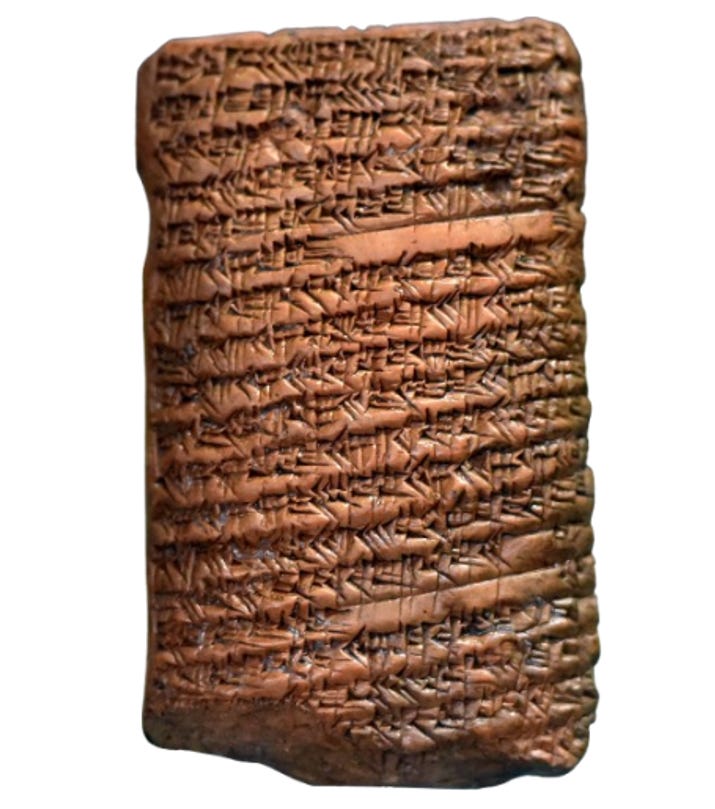
Apart from a few genuine insights however, Babylonian “science” was a patchwork of unconnected observations and supposed correlations, assembled more to guide divination rather than understanding of nature. Scholars may read the scientific wisdom of Babylon directly from their clay tablets.
If in the month Shabatu, the 15th day, Venus disappeared, and stayed out of the sky for three days, and became visible in the east on the 18th day of Shabatu, springs will open, Adad will bring his rain, Ea will bring his floods, and king will send messages of reconciliation to king…
If a man becomes impotent in the month of Nisannu, you catch a male partridge, pluck its wings, strangle it, flatten it, scatter salt on it; you dry it, crush it together with seeds of the mountain-dadanu plant; you give it to him to drink in beer; that man will regain potency…
If a ewe gives birth to a lion and it has two horns on the left — an enemy will take your fortress…
If a white dog pisses on anyone, poverty will overtake him; if a black dog does the same, sickness will seize the man; if a brown dog does the same, that man will be joyful [[xxii]].
Historian Will Durant (1885–1981) observed:
Never was a civilization richer in superstitions. Every tum of chance from the anomalies of birth to the varieties of death received a popular, sometimes an official and sacerdotal, interpretation in magical or supernatural terms. Every movement of the rivers, every aspect of the stars, every dream, every unusual performance of man or beast, revealed the future to the properly instructed Babylonian. The fate of a king could be forecast by observing the movements of a dog, just as we foretell the length of the winter by spying upon the groundhog [[xxiii]].
1.1.2 Egyptian Science
The Greek historian Herodotus (484–425 B.C.) credited the annual flooding of the Nile and the periodic obliteration of property boundaries with the Egyptians’ skill at surveying in particular and geometry in general, and Democritus (460–370 B.C.) similarly admired the talent of the Egyptian “rope-stretchers” [[xxiv]]. Perhaps this is also the reason the Egyptians excelled in astronomical chronology and calendrics. “The ability to measure time and to predict the dates of the floods of the Nile become the basis of power. In the Tigris and Euphrates valleys in southern Mesopotamia the rivers were adapted to irrigation and organized control, and less exacting demands were made on the capacity to predict time” [[xxv]]. In contrast to the chaotic Greek and Babylonian calendars that attempted to keep months on phase with the phases of the moon, the Egyptian calendar had twelve months of thirty days with an additional five days [[xxvi]]. “Even in late antiquity Greek astronomers used the Egyptian-style calendar for preference in their calculations [[xxvii]].
Egyptian mathematical work focused on practical, applied problems and remained largely unchanged for at least a thousand years, from the earliest preserved Egyptian papyrus accounts to the descriptions of the classical Greeks. While the Greeks credited the Egyptians as the source of their own geometric wisdom, surviving Egyptian mathematical accounts are relatively primitive [[xxviii]].
That’s all for now. Remember always to keep calm, and make physics great again.
See you next week,
Hans
P.S. Pick up your copy of Fields & Energy Book I: Fundamentals and Origins of Electromagnetism, if you haven’t already:
Next time: II 1.2 The Greek Roots of Science
Enjoyed the article, but maybe not quite enough to spring for a paid subscription?
Then click on the button below to buy me a coffee. Thanks!

Full Table of Contents [click here]
Follow Online:
You may follow me online in other places as well:
Telegram: 𝔸𝕖𝕥𝕙𝕖𝕣𝕔𝕫𝕒𝕣’𝕤 𝔸𝕖𝕥𝕙𝕖𝕣𝕤𝕥𝕣𝕖𝕒𝕞
Gab: @aetherczar
Twitter: @aetherczar
Amazon: Hans G. Schantz
References
[[i]] Boyer, Carl B., and Uta C. Merzbach, A History of Mathematics, 2nd ed. New York: John Wiley & Sons, Inc., 1991, p. 8.
[[ii]] Cullen, Christopher, Astronomy and mathematics in ancient China: the Zhou bi suan jing, Cambridge: Cambridge University Press, 1996, p. xi. See: https://amzn.to/4qSDycH
[[iii]] Durant, Will, Our Oriental Heritage, The Story of Civilization, vol. 1, New York, Simon and Schuster, 1954, p. 244.
[[iv]] Giovannetti-Singh, Gianamar, “Oriental Chronology: Chinese Astronomy and the Politics of Antiquity in Eighteenth-Century Britain,” Isis, Vol. 115, no. 4, December 2024. See: https://www.journals.uchicago.edu/doi/10.1086/733145
[[v]] Kenoyer, Jonathan M., Ancient Cities of the Indus Valley Civilization, Oxford University Press, 1998, p. 69. “The Indus script, invented around 2600 B.C. reflects the fundamental changes in social, political and ritual organization that accompanied the formation and consolidation of cities (fig. 4.1). When the first inscribed seals were used to stamp bundles of goods, they ushered in an era of economic and political hegemony that would last 700 years. Although archaeologists are still trying to find out where the script was invented and how to decipher it, they have begun to understand how the script was used and possibly why it disappeared.” See: https://archive.org/details/ancientcitiesofi0000keno/page/16/mode/2up
[[vi]] Kak, Subhash, “Kaṇāda, Great Physicist and Sage of Antiquity,” September 25, 2018. See: https://subhashkak.medium.com/ka%E1%B9%87%C4%81da-the-great-physicist-and-sage-of-antiquity-5a2abd79b6f1
[[vii]] Kak, Subhash, Matter and Mind: The Vaisheshika Sutra of Kanada, 2016. See: https://amzn.to/4nSkokp
[[viii]] Baron, Margaret E., The Origins of the Infinitesimal Calculus, New York: Dover, 1969, p. 63. “On the whole Aristotle’s views on the nature of the continuum found fairly general acceptance in the thirteenth and fourteenth centuries: Roger Bacon, Albertus Magnus, Thomas Aquinas, Duns Scotus, William of Ockham, Jean Buridan and his school, Nicole Oresme, Albert of Saxony and many others all rejected indivisibles of any shape or form” 9Ibid., pp. 72-73). See: https://amzn.to/4oVyPpm
[[ix]] Plaice, John, “Charles Matthew Whish Writes About Infinite Series Known to Indian Mathematicians,” Fiat Lux, July 25, 2024. See:

[[x]] Whish, Charles M., “On the Hindú Quadrature of the Circle, and the infinite Series of the proportion of the circumference to the diameter exhibited in the four Sástras, the Tantra Sangraham, Yucti Bháshá, Carana Padhati, and Sadratnamála,” Transactions of the Royal Society of Great Britain and Ireland III(XXXIII):509-523, 1835.
[[xi]] Raju, C.K., Cultural Foundations of Mathematics: The Nature of Mathematical Proof and the Transmission of the Calculus from India to Europe in the 16th c. CE. Delhi: Pearson Longman, 2007, pp. 346-348.
[[xii]] App, Urs, The cult of emptiness : the Western discovery of Buddhist thought and the invention of Oriental philosophy, University Media, Buddhism series, Rorschach, Switzerland, 2012, pp. 161-172.
[[xiii]] Schrödinger, Erwin (1887–1961), My View of the World, Cambridge: At the University Press, 1964, pp. 18-19.
[[xiv]] Culver, R.B. and P.A. Ianna, The Gemini Syndrome: A Scientific Evaluation of Astrology, Buffalo, NY: Prometheus Books, 1984, p. 15.
[[xv]] Boyer, Carl B., and Uta C. Merzbach, A History of Mathematics, 2nd ed. New York: John Wiley & Sons, Inc., 1991, p. 25.
[[xvi]] Lloyd, G.E.R., Early Greek Science: Thales to Aristotle, New York, W.W. Norton & Company, 1970, p. 7.
[[xvii]] Dunthorne, Richard, “A letter from the Rev. Mr. Richard Dunthorne to the Reverend Mr. Richard Mason F. R. S. and Keeper of the Woodwardian Museum at Cambridge, concerning the acceleration of the Moon,” Phil. Trans. R. Soc. Vol. 46, 30 June 1749, pp. 162–172. http://doi.org/10.1098/rstl.1749.0031. See: https://royalsocietypublishing.org/doi/10.1098/rstl.1749.0031
[[xviii]] Grant, Robert, History of physical astronomy from the earliest ages to the middle of the nineteenth century, London: HENRY G. BOHN, YORK STREET, COVENT GARDEN, 1852, p. 60. See: https://archive.org/details/historyofphysica00granrich/page/60/mode/2up
[[xix]] Boyer, Carl B., and Uta C. Merzbach, A History of Mathematics, 2nd ed. New York: John Wiley & Sons, Inc., 1991, p. 23-42. See Chapter 3: Mesopotamia.
[[xx]] This clay tablet narrates a geometric-algebraic theory of how to make a solution for a mathematical problem. The conclusion applies a theory very similar to the Pythagorean theorem. From Tell Tell al-Dhabba’i, Iraq. Old-Babylonian period, 2003-1595 BCE. On display at the Iraq Museum in Baghdad, Republic of Iraq. IM67118. See: https://en.wikipedia.org/wiki/IM_67118#/media/File:Clay_tablet,_mathematical,_geometric-algebraic,_similar_to_the_Pythagorean_theorem._From_Tell_al-Dhabba’i,_Iraq._2003-1595_BCE._Iraq_Museum.jpg

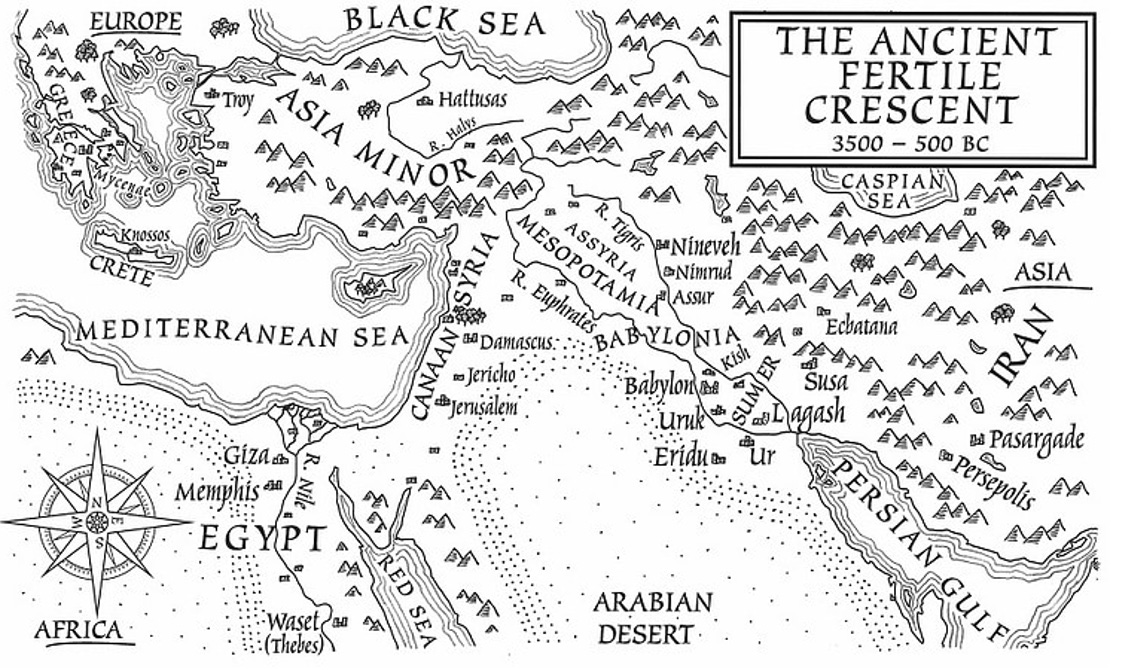
[[xxi]] An illustrated map of the ancient Fertile Crescent, 3500-500 BCE. From the novel The Jericho River by David Tollen. See: https://amzn.to/4rH5alJ or https://pintsofhistory.com/books/
[[xxii]] Culver, R.B. and P.A. Ianna, The Gemini Syndrome: A Scientific Evaluation of Astrology, Buffalo, NY: Prometheus Books, 1984, pp. 17-18.
[[xxiii]] Durant, Will, Our Oriental Heritage, The Story of Civilization, vol. 1, New York, Simon and Schuster, 1954, p. 244.
[[xxiv]] Boyer, Carl B., and Uta C. Merzbach, A History of Mathematics, 2nd ed. New York: John Wiley & Sons, Inc., 1991, p. 16.
[[xxv]] Innis, Harold A. (1894–1952), Empire and Communications, New York: Rowman & Littlefield, Publishers, 2007, originally published 1950, p. 46. See: https://amzn.to/48TEg1g
[[xxvi]] Lloyd, G.E.R., Early Greek Science: Thales to Aristotle, New York, W.W. Norton & Company, 1970, p. 7.
[[xxvii]] Lloyd, G.E.R., Early Greek Science: Thales to Aristotle, New York, W.W. Norton & Company, 1970, p. 8.
[[xxviii]] Boyer, Carl B., and Uta C. Merzbach, A History of Mathematics, 2nd ed. New York: John Wiley & Sons, Inc., 1991, pp. 21-22.
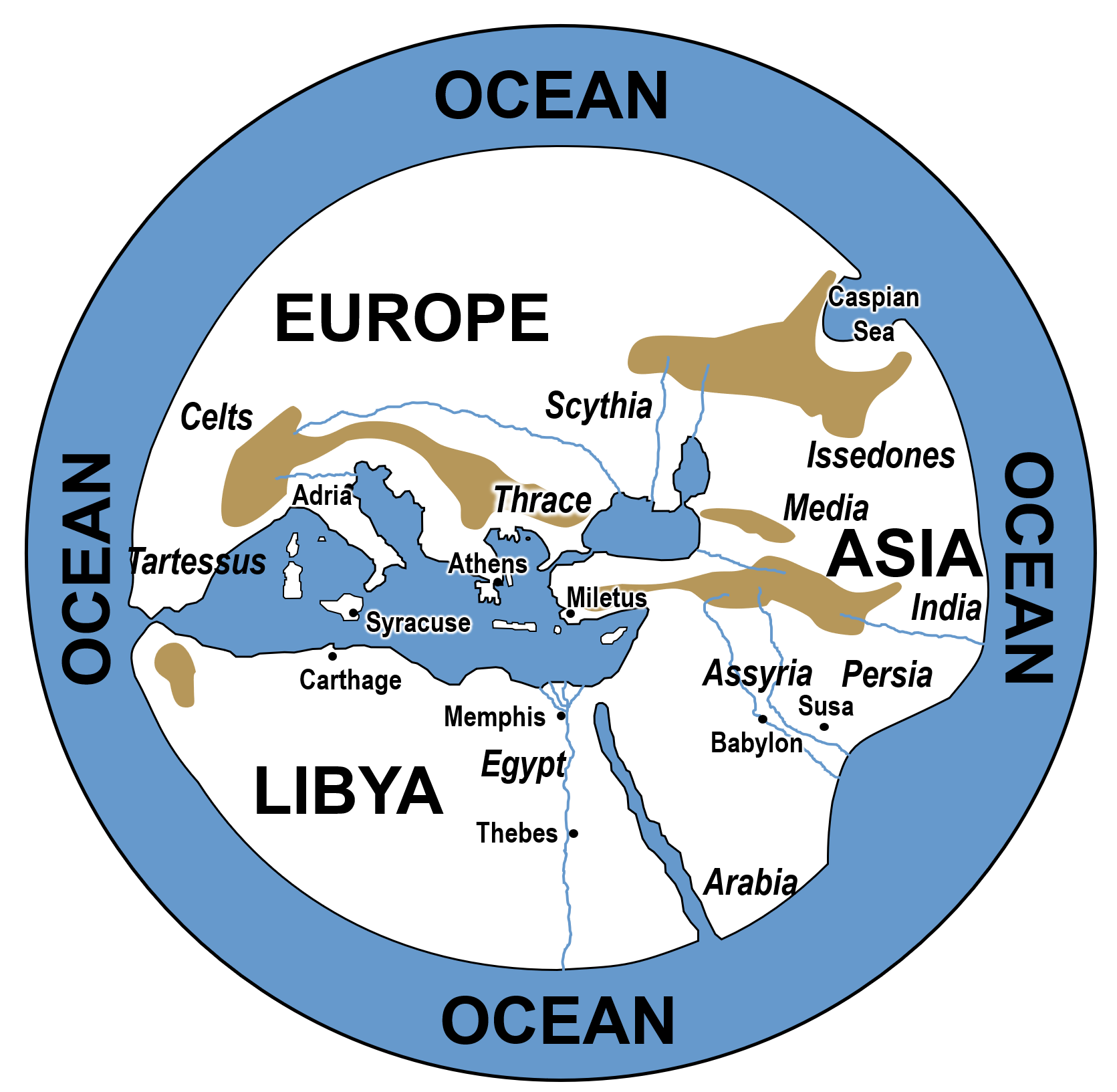
[[xxix]] Bibi Saint-Pol, “Reconstruction of Hecataeus’ map,” based on a GIF by Marco Prins and Jona Lendering from www.livius.org, see http://www.livius.org/a/1/maps/hecataeus_map.gif. See: https://en.wikipedia.org/wiki/Early_world_maps#/media/File:Hecataeus_world_map-en.svg


"Babylonian priests collected scientific observations that are valid and useful to science today, and they pioneered a base sixty counting system (possibly a combination of pre-existing base-ten and base-six systems) that we still use today: sixty seconds to a minute and sixty minutes to an hour."
An interesting observation to the Babylonian (and likely Sumerian) use of the Base 60 system was the power of the ratio that developed. Tables of ratios and relations to right triangles gave indications of an early form of trigonometry. The Greeks used the Assyrian-Babylonian ratio tables for making gears and mechanical items.
The use of zero (a number vice placeholder symbol) and the ability to factor by primes (2, 3, and 5) would have made the Mesopotamian Base 60 system an even more powerful mathematical tool.
Educational and a good reminder. The ancient and classic world still holds truths.