


Earlier cultures had myths to explain the world. What set apart the Greeks was their appeal to natural explanations and their willingness to discuss, critique, and improve upon their myths. In the words of Karl Popper (1902–1994) “…[S]cience must begin with myths and the criticism of myths” [[i]].
1.2.1 Thales of Miletus
Thales of Miletus (~626/623–548/545 BC) was the first philosopher scientist [[ii]]. Writing in the sixth century AD, the Greek Neoplatonic philosopher Simplicius of Cilicia (~AD 480–540) declared:
Thales is said to have been the first to introduce the study of nature to the Greeks: although many others preceded him, as Theophrastus [Aristotle’s colleague and successor as head of the Lyceum] himself admits, yet he so far excelled them as to eclipse all his predecessors [[iii]].
Writing in the third century AD, Diogenes Laertius explained that “arguing from the magnet and from amber, [Thales] attributed a soul or life even to inanimate objects.” [[iv]]
His doctrine was that water is the universal primary substance, and that the world is animate and full of divinities. He is said to have discovered the seasons of the year and divided it into 363 days.
He had no instructor, except that he went to Egypt and spent some time with the priests there. Hieronymus informs us that he measured the height of the pyramids by the shadow they cast, taking the observation at the hour when our shadow is of the same length as ourselves [[v]].
“To him belongs the proverb, ‘Know Thyself’” [[vi]].
While Thales argued everything was “full of Gods,” he sought impersonal, natural causes, for example, proposing water as the world’s archê or fundamental substance and organizing principle [[vii]]. Further, he explained motion through internal powers: Magnets, he thought, had a soul, because they moved iron [[viii]].
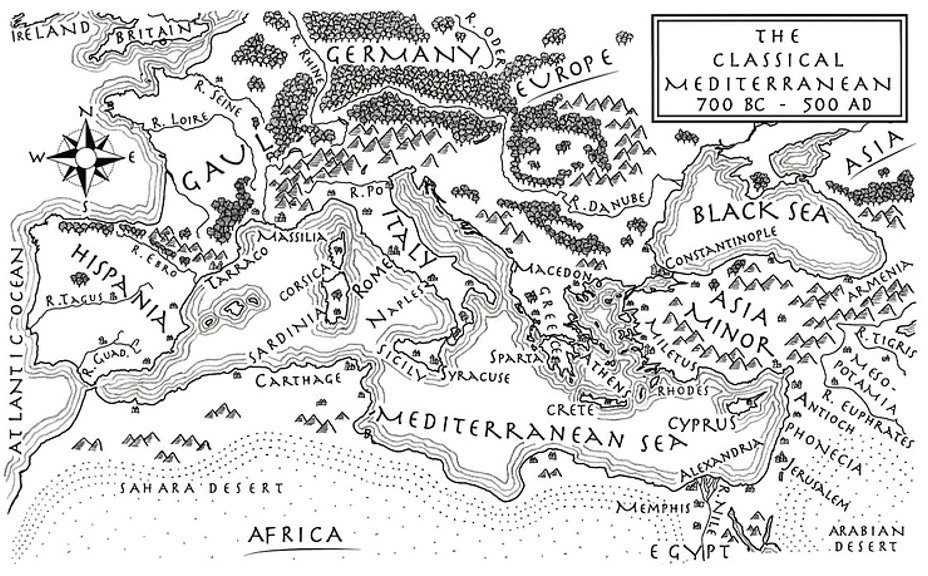
Thales replaced mythic genealogies with natural principles, and he advanced the idea that nature is alive and orderly enough to be intelligible. The key innovation of Thales and the Milesians was to look to nature rather than the Gods for explanation and to tolerate debate between opposing viewpoints [[x]].
1.2.2 Heraclitus & “Logos”
A third element in Greek thinking is that we should attempt to understand the underlying order of things: the “Logos” that governs the behavior of all things. Heraclitus (active ~500 BC) held:
Of the Logos which is as I describe it men always prove to be uncomprehending, both before they have heard it and when once they have heard it. For although all things happen according to this Logos, men are like people of no experience, even when they experience such words and deeds as I explain, when I distinguish each thing according to its constitution and declare how it is; but the rest of men fail to notice what they do after they wake up just as they forget what they do when asleep [[xi]].
This Logos is an account or narrative, the fundamental story of how things work. “That the cosmos obeyed a logos meant not only that it was an orderly place, but also that it was comprehensible to humans if they could grasp the nature of this logos” [[xii]].
His contemporaries dubbed Heraclitus “the Obscure” or “the Riddler” because of his dense, enigmatic, and often paradoxical writings [[xiv]]. Nevertheless, he anticipated Aristotle by grounding explanation in the internal structures of natural things. The Logos is immanent, objective, and knowable in the world’s measured processes, much like Aristotelian forms. “I honour more those things which are learned by sight and hearing” [[xv]], Heraclitus declared.
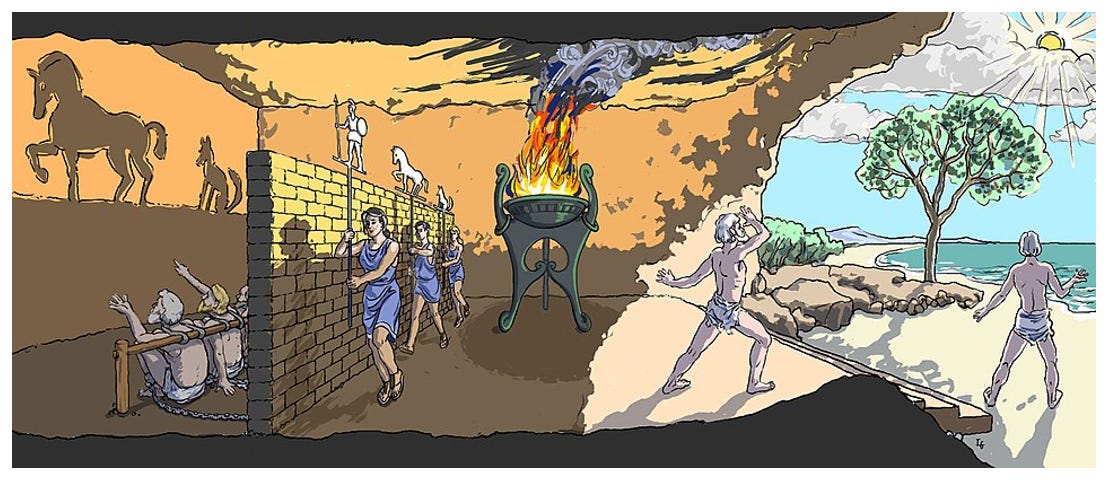
In Plato’s “Allegory of the Cave,” prisoners perceive only shadows on the wall and take them for reality, unaware of the fuller truth beyond the cave [[xvi]]. Heraclitus anticipated Plato by distinguishing between deceptive appearances and a hidden rational order accessible only to the understanding. “Nature loves to hide,” Heraclitus opined [[xvii]]. These ancient Greek perspectives foreshadow our modern-day difficulties with deceptive appearances in quantum mechanics. Our abandonment of the Greek conviction that the Logos is comprehensible is part of how physics went wrong.
Where Thales believed water was fundamental, Heraclitus looked to the chaos of primal fire. “It is impossible to go into the same river twice” the first century Greek biographer and author, Plutarch (AD 46–119), attributed to Heraclitus [[xviii], [xix]]. “All things are constituted from fire and resolve into fire” [[xx]].
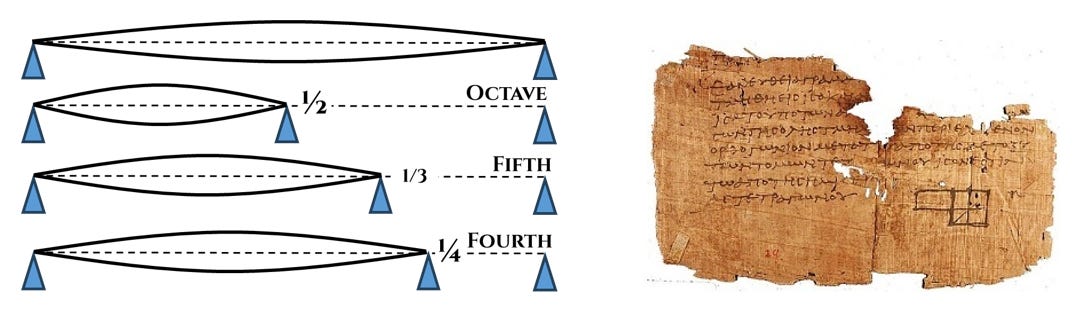
Others insisted the Logos described a reality that was stable, coherent, non-contradictory, and knowable. “It is or it is not,” declared Heraclitus’ contemporary, Parmenides of Elea [[xxii]]. His student, Zeno of Elea (~490–430 BC) [not to be confused with Zeno of Citium (334–262 BC), founder of Stoicism] supported his teacher’s perspective with ingenious puzzles and paradoxes [[xxiii]].
1.2.3 Mathematical Science
The Logos was not necessarily a story expressed exclusively in words. Pythagoras (~570–495 BC) thought the language of nature was numerical. “The Pythagoreans, as they are called,” reported Aristotle, “devoted themselves to mathematics… they thought its principles were the principles of all things… they supposed the elements of numbers to be the elements of all things, and the whole heaven to be a musical scale and a number. And all the properties of numbers and scales which they could show to agree with the attributes and parts and the whole arrangement of the heavens, they collected and fitted into their scheme…” [[xxiv]].
Aristotle’s own teacher, Plato, regarded training in mathematics and geometry as essential. He argued “…that the study of reckoning… there is something fine in it… it is useful for our purposes in many ways, provided it is pursued for knowledge and not for huckstering… it compels the soul to employ pure thought with a view to truth itself” [[xxv]]. Plato further argued that “geometry is the knowledge of the eternally existent… it would tend to draw the soul to truth and would be productive of a philosophical attitude of mind, directing upward the faculties that are now wrongly turned earthward” [[xxvi]].
The ancient Greek mathematician Euclid (active ~300 BC) compiled geometric wisdom in The Elements. For over two millennia until the 19th century, Euclidean geometry was regarded as the definitive description of physical space and the standard of mathematical rigor; its axiomatic-deductive method also shaped broader scientific thought. There is speculation that Euclid studied at Plato’s Academy, but he bridged the Athenian tradition of inquiry across the Mediterranean to Alexandria.
When Alexander the Great (356–323 BC) died, his Egyptian conquests came under the control of his trusted general, Ptolemy I Soter (~369–282 BC) who became the founder of the Ptolemaic Kingdom centered on Egypt. Throughout the Ptolemaic dynasty, Egypt became a beacon of Hellenistic civilization, and Alexandria, the city founded by Alexander, established itself as a major center of Greek cultural and intellectual life [[xxvii]]. Mastery of Euclidean geometry became a hallmark of a well-rounded education. When Ptolemy I famously asked if there was some easier way to learn the subject than The Elements, “Euclid replied that there was no royal road to geometry” [[xxviii]]. Ironically for all the respect paid to him, more than half of what Euclid wrote, including a work on conic sections, was lost in antiquity [[xxix]].
1.2.4 Plato & Aristotle
This brings us up to the two most prominent individuals in Greek philosophy: Aristotle and Plato. In Book I: Chapter Two, I briefly explained Aristotle’s primarily inductive approach in contrast to Plato’s primarily deductive approach. Aristotle emphasized that genuine understanding begins with experience: reality exists independently of our minds, and knowledge arises by observing the world and inducing its governing principles. Plato took the opposite stance, treating consciousness as primary: the world is shaped or constituted by ideas, and knowledge proceeds by deducing consequences from abstract axioms.
“Plato started his examination of politics with abstract discussions of love and justice and the connection between the city and the souls of its citizens. Aristotle started his analysis of politics by gathering 158 different constitutions and analyzing them” [[xxx]].
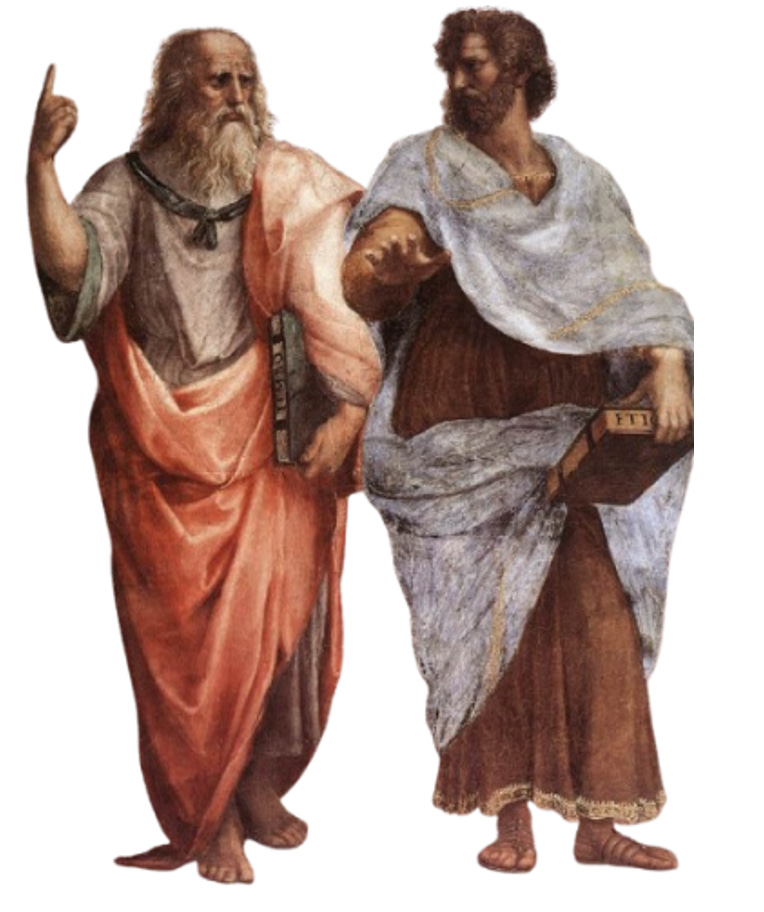
These orientations yield different cognitive styles. Platonists look inward, deriving systems from first principles, Euclidean geometry being the model case. Aristotelians look outward, classifying and generalizing from empirical data, biology serving as the paradigm. In practice, each mode depends on the other: empirical discovery provides the principles from which deductive systematization proceeds, and deductive systems eventually encounter anomalies that lead to new empirical inquiry.
Platonism easily drifts into abstraction detached from reality, a recurrent intellectual pitfall. Science and culture oscillate between Aristotelian phases of discovery and Platonic phases of elaboration until accumulated problems force a new empirical reset. A similar oscillation appears in scientific models of the world, such as the long-running tension between atomism and plenism, between quantization and continuity.
Entire books can and have been written on the history and philosophy of science. The Greeks revolutionized human thought by establishing that nature possesses an underlying rational order, what they called “Logos,” accessible through human reason rather than divine revelation. Beginning with the “Presocratics” in the 6th century BC, thinkers like Thales, and Heraclitus abandoned mythological explanations in favor of naturalistic ones, seeking fundamental principles (archê) that could account for the diversity of phenomena.
Parmenides introduced the crucial constraint that reality must be stable, intelligible, and structured, not chaotic or arbitrary, establishing that genuine knowledge requires understanding what persists beneath surface change. The Pythagoreans made the radical discovery that mathematical structure could reveal nature’s hidden order, finding numerical ratios in musical harmony and geometric patterns in the cosmos, a insight that would echo through Plato’s forms and eventually into modern physics.
This new mode of inquiry integrated observation with reason in productive tension. Aristotle systematically studied biology, insisting that knowledge emerges from careful empirical observation organized by rational principles, while mathematicians like Euclid demonstrated how rigorous deduction from axioms could generate certain knowledge. Greek thinkers increasingly recognized that explanation involves uncovering form, structure, or functional organization: why the heart has chambers, why triangles have certain properties, how the cosmos maintains its order. Crucially, they embraced philosophical disagreement as productive rather than threatening. Atomists debated Aristotelians, Skeptics challenged Stoics, and this very competition refined arguments and exposed weaknesses. The Greek legacy wasn’t a single doctrine but a method: the conviction that nature is intelligible, that reason can penetrate appearances to find underlying order, that observation and logic together can generate genuine knowledge, and that vigorous debate strengthens rather than undermines the pursuit of truth. This framework, more than any specific discovery, became the foundation of Western scientific thought.
That’s all for now. Remember always to keep calm, and make physics great again.
See you next week,
Hans
P.S. Pick up your copy of Fields & Energy Book I: Fundamentals and Origins of Electromagnetism, if you haven’t already:
Next time: II 1.3 Weaknesses of Greek Science
Enjoyed the article, but maybe not quite enough to spring for a paid subscription?
Then click on the button below to buy me a coffee. Thanks!

Full Table of Contents [click here]
Follow Online:
You may follow me online in other places as well:
Telegram: 𝔸𝕖𝕥𝕙𝕖𝕣𝕔𝕫𝕒𝕣’𝕤 𝔸𝕖𝕥𝕙𝕖𝕣𝕤𝕥𝕣𝕖𝕒𝕞
Gab: @aetherczar
Twitter: @aetherczar
Amazon: Hans G. Schantz
References
[[i]] Popper, Karl (1902–1994), Conjectures And Refutations The Growth Of Scientific Knowledge, New York: Basic Books, 1962, p. 49.
“Thus science must begin with myths, and with the criticism of myths; neither with the collection of observations, nor with the invention of experiments, but with the critical discussion of myths, and of magical techniques and practices. The scientific tradition is distinguished from the pre-scientific tradition in having two layers. Like the latter, it passes on its theories; but it also passes on a critical attitude towards them. The theories are passed on, not as dogmas, but rather with the challenge to discuss them and improve upon them. This tradition is Hellenic: it may be traced back to Thales, founder of the first school (| do not mean ‘of the first philosophical school’, but simply ‘of the first school’) which was not mainly concerned with the preservation of a dogma.”
[[ii]] Lloyd, G.E.R., Early Greek Science: Thales to Aristotle, New York, W.W. Norton & Company, 1970, p. 8.
[[iii]] Barnes, Jonathan, Early Greek Philosophy, London: Penguin, 1987, p. 61. Quoting Simplicius, Commentary on the Physics, 23.29-23. Theophrastus (~371-287 BC) was Aristotle’s colleague and successor as head of the Lyceum.
[[iv]] Laertius, Diogenes (third century, AD), Lives of Eminent Philosophers, vol. 1, R.D. Hick, trans. Cambridge: Harvard University Press, 1925, p. 25. See: https://archive.org/details/DiogenesLaertius01LivesOfEminentPhilosophers15_201412/page/40/mode/2up
[[v]] Laertius, Diogenes (third century, AD), Lives of Eminent Philosophers, vol. 1, R.D. Hick, trans. Cambridge: Harvard University Press, 1925, p. 41. See: https://archive.org/details/DiogenesLaertius01LivesOfEminentPhilosophers15_201412/page/48/mode/2up
[[vi]] Laertius, Diogenes (third century, AD), Lives of Eminent Philosophers, vol. 1, R.D. Hick, trans. Cambridge: Harvard University Press, 1925, p. 41. See: https://archive.org/details/DiogenesLaertius01LivesOfEminentPhilosophers15_201412/page/48/mode/2up
[[vii]] Aristotle, Metaphysics 983b20–27. The Complete Works of Aristotle: The Revised Oxford Translation, Jonathan Barnes, ed., vol. 2 Princeton University Press, 1984, p. 1556.
[[viii]] Aristotle, De Anima (On the Soul) 405a19–21. The Complete Works of Aristotle: The Revised Oxford Translation, Jonathan Barnes, ed., vol. 1 Princeton University Press, 1984, pp. 645-646. “Thales, too, to judge from what is recorded about him seems to have held soul to be a motive force, since he said that the magnet a soul in it because it moves the iron.”
[[ix]] An illustrated map of the ancient Fertile Crescent, 3500-500 BCE. From the novel The Jericho River by David Tollen. See: https://amzn.to/4rH5alJ or https://pintsofhistory.com/books/
[[x]] Lloyd, G.E.R., Early Greek Science: Thales to Aristotle, New York, W.W. Norton & Company, 1970, p. 13.
[[xi]] Kirk, G.S. and J.E. Raven, The Presocratic Philosophers, Cambridge: University Press, 1957, p. 187.
[[xii]] Gregory, Andrew, Eureka: The Birth of Science, Cambridge: Icon Books, 2001, p. 14.
[[xiii]] 4edges, “An Illustration of The Allegory of the Cave from Plato’s Republic,” October 24, 2018. See: https://commons.wikimedia.org/wiki/File:An_Illustration_of_The_Allegory_of_the_Cave,_from_Plato%E2%80%99s_Republic.jpg

“And now look again, and see what will naturally follow if the prisoners are released and disabused of their error. At first, when any of them is liberated and compelled suddenly to stand up and turn his neck round and walk and look towards the light, he will have pains; the glare will distress him, and he will be unable to see the realities of which in his former state he had seen the shadows; and then conceive some one saying to him, that what he saw before was an illusion, but that now, when he is approaching nearer to being and his eye is turned towards more real existence, he has a clearer vision, —what will be his reply? And you may further imagine that his instructor is pointing to the objects as they pass and requiring him to name them, —will he not be perplexed? Will he not fancy that the shadows which he formerly saw are truer than the objects which are now shown to him? ” — From Book VII of Plato’s Republic, 380 BC
[[xiv]] Barnes, Jonathan, Early Greek Philosophy, London: Penguin, 1987, p. 103.
[[xv]] Barnes, Jonathan, Early Greek Philosophy, London: Penguin, 1987, p. 103.
[[xvi]] Plato, The Collected Dialogues of Plato Including the Letters, Edith Hamilton and Huntington Caine, eds., Princeton: University Press, 1961, pp. 747-750. Republic VII, 514a–517a.
[[xvii]] Barnes, Jonathan, Early Greek Philosophy, London: Penguin, 1987, p. 112.
[[xviii]] Barnes, Jonathan, Early Greek Philosophy, London: Penguin, 1987, p. 117.
[[xix]] Plutarch, On the E at Delphi, from Browne’s Miscellany Tract On Oracles. See: https://penelope.uchicago.edu/misctracts/plutarche.html
[[xx]] Barnes, Jonathan, Early Greek Philosophy, London: Penguin, 1987, p. 117.
[[xxi]] A papyrus fragment of Euclid’s Elements dated to c. 75–125 AD. Found at Oxyrhynchus, the diagram accompanies Book II, Proposition 5. See: https://en.wikipedia.org/wiki/Euclid#/media/File:P._Oxy._I_29.jpg

[[xxii]] Barnes, Jonathan, Early Greek Philosophy, London: Penguin, 1987, p. 134.
[[xxiii]] Barnes, Jonathan, Early Greek Philosophy, London: Penguin, 1987, pp. 150-158.
[[xxiv]] Aristotle, Metaphysics Book I-5 985b 23–26; 986a 1–2. The Complete Works of Aristotle: The Revised Oxford Translation, Jonathan Barnes, ed., vol. 2 Princeton University Press, 1984, p. 1559.
[[xxv]] Plato, The Collected Dialogues of Plato Including the Letters, Edith Hamilton and Huntington Caine, eds., Princeton: University Press, 1961, p. 758. Republic VII, 525d–526b.
[[xxvi]] Plato, The Collected Dialogues of Plato Including the Letters, Edith Hamilton and Huntington Caine, eds., Princeton: University Press, 1961, p. 759. Republic VII, 527b.
[[xxvii]] Boyer, Carl B., and Uta C. Merzbach, A History of Mathematics, 2nd ed. New York: John Wiley & Sons, Inc., 1991, p. 100-101.
[[xxviii]] Proclus, A Commentary on the First Book of Euclid’s Elements, Glenn R. Morrow, translator, Princeton: University Press, 1970, pp. 56-57.
[[xxix]] Boyer, Carl B., and Uta C. Merzbach, A History of Mathematics, 2nd ed. New York: John Wiley & Sons, Inc., 1991, p. 101.
[[xxx]] Randall, John Herman, Aristotle, New York: Columbia University Press, 1960, p. 257-258.
[[xxxi]] Raphael, “Scuola di Atene” [The School of Athens], 1509–1511. See: https://en.wikipedia.org/wiki/The_School_of_Athens#/media/File:%22The_School_of_Athens%22_by_Raffaello_Sanzio_da_Urbino.jpg

Popper was kind of naive, huh?
“Thus science must begin with myths, and with the criticism of myths; neither with the collection of observations, nor with the invention of experiments, but with the critical discussion of myths, and of magical techniques and practices. The scientific tradition is distinguished from the pre-scientific tradition in having two layers. Like the latter, it passes on its theories; but it also passes on a critical attitude towards them. The theories are passed on, not as dogmas, but rather with the challenge to discuss them and improve upon them. This tradition is Hellenic: it may be traced back to Thales, founder of the first school (| do not mean ‘of the first philosophical school’, but simply ‘of the first school’) which was not mainly concerned with the preservation of a dogma.”