


The Greek approach had some weaknesses, however. Math, in their view, was a tool for contemplation of the divine. Practical applications in accounting or other professions were dismissed as “hucksterism,” beneath the dignity of a true philosopher. A student asked Euclid “of what use is the study of geometry?” Euclid commanded his slave to give the student three small coins “since he must needs make gain of what he learns” [[ii]]. The story is probably apocryphal, yet captures the ancient Greek mindset.
The rigorous geometrical deductions of Euclid were true knowledge, not contained within any particular physical instantiation. Plato in particular emphasized rational deduction over empirical probing.
These can be apprehended only by reason and thought, but not by sight… we must use the blazonry of the heavens as patterns to aid in the study of those realities, just as one would do who chanced upon diagrams drawn with special care and elaboration by Daedalus or some craftsman or painter. For anyone acquainted with geometry who saw such designs would admit the beauty of the workmanship, but would think it absurd to examine them seriously in the expectation of finding in them the absolute truth with regard to equals or doubles or any other ratio [[iii]].
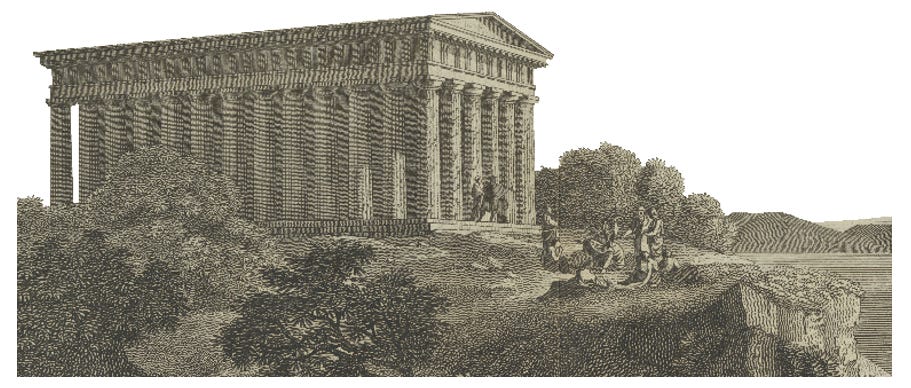
According to Plutarch (AD 46–119), Plato was furious with Eudoxus of Cnidus (~390–340 BC) and Archytas of Tarentum (435/410–360/350 BC) for their applications of mechanics to geometry and vice versa.
Plato… inveighed against them as corrupters and destroyers of the pure excellence of geometry, which thus turned her back upon the incorporeal things of abstract thought and descended to the things of sense, making use, moreover, of objects which required much mean and manual labor. For this reason mechanics was made entirely distinct from geometry, and being for a long time ignored by philosophers, came to be regarded as one of the military arts [[iv]].
Aristotle wasn’t much better. While he endorsed observation, experimentation was not part of his worldview. “Such things [practical arts] may be studied by a free man, but will only be practiced from necessity” [[v]]. “…[N]o man can practice excellence who is living the life of a mechanic or labourer” [[vi]]. “And any occupation, art, or science, which makes the body or soul or mind of the freeman less fit for the practice or exercise of excellence, is mechanical; wherefore we call those art mechanical which tend to deform the body, and likewise all paid employments, for they absorb and degrade the mind” [[vii]].
A modern historian notes:
The Greeks … distinguished between empeira, meaning a knack or skill acquired through practice, and episteme, meaning knowledge, which required the ability to give reasons why something was the case. The person having empeira might be able to manipulate the world, but he would not be able to explain why what he was doing should work. A typical example for the Greeks was the difference between someone who knew a few folk remedies for disease, and a doctor who knew the nature of the body and could explain why, how, and in what circumstances those folk remedies would be effective [[viii]].
Archimedes of Syracuse (287–212 BC) was the great engineer of antiquity. According to the Roman architect and engineer, Vitruvius (~75–15 BC), the King of Syracuse, Hiero II (~308–215 BC), to whom Archimedes may have been related, suspected the gold crown he commissioned might have been adulterated with silver.
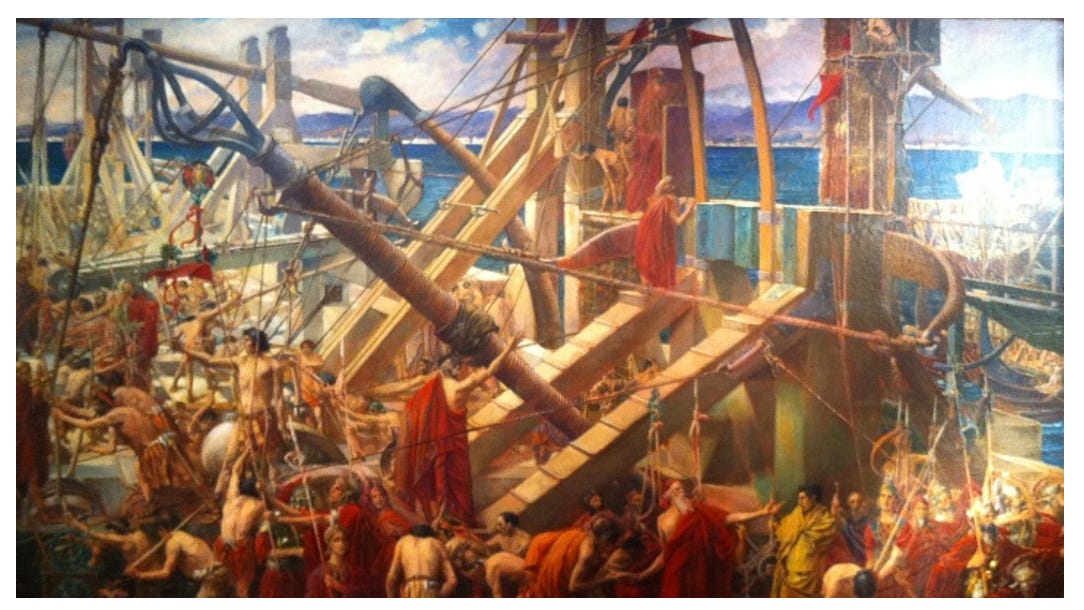
While taking a bath, Archimedes realized that objects displace water proportional to their volume, and that different metals with the same weight would displace different amounts of water due to their different densities. By comparing the water displacement of the crown to that of equal weights of pure gold and silver, he could determine if the crown was mixed with cheaper silver. According to legend, he was so excited by this insight that he ran naked through the streets shouting “Eureka! Eureka!” (“I have found it! I have found it!”) [[x]]. Galileo (1564–1642) [[xi]] as well as more modern scholars [[xii], [xiii]] have expressed doubts about Vitruvius’s account.
I shared Plutarch’s full description of Archimedes from his “Life of Marcellus” last month.
Plutarch on Archimedes

Today’s post is about one of the most fascinating characters of antiquity: a great engineer who refused to document his remarkable inventions because of his disdain for the practical applications of abstract geometry. That attitude strangled classical science in its crib, and the rebirth of that attitude threatens to do similar today. This guest post co…
After King Hiero II’s death, his grandson and successor abandoned Rome and sided with the Carthaginians in the Second Punic War. Fearing his chaotic and tyrannical behavior, insiders assassinated him and a pro-Carthaginian cabal took over. Consul Marcus Claudius Marcellus (268–208 BC) arrived in 213 BC to subdue Rome’s fickle former ally. According to Plutarch, Syracuse defied him thanks to Archimedes’ many war machines: catapults, mirrors that set enemy ships ablaze, even grappling cranes that picked up and dropped ships [[xiv]]. The city ultimately fell to betrayal, and Archimedes was killed by a Roman soldier in the resulting chaos, despite Marcellus’s order that he be spared.
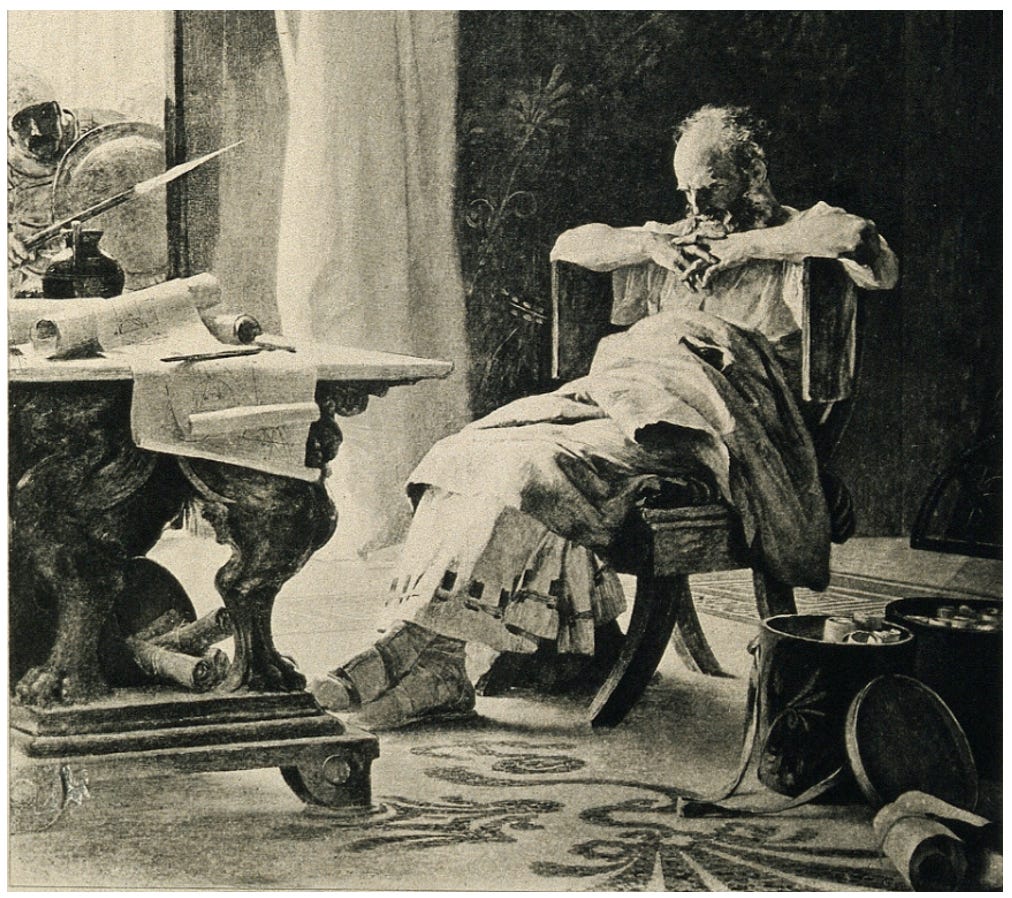
In his Life of Marcellus, Plutarch explains Archimedes’s attitude about his own practical accomplishments.
Yet Archimedes possessed so high a spirit, so profound a soul, and such treasures of scientific knowledge, that though these inventions had now obtained him the renown of more than human sagacity, he yet would not deign to leave behind him any commentary or writing on such subjects; but, repudiating as sordid and ignoble the whole trade of engineering, and every sort of art that lends itself to mere use and profit, he placed his whole affection and ambition in those purer speculations where there can be no reference to the vulgar needs of life; studies, the superiority of which to all others is unquestioned, and in which the only doubt can be, whether the beauty and grandeur of the subjects examined, or the precision and cogency of the methods and means of proof, most deserve our admiration [[xvi]].
Greek science transformed human thought by asserting that nature is governed by an intelligible rational order (Logos) accessible to human reason rather than myth or revelation. They speculated, correctly, that mathematical relations disclose nature’s hidden structure. Plato emphasized rational deduction, while Aristotle grounded knowledge in systematic empirical study. Euclid showed how deductive reasoning from axioms yields certainty. Equally important, Greeks tolerated disagreement and discussion with only occasional recourse to hemlock.
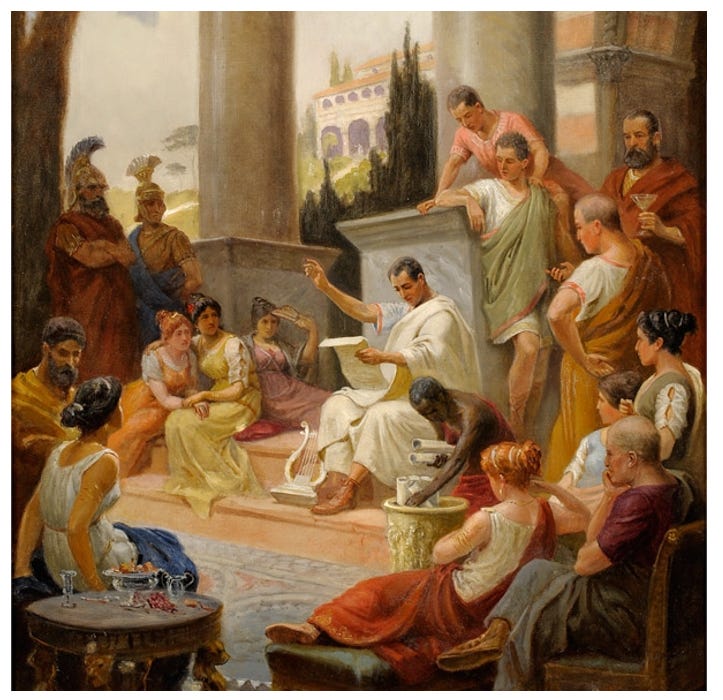
For all their strengths however, the Greeks suffered under two great weaknesses: a fixation on Euclidean deductive reasoning as the archetype of truth and a disdain for applications of geometry and mathematics that even the practical Romans, like Plutarch, often found admirable. Greek philosophy, mathematics, and science advanced, but their divorce from mechanics delayed the emergence of experimental, engineering-driven science. Although the Romans conquered Greece in the 2nd century BC, Greek culture, education, and philosophy profoundly shaped Roman intellectual life. The Roman poet, Quintus Horatius Flaccus (Horace) (65–8 BC) quipped, “Captive Greece captured, in turn, her uncivilized Conquerors, and brought the arts to rustic Latium” [[xviii]].
That’s all for now. Remember always to keep calm, and make physics great again.
See you next week,
Hans
P.S. Pick up your copy of Fields & Energy Book I: Fundamentals and Origins of Electromagnetism, if you haven’t already:
Next time: II 1.4 Greek Exceptionalism
Enjoyed the article, but maybe not quite enough to spring for a paid subscription?
Then click on the button below to buy me a coffee. Thanks!

Full Table of Contents [click here]
Follow Online:
You may follow me online in other places as well:
Telegram: 𝔸𝕖𝕥𝕙𝕖𝕣𝕔𝕫𝕒𝕣’𝕤 𝔸𝕖𝕥𝕙𝕖𝕣𝕤𝕥𝕣𝕖𝕒𝕞
Gab: @aetherczar
Twitter: @aetherczar
Amazon: Hans G. Schantz
References
[[i]] Sounion, Greece: Plato and his disciples on the promontory. Engraving, 1817. Wellcome Collection. Reference: 825565i. See: https://wellcomecollection.org/works/qegsvtw3/images?id=kj9t256w
[[ii]] Boyer, Carl B., and Uta C. Merzbach, A History of Mathematics, 2nd ed. New York: John Wiley & Sons, Inc., 1991, p. 101.
[[iii]] Plato, The Collected Dialogues of Plato Including the Letters, Edith Hamilton and Huntington Caine, eds., Princeton: University Press, 1961, p. 762. Republic VII, 529d-530a.
[[iv]] Plutarch (46–119), Plutarch’s Lives, vol. 1, Switzerland: Castalia Library, 2020, p. 726-7.
[[v]] Aristotle, Politics Book I-11 1258b 10–11. The Complete Works of Aristotle: The Revised Oxford Translation, Jonathan Barnes, ed., vol. 2 Princeton University Press, 1984, p. 1997.
[[vi]] Aristotle, Politics Book III-5 1278a 20–21. The Complete Works of Aristotle: The Revised Oxford Translation, Jonathan Barnes, ed., vol. 2 Princeton University Press, 1984, p. 2028.
[[vii]] Aristotle, Politics Book VIII-2 1337b 9–12. The Complete Works of Aristotle: The Revised Oxford Translation, Jonathan Barnes, ed., vol. 2 Princeton University Press, 1984, p. 2122.
[[viii]] Gregory, Andrew, Eureka: The Birth of Science, Cambridge: Icon Books, 2001, p. 14.
[[ix]] Spence, Thomas Ralph, “Archimedes directing the defenses of Syracuse,” 1895. See: https://en.wikipedia.org/wiki/Siege_of_Syracuse_(213%E2%80%93212_BC)#/media/File:Archimedes_Directing_the_Defenses_of_Syracuse.jpg

[[x]] Marcus Vitruvius Polli, de Architectura, Book IX. See: http://penelope.uchicago.edu/Thayer/E/Roman/Texts/Vitruvius/9*.html.
[[xi]] Galileo (1564-1642), La Bilancetta (“The Little Balance”), 1586. See: https://math.nyu.edu/Archimedes/Crown/bilancetta.html.
[[xii]] See: https://math.nyu.edu/Archimedes/Crown/CrownIntro.html
[[xiii]] Lloyd, G.E.R., Greek Science After Aristotle, New York, W.W. Norton & Company, 1973, p. 47.
[[xiv]] The mirror story was a later invention, not in Plutarch, and may have been a later addition to the Archimedean mythos.
[[xv]] Archimedes Siracus (287–212 BC). Photogravure by R. Paulussen after N. Barabino. Iconographic Collections. Keywords: Archimedes, c.287-212 b.c.; portrait prints; Archimedes; photogravures. See: https://commons.wikimedia.org/wiki/File:Archimedes_Siracus._Photogravure_by_R._Paulussen_after_N._Barabino.jpg

[[xvi]] Plutarch (46–119), Plutarch’s Lives, vol. 1, Switzerland: Castalia Library, 2020, p. 726-7.
[[xvii]] Horace reciting his verses, by Adalbert von Rössler. See: https://en.wikipedia.org/wiki/Horace#/media/File:Adalbert_von_R%C3%B6ssler_Horaz.jpg

[[xviii]] Horace, Epistles, Book II, Epistle 1, lines 156–157. See: https://www.poetryintranslation.com/PITBR/Latin/HoraceEpistlesBkIIEpI.php
"Equally important, Greeks tolerated disagreement and discussion with only occasional recourse to hemlock."
lol
Hello,
I have been studying Alfred North WHITEHEAD and wrote an article, trying to sum up his ideas - it's straight on the line of your article and I am sure that you may find interesting bits!
https://palmoth.substack.com/p/greek-intellectuals-and-their-negative