


Why were the Greeks in their few centuries of brilliance from the seventh to second centuries before Christ so successful compared to their longer standing rivals in Babylon and Egypt?
1.4.1 Egyptian Homogeneity & Stasis
The Greek historian, Herodotus (484–425 BC) hints at the answer. Egypt, he said “has wonders more in number than any other land, and work too it has to show as much as any land, which are beyond expression great…” [[i]]. The Egyptians “established for themselves manners and customs in a way opposite to other men in almost all matters” [[ii]]. “The customs which they practise are derived from their fathers and they do not acquire others in addition” [[iii]]. In Plato’s Timaeus, when the Greek lawgiver Solon (630–560 BC) visits Egypt, an Egyptian priest tells him:
O Solon, Solon, you Hellenes are never anything but children, and there is not an old man among you… in mind you are all young; there is no old opinion handed down among you by ancient tradition, nor any science which is hoary with age [[iv]].
The fertile crescent of Mesopotamia hosted great civilizations whose fate was to be swept away every few centuries by nomadic incursions [[v]]. Disease-ridden diminutive grain-fed urbanized peasants were no match, man-for-man, with their larger meat-and-dairy-fed barbarian opponents [[xvii]]. “The accumulated wealth of an empire that followed an urban revolution attracted the attention of invaders with more efficient means of warfare. Success in the art of horsemanship, the care and breeding of horses, and the ability to use chariots in mountainous regions enabled Aryan groups to dominate the empire” [[vi]]. Egypt was long spared the fate of Babylon by geographic isolation, and the geography of the Nile valley ensured easy logistics, communication, and coordination. Occasionally rule would be split between north and south or Hyksos, Kushite, Assyrian, or Persian invaders would rule for a time, but Egyptian culture largely defied foreign influence. Foreigners adapted themselves to Egypt instead of vice versa.
This cultural conservatism bred stability at the cost of creativity. Plato (~425–347 BC) explains.
Painters and practitioners of other arts and design were forbidden to innovate on these models or entertain any but the traditional standards, and the prohibition still persists, both for these arts and for music in all its branches. If you inspect their paintings and reliefs on the spot, you will find that the work of ten thousand years ago – I mean that expression not loosely but in all precision – is neither better nor worse than that of today; both exhibit identical artistry [[ix]].
This Egyptian cultural stasis was a situation Plato found “immensely to the credit of their legislators and statesmen” [[x]]. How many modern would-be philosopher kings agree with Plato?
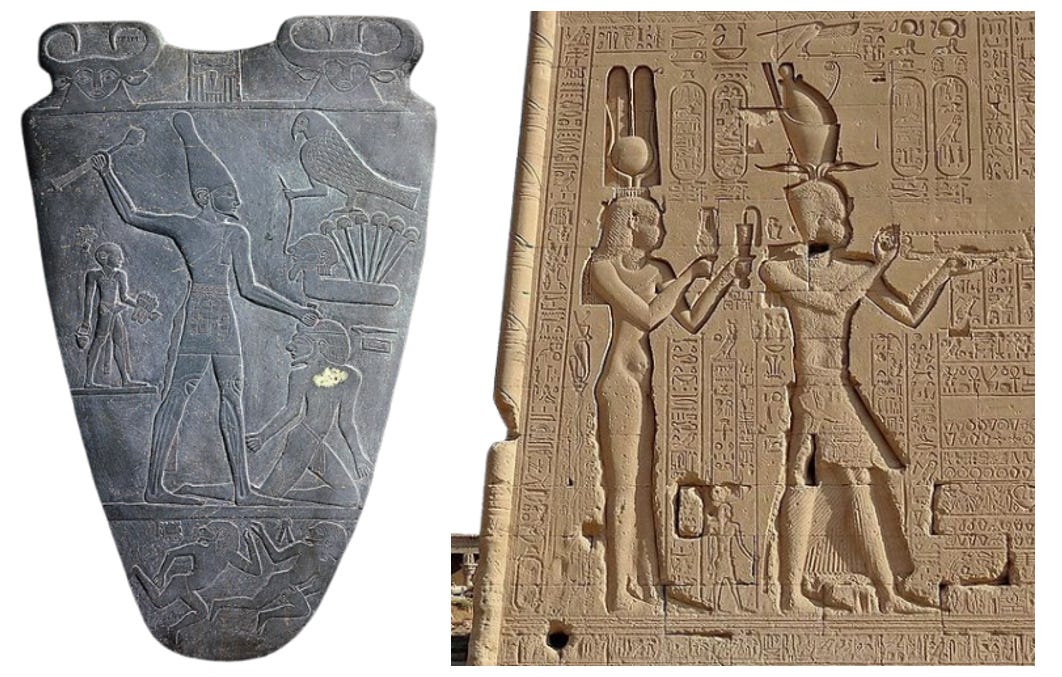
The ancient Egyptians were conservative and tradition bound. Their cultural stasis is made manifest by comparing some of their earliest art to their artistic creations in the years immediately before the Roman conquest. We cannot today verify the ten-thousand-year tradition to which Plato attests, but Egyptian aesthetics were little changed over the three thousand years between the Narmer Palette and Cleopatra. In fact, we stand closer in time to the reign of Cleopatra VII (69–30 BC), final queen of classical Egypt, than she stood to the Great Pyramids of Giza (~2600 BC).
1.4.2 Greek Heterogeneity & Creativity
The mountainous Southern extremity of the Balkan peninsula and the numerous islands of the Aegean sheltered many independent city-states or poleis. They were poor, lacked great natural wealth, and travel was difficult, hindering attempts at communication and centralized control.
Scarcity encouraged trade, innovation, and cooperative arrangements, but also competition and frequent conflict, reinforcing the independence of each polis. Oligarchs married women from the ruling families of other cities, and then joined to participate in great religious festivals or to watch their in-laws compete in the Olympics as early as 776 BC [[xi]]. The ruling families became an international clique, keeping the poleis bound together through ties of blood, language, and religion. Each polis became a kind of experimental laboratory for political and cultural ideas, however. “There is only one Hellas [Greece] but there are many poleis,” declared the poet Poseidippos of Pella (~310–240 BC) [[xii]]. The consequence was political fragmentation. For example, Athens pioneered democracy while Sparta became a military oligarchy. The constant competition between independent poleis spurred art, philosophy, science, and literature.
Antisthenes of Athens (~446–366 BC), a student of Socrates, taught in Athens, and his ideas inspired “Cynicism” and “Stoicism.” Diogenes of Sinope (~404–323 BC), who lived in deliberate poverty, popularized Antisthenes’s teachings. Cynicism rejected social convention, material wealth, and artificial desires, advocating a life of simplicity, virtue, and frank speech (parrhesia) as the most direct route to virtue and freedom [[xiii]].
Epicurus (341–271 BC) founded “Epicureanism,” a school of philosophy that focuses on achieving happiness through pleasure, but not in the purely hedonistic sense. Instead Epicureans sought “ataraxia” (tranquility/freedom from fear) and “aponia” (absence of pain), achieved through simple living, friendship, and philosophical contemplation [[xiv]].
Zeno of Citium (333–261 BC) (not to be confused with the Zeno of Elea (~490–430 BC), the paradoxical follower of Parmenides) was the father of Stoicism. Stoicism holds that the cosmos is ordered by rational logos and that human flourishing consists in living according to reason and nature, cultivating virtue, self-control, and emotional resilience regardless of external fortune [[xvi]].
This is but a small sample of the multiplicity of philosophic viewpoints and teachings that demonstrates the strength and creativity of Greek culture. The Greeks not only laid the foundations of science, but also for much of our modern culture.
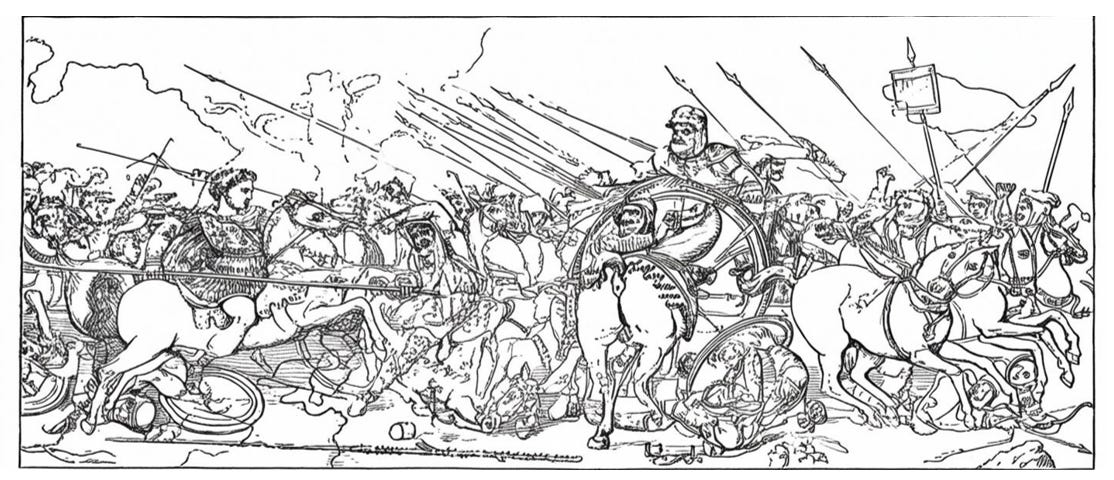
The mighty Persian Empire, with their superb couriers and communications and their tolerance for local customs, ultimately conquered Babylon in 540 BC, yet was unable to subdue the fractious Greek poleis in the Greco-Persian Wars of 499–449 BC. A century later, Alexander (356–323 BC) obtained hegemony over Greece and conquered much of the civilized world, including Persia, Babylon, Egypt, and even parts of distant India. A century after that, Rome increased political and military control over Greece, culminating in the destruction of Corinth in 146 BC and the subjugation of Greece to Rome. How can we account for these remarkable changes in fortune?
That’s all for now. Remember always to keep calm, and make physics great again.
See you next week,
Hans
P.S. Pick up your copy of Fields & Energy Book I: Fundamentals and Origins of Electromagnetism, if you haven’t already:
Next time: II 1.5 So, What Went Wrong?
Enjoyed the article, but maybe not quite enough to spring for a paid subscription?
Then click on the button below to buy me a coffee. Thanks!

Full Table of Contents [click here]
Follow Online:
You may follow me online in other places as well:
Telegram: 𝔸𝕖𝕥𝕙𝕖𝕣𝕔𝕫𝕒𝕣’𝕤 𝔸𝕖𝕥𝕙𝕖𝕣𝕤𝕥𝕣𝕖𝕒𝕞
Gab: @aetherczar
Twitter: @aetherczar
Amazon: Hans G. Schantz
References
[[i]] Herodotus, The Histories of Herodotus, Translated into English by G. C. Macaulay, London & New York: MacMillan and Co., 1890. Book II-35. See: https://www.gutenberg.org/files/2707/2707-h/2707-h.htm#link22H_4_0001
[[ii]] Herodotus, The Histories of Herodotus, Translated into English by G. C. Macaulay, London & New York: MacMillan and Co., 1890. Book II-35. See: https://www.gutenberg.org/files/2707/2707-h/2707-h.htm#link22H_4_0001
[[iii]] Herodotus, The Histories of Herodotus, Translated into English by G. C. Macaulay, London & New York: MacMillan and Co., 1890. Book II-79. See: https://www.gutenberg.org/files/2707/2707-h/2707-h.htm#link22H_4_0001
[[iv]] Plato, The Collected Dialogues of Plato Including the Letters, Edith Hamilton and Huntington Caine, eds., Princeton: University Press, 1961, p. 1157. Timaeus, 22b.
[[v]] Garraty, John A. and Peter Gay, eds., The Columbia History of the World, New York: Harper & Row, 1972, pp. 61-64.
[[vi]] Innis, Harold A. (1894–1952), Empire and Communications, New York: Rowman & Littlefield, Publishers, 2007, originally published 1950, p. 56. See: https://amzn.to/48TEg1g
[[vii]] The Narmer Palette. anonymous - http://www.studyblue.com/notes/note/n/art-midterm/deck/1189362 See: https://en.wikipedia.org/wiki/Narmer_Palette#/media/File:Narmer_Palette.jpg

[[viii]] This relief from one of the walls of the Dendera Temple in Egypt portrays Cleopatra VII along with her son Caesarion as Pharaoh. Cleopatra had intended for her son to succeed her as ruler of the Ptolemaic Kingdom, however her defeat at the hands of Octavian in the Final War of the Roman Republic and Caesarion’s subsequent death prevented this. See: https://www.worldhistory.org/image/8293/relief-of-cleopatra-vii-and-caesarion-at-the-dende/
[[ix]] Plato, The Collected Dialogues of Plato Including the Letters, Edith Hamilton and Huntington Caine, eds., Princeton: University Press, 1961, p. 1254. Laws II, 656e–657a.
[[x]] Plato, The Collected Dialogues of Plato Including the Letters, Edith Hamilton and Huntington Caine, eds., Princeton: University Press, 1961, p. 1254. Laws II, 656e–657a.
[[xi]] Garraty, John A. and Peter Gay, eds., The Columbia History of the World, New York: Harper & Row, 1972, p. 149.
[[xii]] Zhou, Yoqun, Festivals, Feasts, and Gender Relations in Ancient China and Greece, Cambridge: University Press, 2010, p. 6. See: https://api.pageplace.de/preview/DT0400.9780511771590_A23679897/preview-9780511771590_A23679897.pdf#:~:text=and%20the%20same%20city%2Dstate%20culture%2C%20a%20proposition,one%20Hellas%2C%20but%20there%20are%20many%20poleis.
[[xiii]] Laertius, Diogenes (third century, AD), Lives of Eminent Philosophers, vol. 2, R.D. Hick, trans. Cambridge: Harvard University Press, 1925, p. 5. Anticipating the Beatitudes, when told Plato was abusing him, Antisthenes declared. “It is a royal privilege to do good and be ill spoken of” [Book VI 2-4; p. 5].
“Once, when he was applauded by rascals, he remarked, ‘I am horribly afraid I have done something wrong’” [Book VI 4-6; p. 7].
“When he was asked what advantage had accrued to him from philosophy, his answer was, ‘The ability to hold converse with myself’” [Book VI 6-8; p. 9].
“Diocles records the following sayings of his: ‘To the wise man nothing is foreign or impracticable. A good man deserves to be loved. Men of worth are friends. Make allies of men who are at once brave and just. Virtue is a weapon that cannot be taken away. It is better to be with a handful of good men fighting against all the bad, than with hosts of bad men against a handful of good men. Pay attention to your enemies, for they are the first to discover your mistakes. Esteem an honest man above a kinsman. Virtue is the same for women as for men. Good actions are fair and evil actions foul. Count all wickedness foreign and alien’” [Book VI 10-13, p. 13].
“Antisthenes gave the impulse to the indifference of Diogenes, the continence of Crates, and the hardihood of Zeno, himself laying the foundations of their state. Xenophon calls him the most agreeable of men in conversation and the most temperate m everything else” [Book VI 13-15, p. 15].
See Book VI, generally: https://archive.org/details/livesofeminentph02diog/page/12/mode/2up?q=antisthenes.
[[xiv]] Laertius, Diogenes (third century, AD), Lives of Eminent Philosophers, vol. 2, R.D. Hick, trans. Cambridge: Harvard University Press, 1925, p. 653-5.
“He who has a clear and certain understanding of these things will direct every preference and aversion toward securing health of body and tranquillity of mind, seeing that this is the sum and end of a blessed life. For the end of all our actions is to be free from pain and fear, and, when once we have attained all this, the tempest of the soul is laid ; seeing that the living creature has no need to go in search of something that is lacking, nor to look for anything else by which the good of the soul and of the body will be fulfilled. When we are pained because of the absence of pleasure, then, and then only, do we feel the need of pleasure. Wherefore we call pleasure the alpha and omega of a blessed life. Pleasure is our first and kindred good. It is the starting-point of every choice and of every aversion, and to it we come back, inasmuch as we make feeling the rule by which to judge of every good thing. And since pleasure és our first and native good, for that reason we do not choose every pleasure whatsoever, but ofttimes pass over many pleasures when a greater annoyance ensues from them. And ofttimes we consider pains superior to pleasures when submission to the pains for a long time brings us as a consequence a greater pleasure.” See Book X, generally: https://archive.org/details/livesofeminentph02diog/page/652/mode/2up?q=fear.
[[xv]] Oman, C.W.C., A History of Greece From the Earliest Times to the Death of Alexander the Great, London: Longmans, Green, and Co. 1910. Frontispiece. See: https://archive.org/details/in.ernet.dli.2015.203513/page/n11/mode/thumb. The Battle of Issus mosaic resides at the Museo Archeologico Nazionale, Naples, Italy. See: https://en.wikipedia.org/wiki/Alexander_Mosaic
[[xvi]] Laertius, Diogenes (third century, AD), Lives of Eminent Philosophers, vol. 2, R.D. Hick, trans. Cambridge: Harvard University Press, 1925, p. 195. “This is why Zeno was the first (in his treatise On the Nature of Man) to designate as the end ‘life in agreement with nature’ (or living agreeably to nature), which is the same as a virtuous life, virtue being the goal towards which nature guides us” [Book VII 86-88]. See Book VII, generally: https://archive.org/details/livesofeminentph02diog/page/194/mode/2up?q=zeno.
[[xvii]] Scott, James C. (b. 1936), Against the Grain: A Deep History of the Earliest States, Yale University Press, 2017. Grain-fed urbanites smaller in stature and disease ridden, [pp. 11, 84-85]. “Take the Romans, for example, a key defining characteristic of barbarians was that they ate dairy products and meat and not, as the Romans did, grain” [p. 123]. See: https://amzn.to/4bAf3Mq
Very interesting. Nothing on the Peloponnesian War (431–404 BCE)? I think the Eleusinian Mysteries had much to do with the Greek Miracle. A very different mystery tradition than the Mithraic mysteries of Rome. Very different.