


The history of science is inseparable from the history of media. Each advance in communication transformed not only how scientific knowledge was preserved and transmitted, but also who could create it and how rapidly ideas could spread.
1.7.3.1 Oral Tradition and Papyrus Scrolls
Even in antiquity, when the spoken word remained the dominant medium, and recitation and memorization were the principal means of transmission, writing was beginning to transform the preservation and dissemination of knowledge. Every temple maintained its own collection of sacred writings and other scrolls. For instance, Heraclitus (c. 540–c. 480 BC) deposited his treatise in a temple around 500 BC where apparently it was available for Aristotle (384–322 BC) to review and comment upon nearly two centuries later [[i]].
Plato (c. 428/427–348/347 BC) marked the beginning of the transition from oral, dialogical teaching like that of Socrates (c. 470–399 BC) to the more systematic written scholarship of Aristotle (384–322 BC). Writing in general and papyrus scrolls in particular became central to scholarship.
Science, like all learned pursuits in antiquity, depended upon an oral tradition supplemented by handwritten manuscripts on papyrus. The papyrus scroll was well suited to continuous reading, but its serial architecture, laborious reproduction, cumbersome handling, dependence on Egyptian supplies, and limited durability under frequent use constrained the preservation, organization, and dissemination of knowledge. Our best contemporaneous description comes from Pliny the Elder (AD 23/24–79) writing in his Natural History (Book XIII, Ch. XXI, §§68–73):
…[W]e shall also describe the nature of papyrus, since our civilization or at all events our records depend very largely on the employment of paper [i.e. papyrus]. According to Marcus Varro [116-27 BC] we owe even the discovery of paper to the victory of Alexander the Great [356–323 BC], when he founded Alexandria in Egypt, before which time paper was not used. First of all people used to write on palm-leaves and then on the bark of certain trees, and afterwards folding sheets of lead began to be employed for official muniments, and then also sheets of linen or tablets of wax for private documents ; for we find in Homer that the use of writing-tablets existed even before the Trojan period…. Subsequently, also according to Varro, when owing to the rivalry between King Ptolemy [Ptolemy V Epiphanes (210–180 BC); (r. 204–180 BC)] and King Eumenes [Eumenes II (c. 221–159 BC); (r. 197–159)] about their libraries Ptolemy suppressed the export of paper, parchment was invented at Pergamum ; and afterwards the employment of the material on which the immortality of human beings depends spread indiscriminately [[iv], [v]].
Pliny and Varro were wrong that Alexander “discovered” paper or papyrus. The was a book trade in the Hellenic world as early as the middle of the fifth century BC, and papyrus was the principal writing material [[vi]]. Egypt was the major source. The papyrus reed grew freely throughout the Nile delta. This allowed Egyptian rulers to control production and, at times, restrict exports.
Pliny was also wrong that Pergamon “invented” parchment under the reign of King Eumenes. Herodotus (c.484–c.425 BC) mentions its use in the 7th century BC, and examples of parchment have been found as far back as 2550 BC: an Egyptian Book of the Dead written on animal skins [[vii]].
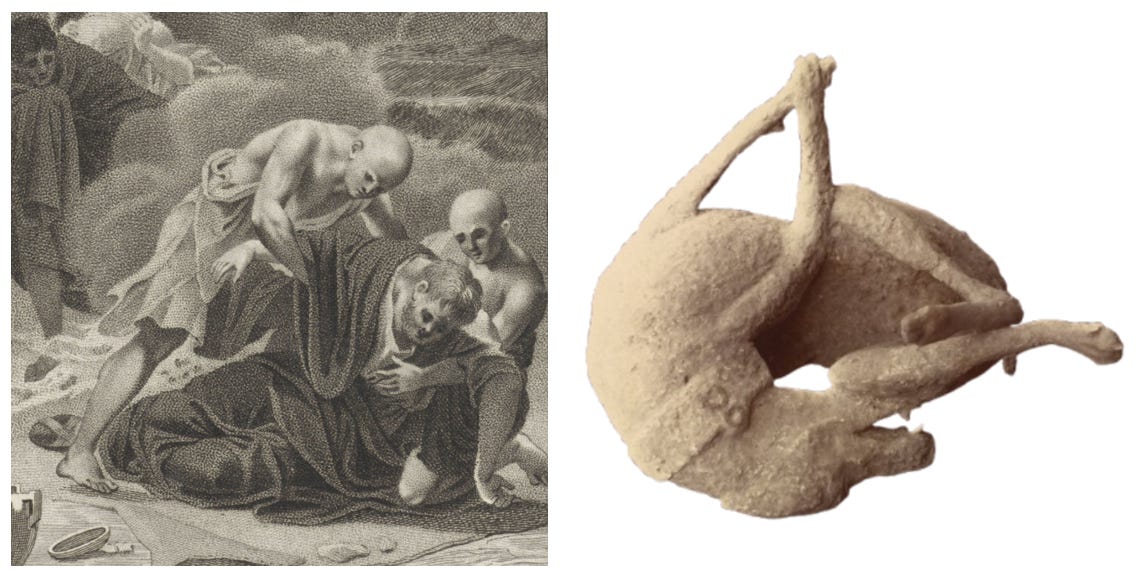
Pliny was right, however, that it was ultimately long-lasting parchment “on which the immortality of human beings depends.” As the commander of the Roman fleet stationed at Misenum in the Bay of Naples, he ordered his ships to investigate the eruption of Vesuvius and rescue victims. We know the details of his death thanks to papyrus letters written by his nephew Pliny the Younger (AD 61/62–c. 113). These papyrus letters were ultimately copied to and preserved on parchment [[viii]]. Furthermore, no less than five parchment copies of Pliny The Elder’s own Natural History survive from the 7th and 8th centuries [[ix]].
Papyrus was not an intrinsically fragile material.
“[T]he myth that papyrus is not a durable material has at last been authoritatively and, one would hope, finally refuted… it was in fact extremely strong and flexible…” however, “even the strongest supporters of papyrus would not deny that parchment of good quality is the finest writing material ever devised by man…. Above all, it possesses one outstanding advantage over papyrus: whereas production of papyrus was limited to Egypt, parchment could be produced wherever the skins of suitable animals were available in sufficient quantity” [[x]].
Galen of Pergamon (AD 129–216) referred to scrolls in the Library of Alexandria marked “a [book] from the ship” [[xi]]. This suggests that some Ptolemaic manuscripts survived into his own lifetime. Or perhaps the “book from the ships” may reflect a continuing cataloging category rather than an original dating from early Ptolemaic times surviving three hundred years [[xii]]. Galen complained, for instance, about scrolls stored in Rome: “they are completely useless and cannot even be unravelled because the papyrus has been glued together by mould. For that place is damp and enclosed, and very humid in the summer” [[xiii]].
Papyrus has survived from as early as 12th Dynasty (1985–1795 BC) Egypt, but only if preserved in dry climates. “Papyrus is mainly made of cellulose, which ages and deteriorates over time, becoming fragile and brittle” [[xiv]]. Ancient repairs to the British Museum’s Rhind Mathematical Papyrus demonstrate that frequently consulted manuscripts could suffer sufficient damage to require restoration [[xv]].
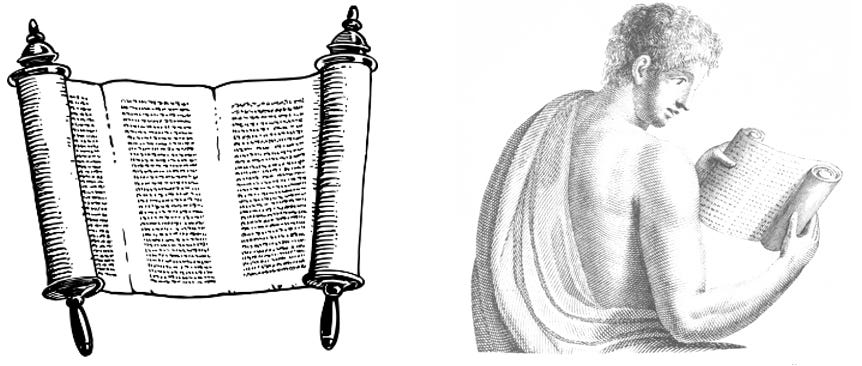
Around 230 BC, the satirist Timon of Phlius (c. 320–c. 230 BC) described how “many are feeding in populous Egypt, scribblers on papyrus, ceaselessly wrangling in the birdcage of the Muses.” [[xviii], [xix]]. Later writers extended the metaphor to imagine scribes at the Library of Alexandria pecking away at their papyrus rolls like chickens, an apt image for the continuous work of copying manuscripts by hand, essential to preserve a collection.
We have no accounts of bookstores until the time of Marcus Tullius Cicero (106–43 BC) in the late Roman Republic. An ancient bookstore was less a warehouse of books than a manuscript production shop. Booksellers maintained exemplars and produced manuscripts to order, rather than selling from inventory [[xx]]. The first public library in Rome dates to 39 BC. A personal library soon became a standard fixture in every affluent home, whether or not the owner was literate. Lucius Annaeus Seneca (“Seneca the Younger”) (c. 4 BC–AD 65) complained:
It was not taste, it was not thoughtfulness, it was learned extravagance — nay not even learned, for they had bought their books for the sake of show, not for the sake of learning — just as with many who are ignorant even of the lowest branches of learning, books are not instruments of study, but ornaments of dining-rooms…. Nowadays a library takes rank with a bathroom [hot & cold baths; not a toilet or lavatory] as a necessary ornament of a house [[xxi]].
There were ultimately no less than twenty-six public libraries in Rome [[xxii]], twenty-eight by the 4th century [[xxiii]].
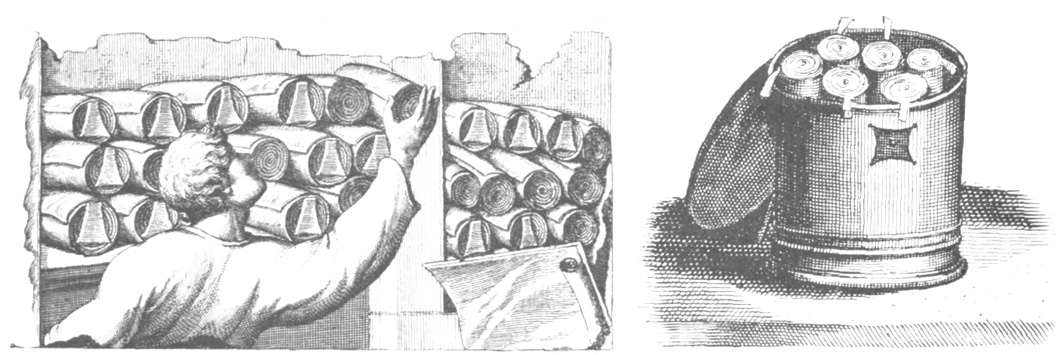
These “books” we’ve been discussing would have been scrolls of papyrus, an architecture unfamiliar to modern readers. A typical Greek or Roman literary scroll consisted of individual sheets of papyrus pasted edge to edge to form a continuous roll approximately 8–12 inches (20–30 cm) high and 15–30 feet (5–9 m) long. The text was written in a series of narrow vertical columns, each typically 2–4 inches (5–10 cm) wide, running from the top to the bottom of the scroll. A wooden rod (umbilicus) was sometimes attached to one or both ends to facilitate rolling and handling [[xxv]].
To read the scroll, the reader held it with both hands, unrolling it with one hand while simultaneously rolling up the portion already read with the other. Only one or two columns of text were visible at a time, so reaching a passage near the end required laboriously advancing through the intervening columns. The scroll was a serial-access medium, making rapid consultation, cross-referencing, and comparison of widely separated passages cumbersome. And those of an age to remember “Blockbuster” will appreciate the necessity — and inconvenience — for the user to rewind the media before the next use [[xxvi]].
Cassiodorus (c. AD 485–c. 585) bookended the other side of the transition, where oral communication supplemented by scrolls finally gave way to parchment codices as the principal means of storage and transmission of knowledge. “These books [of Cassidorus et al] made the culture of a very ancient world available to a less privileged generation, which could no longer count on having teachers available, in their locality, to explain difficult texts to them by word of mouth” [[xxvii]]. What exactly is a “codex?”
That’s all for now. Remember always to keep calm, and make physics great again.
See you next week,
Hans
P.S. Pick up your copy of Fields & Energy Book I: Fundamentals and Origins of Electromagnetism, if you haven’t already:
Next time: II 1.7.3.2 The Parchment Codex Revolution: The Birth of the Book and the Loss of the Ancient World
Enjoyed the article, but maybe not quite enough to spring for a paid subscription?
Then click on the button below to buy me a coffee. Thanks!

Full Table of Contents [click here]
Follow Online:
You may follow me online in other places as well:
Telegram: 𝔸𝕖𝕥𝕙𝕖𝕣𝕔𝕫𝕒𝕣’𝕤 𝔸𝕖𝕥𝕙𝕖𝕣𝕤𝕥𝕣𝕖𝕒𝕞
Gab: @aetherczar
Twitter: @aetherczar
Amazon: Hans G. Schantz
References
[[i]] Reynolds, L.D. and Wilson, N.G., Scribes and Scholars: A Guide to the Transmission of Greek and Latin Literature, Oxford: Oxford University Press, 1968, p. 1. See: https://archive.org/details/scribesscholars0000ldre/page/n9/mode/2up
[[ii]] Portman, Ludwig Gottlieb, after Jacques Kuyper. Dood van Plinius de Oudere (The Death of Pliny the Elder). Stipple engraving and etching. Amsterdam, 1805. Rijksmuseum, RP-P-1905-2220. Illustration from: Romeinsche geschiedenissen, Part XXVI, p. 18. Martinus Stuart. Amsterdam: Johannes Allart, 1805. In AD 79, while serving as commander of the Roman fleet at Misenum, Pliny the Elder sailed to investigate the eruption of Mount Vesuvius and to rescue those endangered along the coast. After reaching Stabiae, he succumbed to volcanic fumes, becoming one of history’s earliest recorded scientists to lose his life while investigating a natural phenomenon. Our principal account comes from two letters written by his nephew, Pliny the Younger (AD 61/62–c. 113), to the historian Tacitus (c. AD 56–c. 120) (Epistles 6.16 and 6.20). See: https://commons.wikimedia.org/wiki/File:Dood_van_Plinius_de_Oudere,_RP-P-1905-2220.jpg

[[iii]] Giorgio Sommer (Italian, born Germany, 1834 - 1914) (1834 - 1914) – photographer (Italian), Cast of a Dog Killed by the Eruption of Mount Vesuvius, Pompeii, Catalogue nr. 1287. 1863. See: https://commons.wikimedia.org/wiki/File:Giorgio_Sommer_(Italian,_born_Germany_-_(Cast_of_a_Dog_Killed_by_the_Eruption_of_Mount_Vesuvius,_Pompeii)_-_Google_Art_Project.jpg
_-_Google_Art_Project.jpg)
[[iv]] Pliny The Elder (AD 23/24–79), Natural History, Vol. IV: Books XII–XVI. Translated by Harris Rackham (1868–1944), Loeb Classical Library 370. Cambridge, MA: Harvard University Press; London: William Heinemann, 1945. Book XIII, Ch. XXI, §§68–73, pp. 139-141. See: https://www.attalus.org/pliny/hn13b.html and https://archive.org/details/in.ernet.dli.2015.185128/page/n145/mode/2up
[[v]] MacLeod, Roy, “Introduction: Alexandria in History and Myth,” collected in The Library of Alexandria: Centre of Learning in the Ancient World, Roy MacLeod, ed., New York: I.B. Taurus & Co. Ltd., 2004, pp. 1-15. For the seven hundred years, until the 4th century AD, as many as a hundred scholars at a time came to the Library [of Alexandria] to consult this collection, to read, talk, and write. They wrote first on papyrus, of which Alexandria had a monopoly; and then on parchment, when the Ptolemies stopped exporting papyrus in an attempt to strangle the young library set up by the Selucids in Pergamon [The Library of Pergamon dates to roughly the early 2nd century BC under the Attalid kings, not the Seleucids]. At first they wrote on scrolls, which were stored in linen or leather jackets, and kept in racks in the hall, or in the cloisters. Later, in Roman times, they wrote manuscripts, in codex form, which were stored in wooden chests (armaria). See: https://archive.org/details/LibraryOfAlexandriaBYSamy/page/n13/mode/2up
[[vi]] Reynolds, L.D. and N.G. Wilson, Scribes and Scholars, 2nd ed., Oxford: Clarendon Press, 1975, p. 2. See: https://archive.org/details/bwb_S0-BKW-016/page/2/mode/2up
[[vii]] Wyth, Meistres Elena, “Parchment History,” see: https://elenawyth.wordpress.com/parchment/history/
[[viii]] Pliny the Younger (AD 61/62–c. 113), The Letters of Pliny the Younger, William Melmoth (1710?–1799), trans.; rev. Frederick Charles Tindal Bosanquet (1832–1918), New York: Hinds, Noble & Eldredge, 1900. Book VI, Letters 16 and 20, pp. 193-198; 200-204. See: https://archive.org/details/lettersofplinyyo00plin/page/192/mode/2up
[[ix]] Pearse, Roger, “The manuscripts of Pliny the Elder’s ‘Natural History,’” June 22, 2013. An excellent discussion of the earliest sources and copies of this famous work. See: https://www.roger-pearse.com/weblog/2013/06/22/the-manuscripts-of-pliny-the-elders-natural-history/
[[x]] Roberts, Colin H. (1909–1990), and T. C. Skeat (1907–2003), The Birth of the Codex, London: Oxford University Press for the British Academy, 1983, p. 7. See: https://archive.org/details/colin-henderson-roberts-theodore-cressy-skeat-the-birth-of-the-codex/page/n7/mode/2up
[[xi]] Galen of Pergamon (AD 129–216), Commentary on Hippocrates’ Epidemics, in Claudii Galena Opera Omni vol. XVII, trans, Assmann, Friedrich Wilhelm, 1800-; Kühn, Karl Gottlob, (1754-1840), pp. 606-607. See: https://archive.org/details/b29339339_0017/page/606/mode/2up
Ptolemy the king of Egypt was so eager to collect books, that he ordered the books of everyone who sailed there to be brought to him. The books were then copied into new manuscripts. He gave the new copy to the owners, whose books had been brought to him after they sailed there, but he put the original copy in the library with the inscription “a [book] from the ships”. See: https://www.attalus.org/translate/extracts.html [17a.605]
Also: “…having given them [the Athenians] a deposit of fifteen talents of silver, he [King Ptolemy] received the books of Sophocles (c. 496–406 BC), Euripides (c. 480–406 BC), and Aeschylus (c. 525–456 BC), in order only to copy them and then immediately return them unharmed. But when he had splendidly prepared copies on the finest papyrus of those he had received from the Athenians, he kept the originals for himself; and the copies which he had prepared he sent to them, asking that they keep the fifteen talents and accept the new copies in place of the old books they had given.”
[[xii]] Galen of Pergamon (AD 129–216), Commentary on Hippocrates’ Epidemics, in Claudii Galena Opera Omni vol. XVII, trans, Assmann, Friedrich Wilhelm, 1800-; Kühn, Karl Gottlob, (1754-1840), pp. 606-607. See: https://archive.org/details/b29339339_0017/page/606/mode/2up
“They say that a certain copy of the third book of the Epidemics was found with the inscription ‘from the ships.’” See also: https://www.attalus.org/translate/extracts.html [17a.605]
[[xiii]] Galen of Pergamon (AD 129–216), Galen: An Anthology, edited and translated by P. N. Singer (b. 1962), Oxford: Oxford University Press, 2025, preview PDF, p. 7. Originally from Galen’s On Avoiding Distress (De indolentia), §19. See: https://api.pageplace.de/preview/DT0400.9780190641412_A63381409/preview-9780190641412_A63381409.pdf
[[xiv]] Sharp, Helen, “Preserving Papyrus: Caring for 4,000-Year-Old Documents,” British Museum Blog, January 27, 2023. “…it’s broken down by hydrolysis (a reaction with water) and oxidation (a reaction with oxygen).” See: https://www.britishmuseum.org/blog/preserving-papyrus-caring-4000-year-old-documents
[[xv]] Ibid.
[[xvi]] See: https://freesvg.org/written-scroll
[[xvii]] Clark, John Willis (1833–1910), The Care of Books: An Essay on the Development of Libraries and Their Fittings, from the Earliest Times to the End of the Eighteenth Century, Cambridge: Cambridge University Press, 1909, 28. See: https://archive.org/details/careofbooks00claruoft/page/n49/mode/1up
[[xviii]] Mimms, Walker, “The Birdcage of the Muses,” Dispatch, New Criterion, November 3, 2015. See: https://newcriterion.com/dispatch/the-birdcage-of-the-muses/
[[xix]] Reynolds, L.D. and N.G. Wilson, Scribes and Scholars, 2nd ed., Oxford: Clarendon Press, 1975, p. 6. Reynolds and Wilson offer the translation: “…in populous Egypt they fatten up many bookish pedants who quarrel unceasingly in the Muses’ ‘bird-cage’ (Athanaeus 1.22d).” See: https://archive.org/details/bwb_S0-BKW-016/page/6/mode/2up
[[xx]] Reynolds, L.D. and N.G. Wilson, Scribes and Scholars, 2nd ed., Oxford: Clarendon Press, 1975, pp. 22-23. See: https://archive.org/details/bwb_S0-BKW-016/page/22/mode/2up
[[xxi]] Clark, John Willis (1833–1910), The Care of Books: An Essay on the Development of Libraries and Their Fittings, from the Earliest Times to the End of the Eighteenth Century, Cambridge: Cambridge University Press, 1909, p. 21. Quoting Seneca the Younger (c. 4 BC–AD 65), De Tranquillitate Animi (“On Tranquility of Mind”), ch. 9. See: https://archive.org/details/careofbooks00claruoft/page/n41/mode/2up
[[xxii]] Clark, John Willis (1833–1910), The Care of Books: An Essay on the Development of Libraries and Their Fittings, from the Earliest Times to the End of the Eighteenth Century, Cambridge: Cambridge University Press, 1909, p. 12, 15. See: https://archive.org/details/careofbooks00claruoft/page/n33/mode/2up
[[xxiii]] Reynolds, L.D. and N.G. Wilson, Scribes and Scholars, 2nd ed., Oxford: Clarendon Press, 1975, p. 70. See: https://archive.org/details/bwb_S0-BKW-016/page/70/mode/2up
[[xxiv]] Clark, John Willis (1833–1910), The Care of Books: An Essay on the Development of Libraries and Their Fittings, from the Earliest Times to the End of the Eighteenth Century, Cambridge: Cambridge University Press, 1909, p. 30, 35. See: https://archive.org/details/careofbooks00claruoft/page/n56/mode/1up
[[xxv]] Reynolds, L.D. and N.G. Wilson, Scribes and Scholars, 2nd ed., Oxford: Clarendon Press, 1975, pp. 2-3. See: https://archive.org/details/bwb_S0-BKW-016/page/2/mode/2up
[[xxvi]] Blockbuster was a popular and ubiquitous video rental chain during the late twentieth and early twenty-first centuries (c. 1985–2010). Customers rented movies recorded on magnetic videotape, a serial-access medium played on Video Cassette Recorders (VCRs). As with papyrus scrolls, VHS tapes gradually degraded with repeated use, often producing ghosting, snowy images, tracking errors, and muffled audio. A small break-off plastic tab prevented accidental recording over the tape; covering the opening with adhesive tape restored the cassette’s recordability. The resolution was approximately 720 × 480 pixels, that of broadcast analog television (the NTSC 525 line system used in the US). After viewing, the tape had to be rewound for the next customer and returned to the store: “Be kind; rewind.” Failing to do so could result in an additional fee.
[[xxvii]] Brown, Peter, The Rise of Western Christendom, Triumph and Diversity, 2nd ed., Malden, MA: Blackwell Publishing, 2003, p. 197. See: https://amzn.to/4a8lqVF
Excellent! Fascinating! Science and media are joined at the hip for sure. BTW, I wonder if anyone ever called Aristotle a scroll-worm?
The only flaw in this thesis is calling much of the early gathering of observations and speculation about correlation and causation and leaving a record of thoughts about same *science*.
It was and is natural philosophy.
What I would recognise as science began with a scattering of individuals much much later.