


Oliver Heaviside the Man, the classic firsthand biography of Oliver Heaviside (1850–1925) by G. F. C. Searle (1864–1954), one of the people who knew him personally, has long been out of print and difficult to obtain.
With the permission of the late Ivor Catt (1935-2025) and the cooperation of Forrest Bishop, we are bringing it back: a newly typeset and proof-read edition.
The complete text will be included in the proceedings of the Heaviside Symposium: Heaviside the Man, His Life & Legacy, alongside the papers presented at the Symposium.
In the meantime, we are serializing Oliver Heaviside the Man on Fields & Energy, making Searle’s remarkable portrait of Heaviside available to a new generation of readers.
My First Meeting With Heaviside
I naturally begin with the first occasion on which I met him. I had read Oliver’s paper on “The Electro-Magnetic Effects due to the Motion of Electrification through a Dielectric” in the Philosophical Magazine, April 1889 (Electrical Papers Vol.2, p. 504) and had come to the conclusion that some of his work was wrong. I wrote to him on 19 August 1892 and told him what I thought. He replied that he was in error, and thanked me for the opportunity of making the correction (see Electrical Papers, p. 514). This led to correspondence and on 28 August 1892 I wrote and said I hoped to ride my bicycle from Cambridge to Plymouth for Devonport. I might perhaps pass through Paignton and should hope to have an opportunity of seeing him. (My approach was rather timid than bold). He replied that he would be glad to see me. The weather broke up, and I went on from Winchester to Devonport by train. A few days later I went from Devonport to Paignton via Torquay and made enquiries of people in the street as to where the distinguished Oliver Heaviside lived, but nobody knew. The only address I had was simply “Paignton”. At last a man suggested that I might try “Reynold’s Music Stores”. I did so, and saw “Charles Heaviside” in small letters beneath “Reynold’s Music Stores”. I went into the shop, saw a young man and asked him if Mr. Oliver Heaviside was at home. In answer to my enquiry, he said, “Mr. Oliver Heaviside lives at Newcastle”. I told him what had happened that day, and he said he could make enquiries. He brought a man down from the house above the shop, who said he was Charles Heaviside. He said his brother never went out except on his bicycle. This had gone to be mended and so Oliver would be sure to be at home at Paignton. I returned to Paignton by steamer and this time took the precaution of going to the house door. “Was Mr. Oliver Heaviside at home?” “Yes”. I went in and saw him there with his father and his mother and had tea with them. When I told him about the young man in the shop, he said “He is my nephew, but he has no brains at all”.
Neither Frederick nor Charles T. Heaviside, sons of Charles Heaviside, was serving in either shop. They were too young. They were sometimes in the shops and Oliver my have thought that they were acting as regular apprentices. There is a sufficient similarity of sound between “Oliver” and “A.W.” to lead an apprentice to suppose I wanted Arthur W. Heaviside. “A.W.” often came into the shops and would be known by an apprentice, but of Oliver an apprentice would know very little. Charles T. Heaviside was clever. He drew many diagrams for Oliver’s papers. He died 3 June 1939.
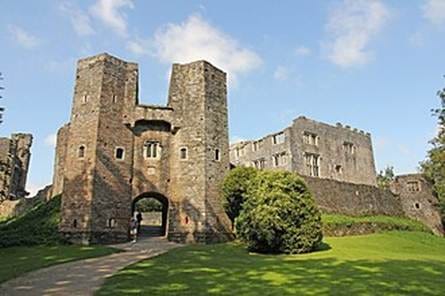
I went to Paignton again in September 1893 and in September 1894. On one of these occasions we cycle to Berry Pomeroy Castle, five miles from Paignton. We took food with us for a picnic lunch and eat it while we sat on the top of the castle. Oliver opened a tin of sardines and, after his manner, cut his finger and left it to me to bandage it. As we walked about the castle, I wondered what a room on the ground floor had been. It could not have been a dungeon as there were not places in the stonework of the windows for any bars. Oliver had the solution. “I know what it was. It is very damp. It must have been the servants’ bedroom”.
The number of persons interested in Oliver Heaviside’s work, who saw him in the flesh, is now (1950) very small. The rest must be content to gather what they can from the descriptions given by others and by me, and from the excellent portrait in the Institution of Electrical Engineers, painted by Francis Hodge. This portrait was made from a photograph of Oliver taken when he was perhaps forty. Mrs. Searle and I provided the artist with as full a description of his colouring – of course in later years – as we could, and the artist brought the nearly finished portrait to Cambridge for our criticism.
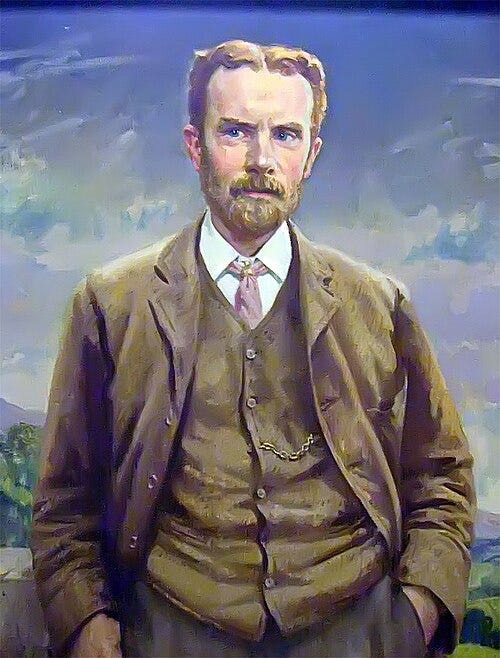
When I first knew him his hair was thick and sandy brown in colour; his face and his hands had the colour generally seen with persons with hair like Oliver’s. He has a beard in 1892 and kept it till he died. The portrait shows very vividly his piercing eyes. He was of middle height and rather broad of shoulder. His head was a little smaller than would be usual in a man of his build. He used to cut his own hair and beard. Perhaps he cut it when he was expecting us to visit him. At any rate, we never saw him with really overgrown hair or beard. He did not go bald and in January 1925 his hair was still thick. Charles Heaviside and his son Charles Thomas Heaviside also cut their own hair.
Oliver was somewhat deaf in 1893. For the last few years of his life his hearing was very poor. He had had much trouble with his ears. The drum of one ear had at one time bee ruptured, but it had healed.
Oliver never spoke of taking alcohol himself; I believe he was a lifelong teetotaller. He had strong opinions on the subject. “I read with some surprise yesterday (29 Jan. 1913) that the men in the Navy are served with a pint of grog a day (rum). That is brutal. No wonder they behave so badly on shore. They should not have any at all, for they are well fed, well clothed, picked me, doing healthy work in the purest air. The pint of grog a day is a direct manufacture of the drink habit. It should, with a view to ultimate abolition, be at once reduced to half a pint. Five years experience would show that the men were better on the half pint than on the one pint. Then reduce it to one gill, and try again.”
He smoked a good deal but was not a slave to the habit. It was always a pipe. I never saw a cigar or cigarette. I think that as a young man he was physically very strong, but he had no interest as far as I know in any kind of athletic pursuit. At forty he was an active cyclist, going considerable distances in spite of the Devonshire hills. In one letter he told me how many brake spoons he had worn out in descending the hills. In those days cycles were controlled by a spoon brake on the front wheel. At times he did a little gardening work, but I should judge that his knowledge of horticulture was far inferior to his knowledge of electro-magnetic theory.
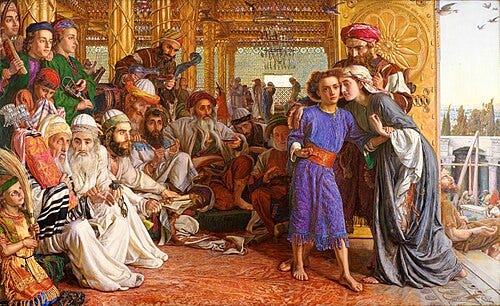
His brother, Charles Heaviside, and his family were, I believe, Unitarians, and on one occasion I met their minister at Charles Heaviside’s house in Torwood Street, Torquay. Oliver would perhaps have described himself as “nothing”. He loved making fun of dignitaries and would often tell me of the various bishops who stayed in Torquay. He got this information from the newspapers’ visitors lists. The dual sees of Bath and Wells and of Sodor and Man, led him to invent the See of Sodom and Gomorrah. He never showed any bitterness against religion or against any persons trying to live Christian lives. He certainly was never blasphemous or obscene. Where the picture came from I do not know, but in his study at Homefield, Torquay, over the mantlepiece, was a good painting representing Jesus as a boy in the Temple. “They found him in the temple, sitting in the midst of the doctors, both hearing them and asking them questions”. (St. Luke 11, 46.)
Oliver’s mother Rachel Elizabeth Heaviside (née West), born 17 December 1818, died at Paignton on 31 October 1894. His father Thomas Heaviside, born 6 December 1813, died at Paignton no 16 November 1896. In 1913 he wrote, “I have nursed my parents night and day, half asleep all the time.”
After his father’s death, Oliver continued, for a few months, to live at Paignton. On 25 January 1897, he wrote “I am now quite alone, excepting the woman who is now my servant, and I no longer allow her to do as she likes, and neglect her work, but have reformed her considerably. If you are down this way, I can accommodate you with a bedroom. If I should have moved, as I intend doing, the people here will let you know where I have gone.”
In 1897, Oliver moved to a house “Bradley View”, Newton Abbot, eight miles from Paignton and six miles from Torquay. He hired it from the owners, Messrs. A.S. Rendell and F. Symons, from 24 June, 1897, at thirty five pounds per annum. His tenancy ended on 24 June, 1909. The house was then sold, and, for a time was a children’s home under the Urban District Council. The house is on the outskirts of Newton Abbot and is near Bradley Woods and not far from Bradley Manor, in part a fifteenth century mansion. He took the Paignton housekeeper with him. She left in February 1899. By letters from Heaviside to Oliver Lodge it seems that she had a stroke before 2 February and had left, probably incapable of further work, before 18 February 1899.

The east front of Bradley, the medieval manor house in Newton Abbot, Devon, UK.[3]
I stayed with Oliver at “Bradley View” in the Septembers of 1897 and 1899. In 1897, he still had his housekeeper. We went for some cycle rides. He had an ordinary safety bicycle, with no free-wheel and with only a spoon brake on the front tyre. He would put his feet on the foot rests on the front forks, fold his arms, and let the bicycle rip down steep and rough Devon lanes. He left me far behind down those hills.
One day in September 1899, I rode, by myself, to Torquay to consult his brother Charles, at 27 Torwood Street, about Oliver’s complaint that men driving carts past his house, and other passers-by made very abusive remarks concerning him. His brother was confident that Oliver, who was then somewhat deaf, was under a delusion in that matter. He said that Oliver never came to Torwood Street and that they would be very gad if he did come. I said that, if I could, I would bring him. Next morning when he said, “What shall we do today?” I said “Let’s cycle to Babbacombe” – a suburb of Torquay. When we were nearly there I said “we had better see about getting something to eat.” He replied “I’ll tell you what we will do. We will got to see my brother; he will give us some lunch.” So we went to Torwood Street and had lunch there.
On my 1899 visit, we were out on a cycle ride to, I think, the Little Haldon moor. He said “what is that ‘lemma’ in your work?” “There is no ‘lemma’”, I said. (A ‘lemma’ is a theorem which is proved as a preliminary to, and not in the middle of, a connected piece of analysis.” After some cross-questioning, we found that he thought that the Greek letter ‘lambda’ (λ) was called ‘lemma’. In a paper “On the steady motion of an electrified ellipsoid” (Phil. Mag. Oct. 1897) I found the energy of an electrified ellipsoid of revolution moving along its axis of symmetry. (The value of a sphere had been stated in 1896, without proof, in Proc. Roy. Soc. Lol 59). The method involved a parameter λ. For an ellipsoid of axes a, b, c, moving along the a – axis these surfaces are

Where a = 1 – u2/v2, and u/v is the ratio of the velocity of the ellipsoid to that of light. When α = 1, the surfaces are true confocals.
In “The Electrician”, 29 November 1891, Oliver, by using an electro-magnetic wave method of great simplicity and power, free from any taint of confocals, verified my value for the energy. He writes “I have much pleasure in arriving at his results because I could not understand his. It seemed academical, not electrical. He said it was not lemma, but lambda. That might be, but was unconvincing.”
In 1892, my sisters and I stayed with friends in Hanover. I went, for one night, to Gottingen, where I met Max Abraham and other mathematicians and physicists. They had read, with care, Oliver’s articles in “The Electrician”, but what they could not fathom was the meaning of “He said it was not lemma, but lambda”.
On my second visit to “Bradley View”, I was under his care, as he was without help. The first morning, when I came down from my bedroom, he said “I hope you did not drink the water in the bottle upstairs.” I said “No, why?” He replied “It has been in that room since the last person slept there, three months ago.” Who that visitor was I do not know.
Professor G.F. Fitzgerald, in a letter of 13 September 1899, wrote “If you have not already seen him, please remember me to him most sincerely and remind him of my visit to him about this time last year, which I enjoyed so much. I am sorry I have not been able to go over to Dover (sic) this year on account of an old enemy of his, indigestion, which my visit to him (about 17 September 1898), and his exciting riding in Devonshire lanes last year helped to banish then.”
Fitzgerald met Oliver twice. In a letter to Sir Joseph Larmor, quoted in his obituary notice of Oliver [I presume he meant Fitzgerald], published in Nature, 7 March 1901, and given on page xxiv of “The Scientific Writings of the late George Francis Fitzgerald: (edited by Larmor), Oliver wrote:- “I only saw him twice knowingly, once for two hours, and then again for six hours, after a long interval.” Fitzgerald died in 1901, on 22 February, according to Oliver Lodge, on 21 February, according to Larmor. It is certain that the “two hours” meeting was prior to 1898 “by a long interval”; it may have been earlier than 10 February 1890, the date of the Royal Society Certificate, which bears Fitzgerald’s signature. Oliver, with his father and mother, left London for Paignton in the autumn of 1889. Hence the earlier meeting was probably in London.
In a letter from Oliver Heaviside to Oliver Lodge dated 19 January 1901, he wrote from Newton Abbot,
“I am grieved to hear of the illness of our friends of brilliant ideas. I will take care not to worry him. I had only a short correspondence with him last year. I hope it is not be intention that you say he “may” get all right again. Is there any doubt about it? If it is a cerebro-gastric disturbance due to over-much brainwork of an exciting and exhausting kind, it is only a matter of rest, and change of occupation; but your remarks suggest something much more serious, which I hope is not the case.”
Another letter from O.H. to Oliver Lodge on 27 February 1901 said,
“I was somewhat warned by an ominous looking letter from you some time ago, not knowing previously that he had anything the matter with him; neverthe less a post card from (Professor J.) Perry, “Fitzgerald is dead”, came as a great shock, and I am not easily shocked. I understand and sympathize with your grief, for knowing him so much better than myself. I only saw him twice but we had a lot of correspondence at one time, and I got to love the an. There was a considerable mutual understanding, to say nothing of his kindness to me.
He once tole me he was a poor man. Of course everything proper will be done for his family, if they need help. Do you know what the disease was? Tumour, cancer?
The premature death of a man of brilliant genius and wide sympathies is a national misfortune, though, of course, the “nation” won’t know anything about that.”
Fitzgerald stayed with O.H. at Newton Abbot in 1898. When the first meeting was I do not know. Oliver Heaviside dedicated volume three of his Electromagnetic Theory in these words:-
In memory of
GEORGE FRANCIS FITZGERALD, F.R.S.
“We needs must love the highest when we know him.”
He was anxious to get into contact with Mrs. Fitzgerald. In a letter of 17 November 1912 to me he writes:-
“Ye igitur, I got Mrs. F’s address in this roundabout way. 1. Asked you. 2. Referred to Joly. 3. Wrote Joly. 4. No reply. 5. Received acknowledgement of my book from Lodge, 6 weeks after sending. 7. He asked Joly. 8. Reply from Joly: “Sir O. Lodge instructs me you desire Mrs. F’s address. Here it is.” 9. Thanked him, adding that I asked him direct. (I didn’t apologise for having troubled him. Perhaps I ought. Big man Joly, I should say. But his dead brother was all right.)”
Oliver apparently wrote to Mrs. Fitzgerald. He says
“Got receipt from Mrs. F instantly. Regular woman’s letter. Pride; and joy; not forgotten; loss hard to bear; etc. Well; very glad to have given her the pride and joy; but I won’t recommend her to study the work carefully to find more consolation. She might go out of her mind in the process.”
On 13 December 1949, my wife and I went to Newton Abbot to see “Bradley View”. The house is not far from the Market Place, on the right hand side of the road leading to Totnes, a little distance beyond some alms houses. After the alms houses the road rises rather steeply, bending to the left. “Bradley View” is on the bend. The hill gives it a commanding position, as the ground on the right falls steeply to a meadow used a as playing field. The river Lemon, a tributary of the Teign, runs through the grounds of Bradley Manor which border on the meadow. The Manor lies between the road to Totnes and that to Bickington and Ashburton. As seen from “Bradley View” the ground behind the Manor House rises steeply and on the slope is an extensive wood – Bradley Wood.
We went first to Bradley Manor, where Mrs. Diana Wooler showed us over the ancient house and chapel and gave us tea. She has often been to Cambridge and knew of one at least of my father’s books,- an Anglo-Saxon ‘Onamasticon’. We then went to “Bradley View” and Mrs. Parkinson showed us the house. She and her husband are both graduates of Cambridge University. The house has been put into very good modern condition. But we recognised the little glazed porch and the sitting room where Oliver used to sit in from of his gas fire.
In a letter from Newton Abbot, Oliver told me how he got on with his cooking. I have not got the date; it was probably after the departure of his housekeeper.
“I made some jam the other day out of some apples the boys had not stolen and some blackberries which I could not eat. But I am not fit for a cook, I forget. Then it all goes to cinders, to be discovered hours later. Or if I boil an egg I am startled by a lout report; either I did not put any water in or else it has all boiled away.”
A fuller account of his cooking and housework is given in letters dated 18 February and 30 October, 1899, to Oliver Lodge. Preceding these was a letter of 2 February 1899.
“Middle aged Virgin had a stroke! Pretty piece of work. But she is getting over it nicely, and I think will be fit for work again. Doing easy work today, in fact. Caused by the cold; she was wretchedly clad (unclad, I should say); plenty of wages, abut she has to partially support a sister. I have of course clothed her properly.” This refers to his housekeeper whom he brought from Paignton. She was at Newton Abbot in 1897 but had left before September 1899.
“Poor woman sent away. No good for hard work again, I fear. Then had a charwoman two days. She left off coming, since when I have been alone. Quite independent, and have whatever I like for dinner. Stone broth, ditchwater soup. Made several discoveries. Parsnips cook easily. Carrots don’t. So if you boil them together, the same time, when the parsnips are done, the carrots are hard as stones; and when the carrots are done, the parsnips have lost all the fine flavour of proper parsnips. You mustn’t pour anything hot into a glass dish. Catastrophe. Band goes sixpence! If a pound of beef is used to make soup, and is kept boiling day after day, how long will it take to disappear? Haven’t found out yet. Big lump left. Eggs and bacon diet cannot be tolerated more than one day at a time. Potatoes is by far the best and most useful diet if limited to one sort of vegetable, and are perfectly easily cooked to flouriness. Add butter, of course, presuming no gravy or meat fat. Better than bread, I am sure, is potatoes, for a staple diet. The 2d egg for breakfast is very unsatisfying; too nitrogenous and albuminous; a 2d rasher of bacon is much better. But then it is so easy to cook the egg; the bacon is a bother, as the fire has to be made nice. Never fry bacon; always toast it. Be sure the wood is dry; it is troublesome to light fires with wet wood. All pots should be cleaned out immediately, when hot; don’t wait till the stuff left in gets hard. Use hot water in washing up. Never use the kitchen range if you want to boil a kettle. Most extravagant of coal and of time. Just put the kettle on an open fire. Never fill the kettle if you want 2 cups of tea. A kipper is most rapidly cooked over the top; but it dries it up; therefore toast it in front if you can.” (Newton Abbot, 18 February 1899)
“Domestic. Carrots and parsnips. I have had some carrots and am going to have some parsnips this week. Much difficulty to get a suitable person in a place like this; had two; one too young, wanted a missus; other too old, couldn’t stand the house cleaning work. So I have gradually got used to doing it all myself, and have given up looking or enquiring about working housekeepers. It isn’t so very bad; a nuisance certainly; but there are compensations; no row going on in the kitchen, unless I go and make it myself; a great saving of money, much needed now I am out of work; balance put on the proper side. I have adopted the Principle of Least Action. It is a most clumsy machine in electromagnetics, but is splendid in the house; assisted by the older principle that Prevention is better than Cure. E.g., nasty job blacking boots. Dont black ‘em; use tan boots. Fires is a most horrid nuisance, with the dirt and the work. Abolish them; use gas fires; no more trouble and labour. I have four, a gas cooker in the kitchen and gas fires in sitting room and bedroom. It is such a blessing, that I am always thinking of how to get gat or something to do the rest of the housework. Cooking dinners is a nuisance, so don’t have any dinners, that is, of the usual style. Breakfast, tea, and supper and easily managed; I get my coffee, bacon and egg all ready in 15 minutes ad the most; tea and supper, 5 minutes is enough; then dinner is simplified by having just potatoes, and perhaps another vegetable, with milk, or cocoa, cake, jam etc. The worst of all is the house cleaning. That is a serious matter, but thank God it doesn’t want doing every day.” (Newton Abbot, 30 October 1899.) The gas fires appear to have been installed after the housekeeper had left.
I did not see him again until Christmas 1905. I had then been married for 1 ½ years and we were on our first visit to Torquay. I wrote and told him that we were going to Torquay; he replied he could be please to see us. We went to Newton Abbot and Mrs. Searle took him some flowers. We had tea with him. We had been warned as to what we should find. The teapot spout was completely stopped up by tea leaves and no tea could come out of it. Oliver tipped the pot so far that the tea ran out of the top. He caught what he could in the cups, and carefully spooned the tea leaves out of Mrs. Searle’s cup. We went to “Bradley View” nearly every other day for perhaps three weeks. Before our next visit to Torquay I wrote and asked him if we should visit him. He said he would be glad to see us. On the back of the envelope he put “No flowers by request”. We went many times to Torquay in either the winter or the spring; on each visit we went several times to “Bradley View”, as long as he was there.
He would sit in an arm-chair near the gas fire with his feet on another chair. He had a dressing gown over his ordinary clothes and covered his legs with an eiderdown. He had a constant longing for warmth. To us from the colder climate of Cambridge his house was often oppressively hot. After some conversation he would say “Now I must go and get the tea ready and you would hear him cleaning the knives, and then throwing them down. His habit was to throw things rather than put them down quietly. Then he would ring a little bell and we went in to tea. He said one day “There are nine pieces of bread and butter – three pieces each. There is some cake at the end but I don’t recommend it.”
The last time we saw him at “Bradley View” was at Christmas 1906. He was quite yellow with jaundice and in a very shaky condition. He had been sitting upstairs watching to see whether boys would break any more windows. Boys used to tease him a lot and write on his gate.
[1] See: https://commons.wikimedia.org/wiki/File:Berry_Pomeroy_Castle_-_geograph.org.uk_-_4661269.jpg
[2] See: https://en.wikipedia.org/wiki/The_Finding_of_the_Saviour_in_the_Temple#/media/File:William_Holman_Hunt_-_The_Finding_of_the_Saviour_in_the_Temple_-_Google_Art_Project.jpg
[3] [Smalljim - Own work], https://en.wikipedia.org/wiki/Bradley_(house)#/media/File:Bradley_Manor,_Newton_Abbot,_Devon.jpg
Download the Conference Flyer, Here!
That’s all for now. Remember always to keep calm, and make physics great again.
And join us at the Heaviside Symposium.
More soon,
Hans
And you may subscribe to Forrest Bishop’s Substack, here:


The Searle manuscript that came to us was found in a metal box containing Heaviside's memorabilia collected by his friend Searle. It has letters to and from OH spanning at least 25 years, along with notes from Searle made after Heaviside's passing, and is clearly the source material that Searle drew from when he wrote this book 25 years later, in 1950. The box was manufactured in 1908, in Birmingham. The video of Ivor Catt reviewing its contents was made in 2006, at his house in St. Albans. It's on four, 41 minute long MiniDV's with some closeups of the letters and some readings. These in turn were excavated during an archeological expedition on North America in 2026. We'll have some images, clips, and transcripts available shortly.
The boys used to break his windows. Didnt you mention this in one of the hidden truth novels?