

Plutarch on Archimedes
Plato Slew Classical Science; Might Similar Happen Today?

Today’s post is about one of the most fascinating characters of antiquity: a great engineer who refused to document his remarkable inventions because of his disdain for the practical applications of abstract geometry. That attitude strangled classical science in its crib, and the rebirth of that attitude threatens to do similar today. This guest post comes from the great Roman historian, Plutarch (AD 46–119), taken from his “Life of Marcellus.” It is the third century BC, and a brilliant philosopher who thinks engineering is beneath his dignity is about to save his home town of Syracuse, on the island of Sicily, from an immediate conquest by the Romans. Read on!
Background
Excerpted from The Story of the Greatest Nations (1900)
The venerable King Hiero of Syracuse remained faithful to the Romans, though his son Gero attempted without success to draw the city to the side of Carthage. When Hiero died, however, Syracuse swung over to the Carthaginians, who, counting upon the severe blow it would prove to the Romans, diverted to Sardinia the supplies which Mago was about to send to his brother Hannibal. This led the Sardinians to revolt against Rome, and Philip, or Philippus, a degenerate king of Macedonia, promised to send a large army to help Hannibal. Both plans failed. The force which reached Sardinia was destroyed by the praetor Manlius, and Philip was so sluggish that the Romans landed an army ahead of him which defeated his movements. Marcellus had become consul for the third time, and was given the work of reducing Syracuse, which labor brings forward a man in whom every one is interested.
This was Archimedes, who was born in Syracuse, B.C. 287, and was said to have been a relation of King Hiero, though he devoted his whole attention to science. No mathematician of ancient times equaled him, and he was the only one who contributed anything satisfactory to the theory of mechanics and hydrostatics. Hiero had employed a goldsmith to make him a crown of pure gold, but suspecting that it contained alloy, he asked Archimedes to ascertain whether such was the fact. The problem perplexed the mathematician for a time, but one day, while in his bath, the solution flashed upon him.
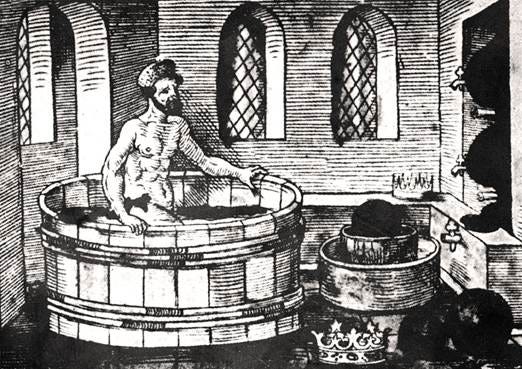
He was so overjoyed that, without waiting to don his clothing, he rushed homeward shouting, “Eureka! Eureka! (”I have found it! I have found it!’‘).
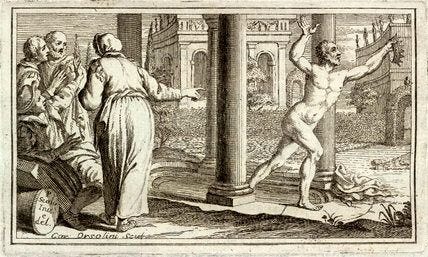
He had recognized the fact that the level of water in a vessel rises when a solid body is immersed in it, and that the liquid mounts in exact proportion to the volume or size of the solid introduced. The weight of the crown had been right ; the thieves were clever enough to see to that. But they had substituted for some of the gold cheaper and lighter metals ; and they had been obliged to use more of these, to get the proper weight. So the volume of the crown was too great, and when Archimedes plunged it into the water the liquid rose too high ; thus the cheat was proven.
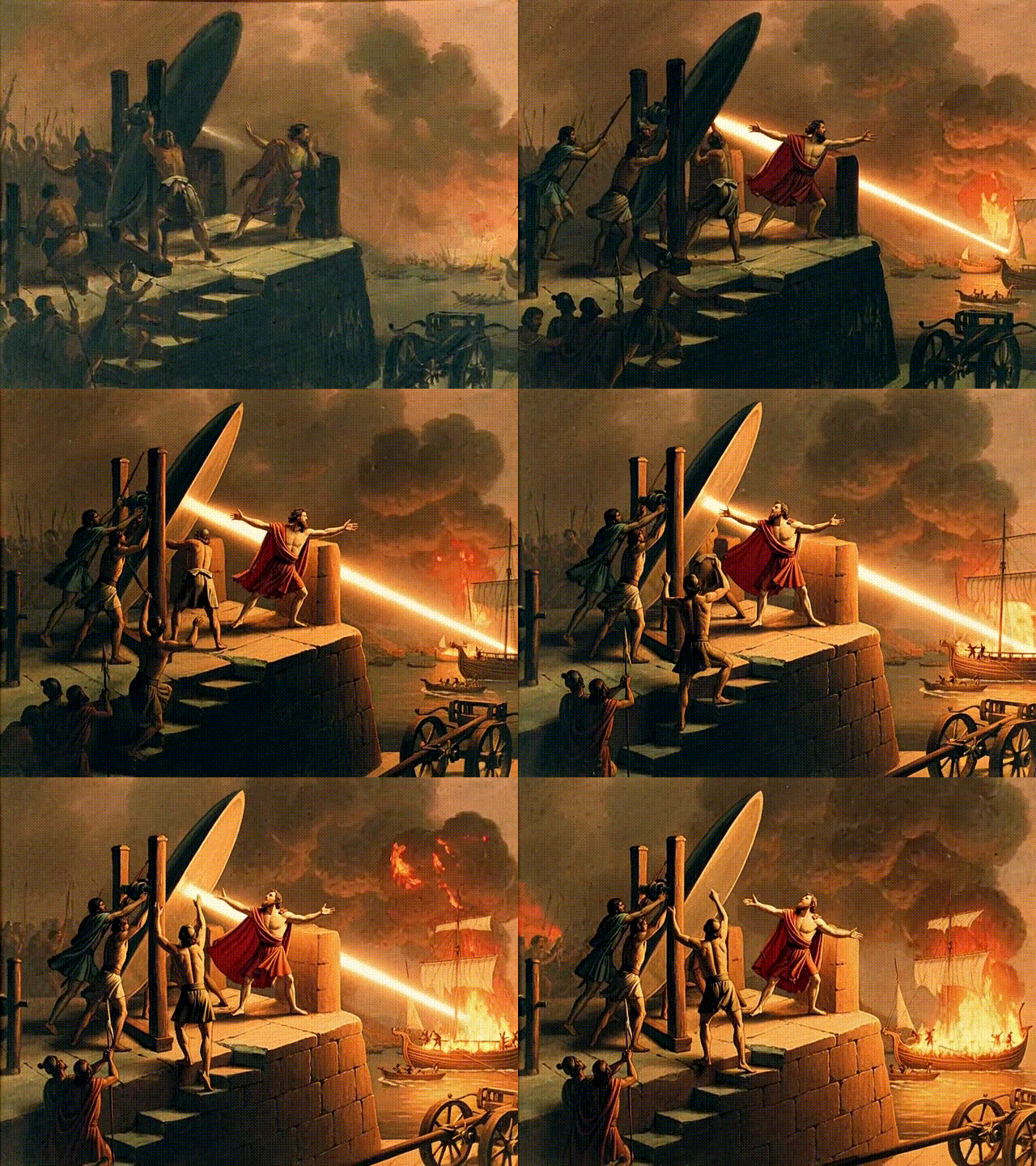
Among the many inventions credited to Archimedes are the endless screw and the water-screw, in the latter of which the water is made to ascend by its own gravity. During the siege of Syracuse, he exerted his wonderful ingenuity in its defence; but while Polybius, Livy, and Plutarch speak with amazement of the machines he employed, they fail to mention the common story that he set fire to the enemy’s ships by means of mirrors. When the city fell, tradition says Archimedes was sitting so deep in thought over a number of geometrical figures before him, that he knew nothing of the assault. The Roman general had given special orders to save the valuable life of the philosopher. A soldier, bursting in on him, demanded if he was Archimedes; but the sage only called out to the intruder to be careful not to destroy the figures he had drawn, and the warrior cut him down. In accordance with the wishes of Archimedes, a cylinder inclosing a sphere was engraved upon his tombstone, in commemoration of his discovery of the relation between these solids — the discovery being one upon which he placed great value.
Ellis, Edward Sylvester, (1840-1916); Horne, Charles F. (Charles Francis), (1870-1942); The Story of the Greatest Nations, 1900, pp. 336-337.
Who Was Marcellus?
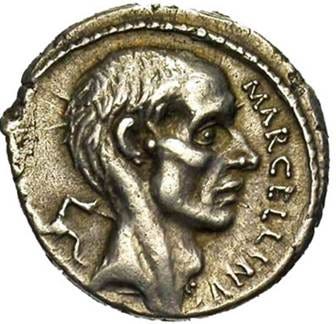
From Wikipedia (and note, there are several Marcelli in Roman history): Marcus Claudius Marcellus (~270 – 208 BC) was a Roman general and politician during the 3rd century BC. Five times elected as consul of the Roman Republic (222, 215, 214, 210, and 208 BC). Marcellus gained the most prestigious award a Roman general could earn, the spolia opima, for killing the Gallic King Viridomarus in single combat in 222 BC at the Battle of Clastidium. Furthermore, he is noted for having conquered the fortified city of Syracuse in a protracted siege during which Archimedes, the famous mathematician, scientist, and inventor, was killed, despite Marcellus ordering the soldiers under his command not to harm him. Marcus Claudius Marcellus died in battle in 208 BC, leaving behind a legacy of military conquests and a reinvigorated Roman legend of the spolia opima: the armor, arms, and other effects that an ancient Roman general stripped from the body of an opposing commander.
Plutarch’s Life of Marcellus
Plutarch’s Lives in eleven volumes. Vol.5: Agesilaus and Pompey. Pelopidas and Marcellus [Loeb 87] by Plutarchus / Plutarch (AD 46 - ~122); Perrin, Bernadotte (1847-1920), trans.
…
At this time Marcellus, first incensed by injures done him by Hippocrates, commander of the Syracusans, (who, to give proof of his good affection to the Carthaginians, and to acquire the tyranny to himself, had killed a number of Romans at Leontini,) besieged and took by force the city of Leontini; yet violated none of the townsmen; only deserters, as many as he took, he subjected to the punishment of the rods and axe. But Hippocrates, sending a report to Syracuse, that Marcellus had put all the adult population to the sword, and then coming upon the Syracusans, who had risen in tumult upon that false report, made himself master of the city. Upon this Marcellus moved with his whole army to Syracuse, and, encamping near the wall, sent ambassadors into the city to relate to the Syracusans the truth of what had been done in Leontini. When these could not prevail by treaty, the whole power being now in the hands of Hippocrates, he proceeded to attack the city both by land and by sea. The land forces were conducted by Appius Marcellus, with sixty galleys, each with five rows of oars, furnished with all sorts of arms and missiles, and a huge bridge of planks laid upon eight ships chained together, upon which was carried the engine to cast stones and darts, assaulted the walls, relying on the abundance and magnificence of his preparations, and on his own previous glory; all which, however, were, it would seem, but trifles for Archimedes and his machines.
These machines he had designed and contrived, not as matters of any importance, but as mere amusements in geometry; in compliance with King Hiero’s desire and request, some little time before, that he should reduce to practice some part of his admirable speculations in science, and by accommodating the theoretic truth to sensation and ordinary use, bring it more within the appreciation of people in general. Eudoxus and Archytas had been the first originators of this far-famed and highly prized art of mechanics, which they employed as an elegant illustration of geometrical truths, and as a means of sustaining experimentally, to the satisfaction of the senses, conclusions too intricate for proof by words and diagrams. As, for example, to solve the problem, so often required in constructing geometrical figures, given the two extreme, to find the two mean lines of a proportion, both these mathematicians had recourse to the aid of instruments, adapting to their purpose certain curves and sections of lines.
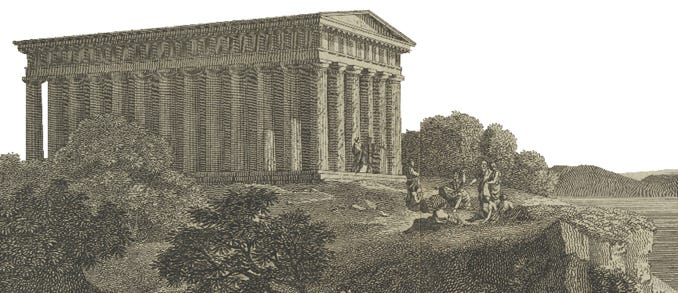
But what with Plato’s indignation at it, and his invectives against it as the mere corruption and annihilation of the one good of geometry, -- which was thus shamefully turning its back upon the unembodied objects of pure intelligence to recur to sensation, and to ask help (not to be obtained without base subservience and depravation) from matter; so it was that mechanics came to be separated from geometry, and, repudiated and neglected by philosophers, took its place as a military art.
Archimedes, however, in writing to King Hiero, whose friend and near relation he was, had stated, that given the force, any given weight might be moved, and even boasted, we are told, relying on the strength of demonstration, that if there were another earth, by going into it he could remove this.
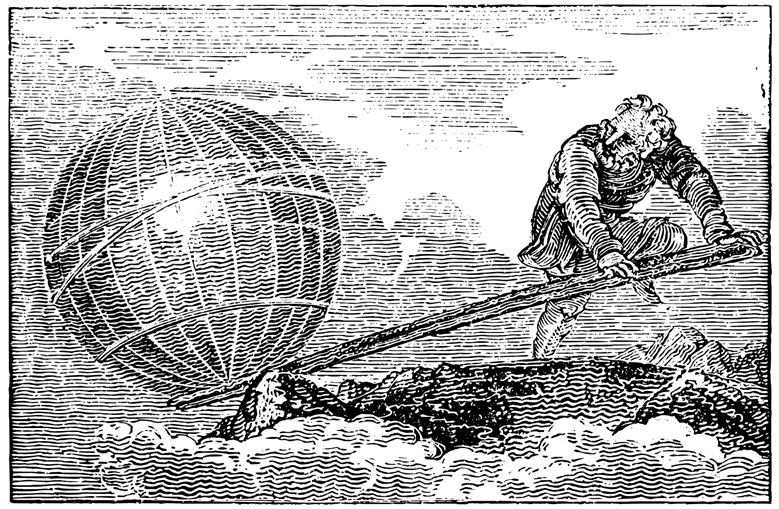
Hiero being struck with amazement at this, and entreating him to make good this problem by actual experiment, and show some great weight moved by a small engine, he fixed accordingly upon a ship of burden out of the king’s arsenal, which could not be drawn out of the dock without great labor and many men; and, loading her with many passengers and a full freight, sitting himself the while far off, with no great endeavor, but only holding the head of the pulley in his hand and drawing the cord by degrees, he drew the ship in a straight line, as smoothly and evenly, as if she had been in the sea. The king, astonished at this, and convinced of the power of the art, prevailed upon Archimedes to make him engines accommodated to all the purposes, offensive and defensive, of a siege. These the king himself never made use of, because he spent almost all his life in a profound quiet, and the highest affluence. But the apparatus was, in a most opportune time, ready at hand for the Syracusans, and with it also the engineer himself.
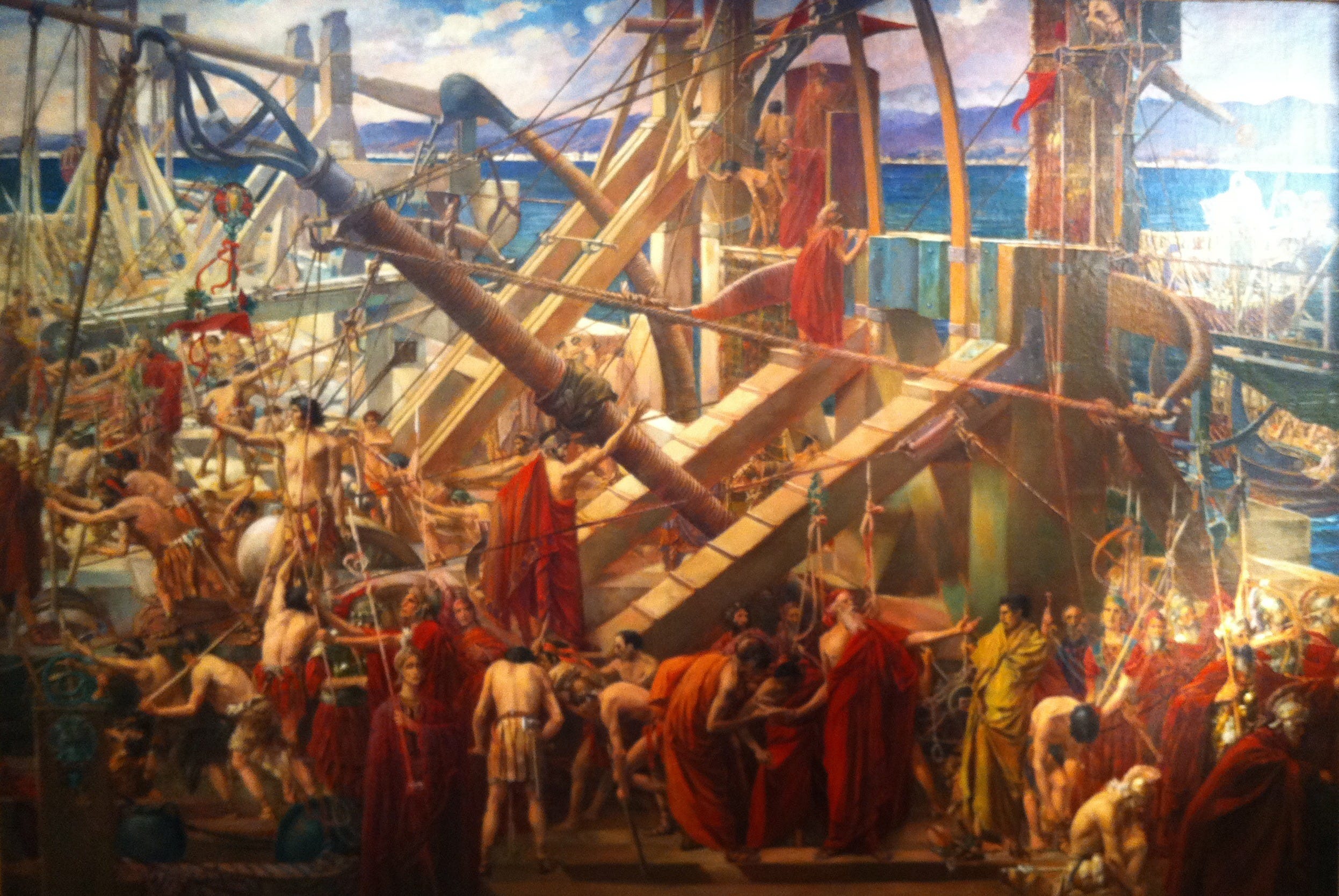
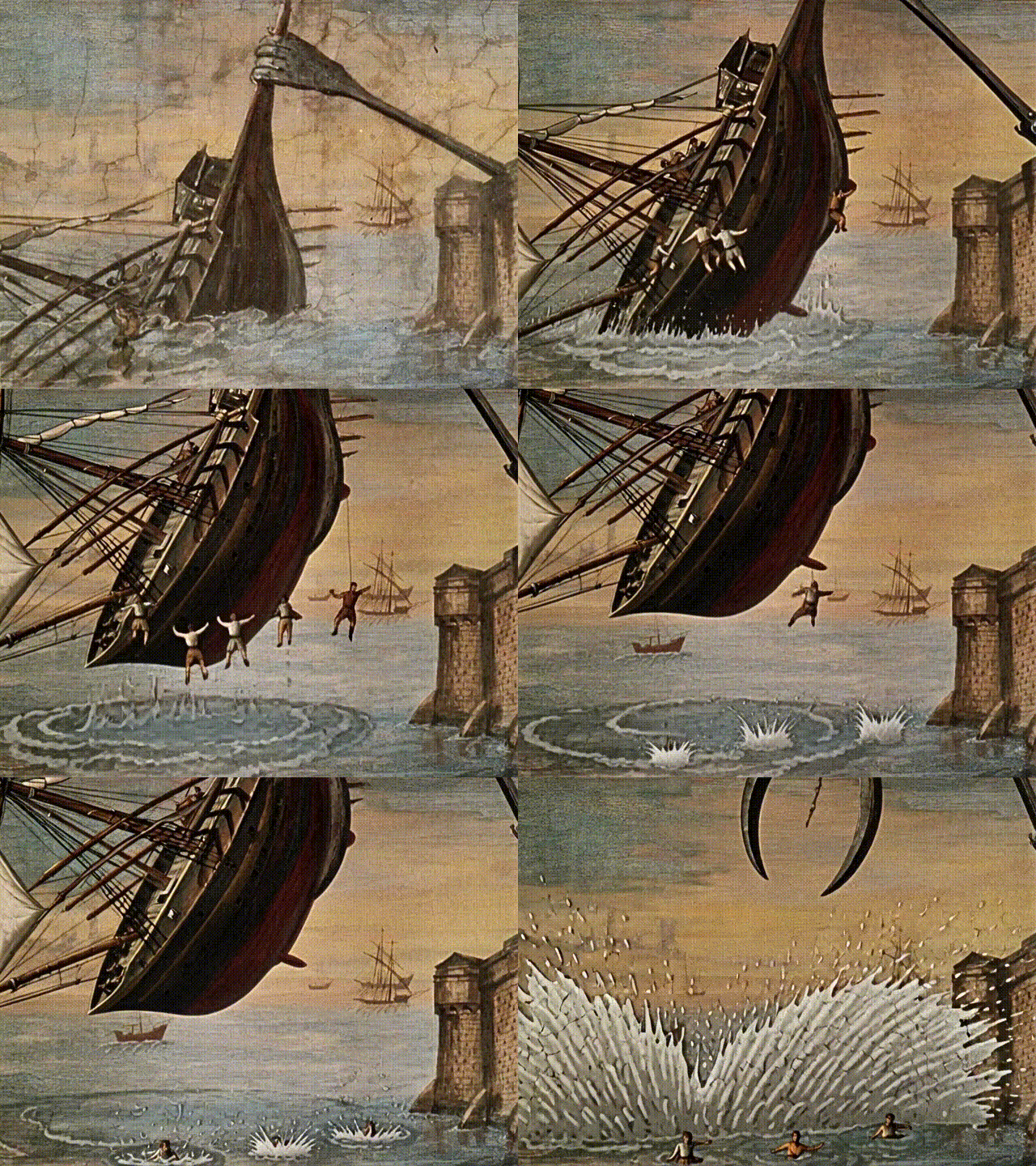
When, therefore, the Romans assaulted the walls in two places at once, fear and consternation stupefied the Syracusans, believing that nothing was able to resist that violence and those forces. But when Archimedes began to ply his engines, he at once shot against the land forces all sorts of missile weapons, and immense masses of stone that came down with incredible noise and violence, against which no man could stand; for they knocked down those upon whom they fell, in heaps, breaking all their ranks and files. In the meantime huge poles thrust out from the walls over the ships, sunk some by the great weights which they let down from on high upon them; others they lifted up into the air by an iron hand or beak like a crane’s beak, and, when they had drawn them up by the prow, and set them on end upon the poop, they plunged them to the bottom of the sea; or else the ships, drawn by engines within, and whirled about, were dashed against steep rocks that stood jutting out under the walls, with great destruction of the soldiers that were aboard them. A ship was frequently lifted up to a great height in the air (a dreadful thing to behold), and was rolled to and fro, and kept swinging, until the mariners were all thrown out, when at length it was dashed against the rocks, or let fall.
At the engine that Marcellus brought upon the bridge of ships, which was called Sambuca from some resemblance it had to an instrument of music, while it was as yet approaching the wall, there was discharged a piece of a rock of ten talents’ weight [about 700 pounds], then a second and a third, which, striking upon it with immense force and with a noise like thunder, broke all its foundation to pieces, shook out all its fastenings, and completely dislodged it from the bridge. So Marcellus, doubtful what counsel to pursue, drew off his ships to a safer distance, and sounded a retreat to his forces on land. They then took a resolution of coming up under the walls, if it were possible, in the night; thinking that as Archimedes used ropes stretched at length in playing his engines, the soldiers would now be under the shot, and the darts would, for want of sufficient distance to throw them, fly over their heads without effect. But he, it appeared, had long before framed for such occasion engines accommodated to any distance, and shorter weapons; and had made numerous small openings in the walls, through which, with engines of a shorter range, unexpected blows were inflicted on the assailants. Thus, when they who thought to deceive the defenders came close up to the walls, instantly a shower of darts and other missile weapons was again cast upon them. And when stones came tumbling down perpendicularly upon their heads, and, as it were, the whole wall shot out arrows at them, they retired. And now, again, as they were going off, arrows and darts of a longer range indicted a great slaughter among them, and their ships were driven one against another; while they themselves were not able to retaliate in any way. For Archimedes had provided and fixed most of his engines immediately under the wall; whence the Romans, seeing that infinite mischiefs overwhelmed them from no visible means, began to think they were fighting with the gods.
Yet Marcellus escaped unhurt, and, deriding his own artificers and engineers, “What,” said he, “must we give up fighting with this geometrical Briareus, who plays pitch and toss with our ships, and, with the multitude of darts which he showers at a single moment upon us, really outdoes the hundred-handed giants of mythology?” And, doubtless, the rest of the Syracusans were but the body of Archimedes’ designs, one soul moving and governing all; for, laying aside all other arms, with his alone they infested the Romans, and protected themselves. In fine, when such terror had seized upon the Romans, that, if they did but see a little rope or a piece of wood from the wall, instantly crying out, that there it was again, Archimedes was about to let fly some engine at them, they turned their backs and fled, Marcellus desisted from conflicts and assaults, putting all his hope in a long siege.
Yet Archimedes possessed so high a spirit, so profound a soul, and such treasures of scientific knowledge, that though these inventions had now obtained him the renown of more than human sagacity, he yet would not deign to leave behind him any commentary or writing on such subjects; but, repudiating as sordid and ignoble the whole trade of engineering, and every sort of art that lends itself to mere use and profit, he placed his whole affection and ambition in those purer speculations where there can be no reference to the vulgar needs of life; studies, the superiority of which to all others is unquestioned, and in which the only doubt can be, whether the beauty and grandeur of the subjects examined, or the precision and cogency of the methods and means of proof, most deserve our admiration.
It is not possible to find in all geometry more difficult and intricate questions, or more simple and lucid explanations. Some ascribe this to his natural genius; while others think that incredible effort and toil produced these, to all appearance, easy and unlabored results. No amount of investigation of yours would succeed in attaining the proof, and yet, once seen, you immediately believe you would have discovered it; by so smooth and so rapid a path he leads you to the conclusion required. And thus it ceases to be incredible that (as is commonly told of him), the charm of his familiar and domestic Siren made him forget his food and neglect his person, to that degree that when he was occasionally carried by absolute violence to bathe, or have his body anointed, he used to trace geometrical figures in the ashes of the fire, and diagrams in the oil on his body, being in a state of entire preoccupation, and, in the truest sense, divine possession with his love and delight in science. His discoveries were numerous and admirable; but he is said to have requested his friends and relations that when he was dead, they would place over his tomb a sphere containing a cylinder, inscribing it with the ratio which the containing solid bears to the contained.
Such was Archimedes, who now showed himself, and, so far as lay in him, the city also, invincible. While the siege continued, Marcellus took Megara, one of the earliest founded of the Greek cities in Sicily, and capturing also the camp of Hippocrates at Acilae, killed above eight thousand men, having attacked them whilst they were engaged in forming their fortifications. He overran a great part of Sicily; gained over many towns from the Carthaginians, and overcame all that dared to encounter him. As the siege went on, one Damippus, a Lacedaemonian, putting to sea in a ship from Syracuse, was taken. When the Syracusans much desired to redeem this man, and there were many meetings and treaties about the matter betwixt them and Marcellus, he had opportunity to notice a tower into which a body of men might be secretly introduced, as the wall near to it was not difficult to surmount, and it was itself carelessly guarded. Coming often thither, and entertaining conferences about the release of Damippus, he had pretty well calculated the height of the tower, and got ladders prepared.
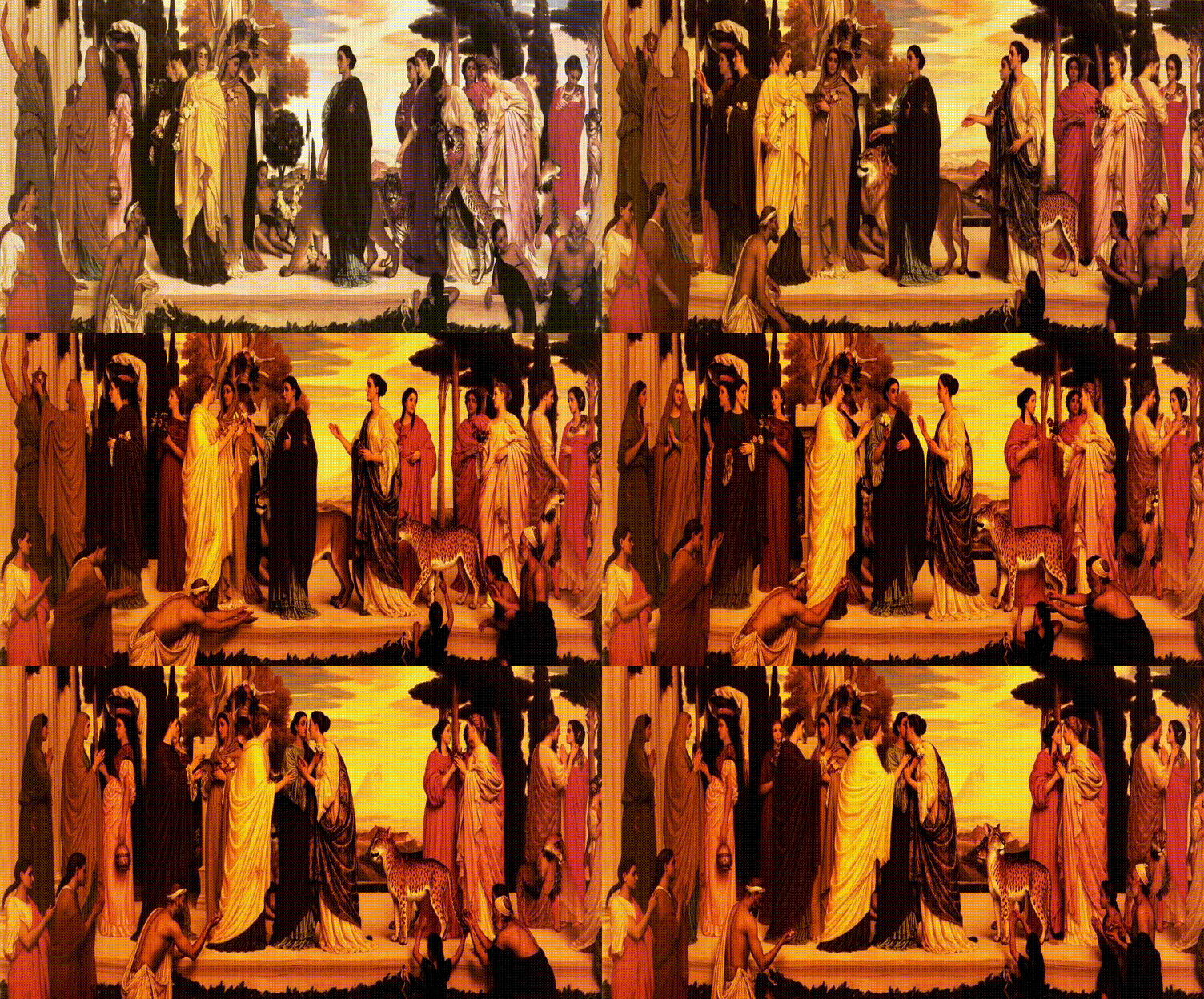
The Syracusans celebrated a feast to Diana; this juncture of time, when they were given up entirely to wine and sport, Marcellus laid hold of, and, before the citizens perceived it, not only possessed himself of the tower, but, before the break of day, filled the wall around with soldiers, and made his way into the Hexapylum. The Syracusans now beginning to stir, and to be alarmed at the tumult, he ordered the trumpets everywhere to sound, and thus frightened them all into flight, as if all parts of the city were already won, though the most fortified, and the fairest, and most ample quarter was still ungained.
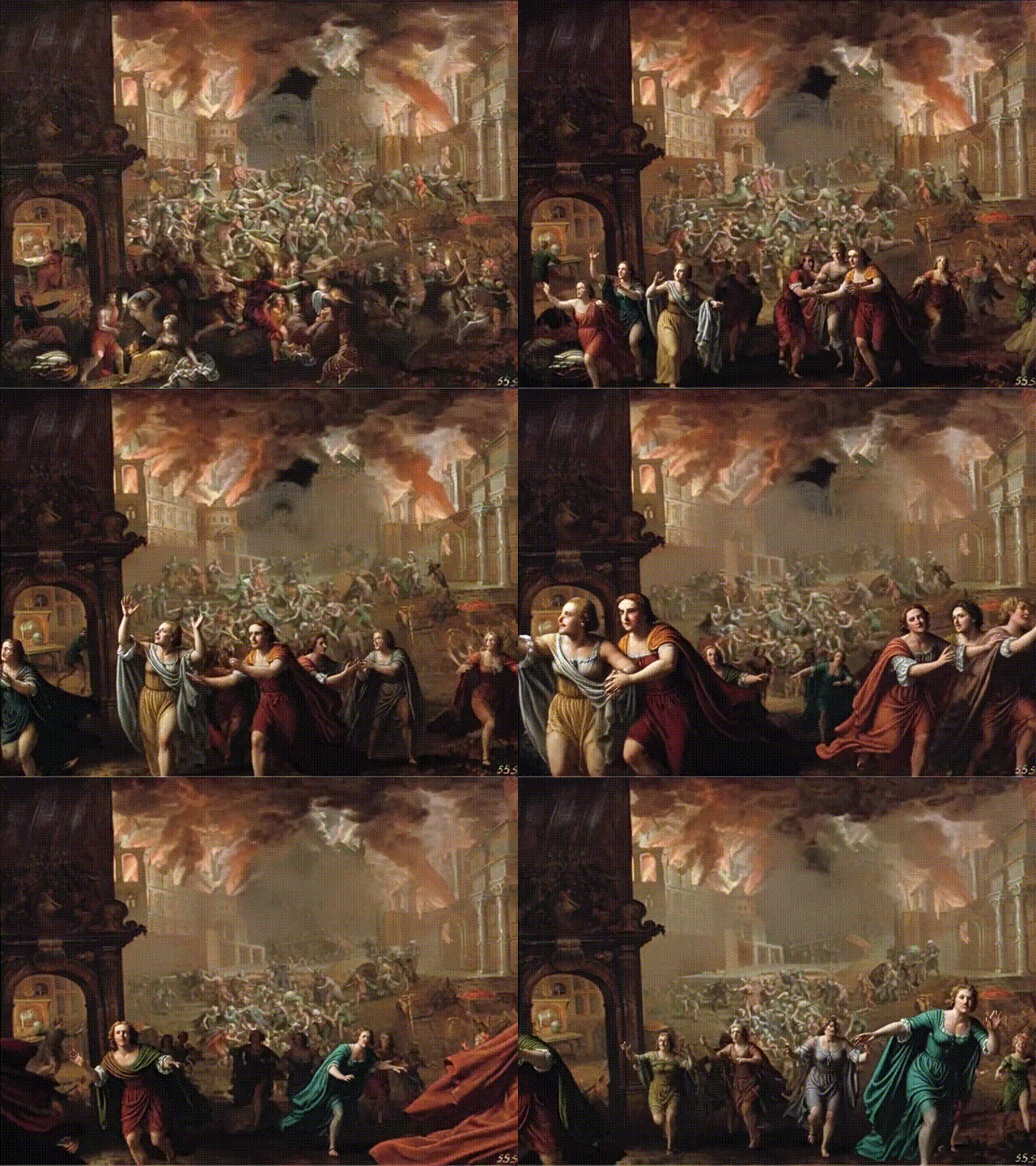
It is called Acradina, and was divided by a wall from the outer city, one part of which they call Neapolis, the other Tycha. Possessing himself of these, Marcellus, about break of day, entered through the Hexapylum, all his officers congratulating him. But looking down from the higher places upon the beautiful and spacious city below, he is said to have wept much, commiserating the calamity that hung over it, when his thoughts represented to him, how dismal and foul the face of the city would in a few hours be, when plundered and sacked by the soldiers. For among the officers of his army there was not one man that durst deny the plunder of the city to the soldiers’ demands; nay, many were instant that it should be set on fire and laid level to the ground: but this Marcellus would not listen to. Yet he granted, but with great unwillingness and reluctance, that the money and slaves should be made prey; giving orders, at the same time, that none should violate any free person, nor kill, misuse, or make a slave of any of the Syracusans. Though he had used this moderation, he still esteemed the condition of that city to be pitiable, and, even amidst the congratulations and joy, showed his strong feelings of sympathy and commiseration at seeing all the riches accumulated during a long felicity, now dissipated in an hour. For it is related, that no less prey and plunder was taken here, than afterward in Carthage.
For not long after, they obtained also the plunder of the other parts of the city, which were taken by treachery; leaving nothing untouched but the king’s money, which was brought into the public treasury. But nothing afflicted Marcellus so much as the death of Archimedes; who was then, as fate would have it, intent upon working out some problem by a diagram, and having fixed his mind alike and his eyes upon the subject of his speculation, he never noticed the incursion of the Romans, nor that the city was taken. In this transport of study and contemplation, a soldier, unexpectedly coming up to him, commanded him to follow to Marcellus; which he declining to do before he had worked out his problem to a demonstration, the soldier, enraged, drew his sword and ran him through.
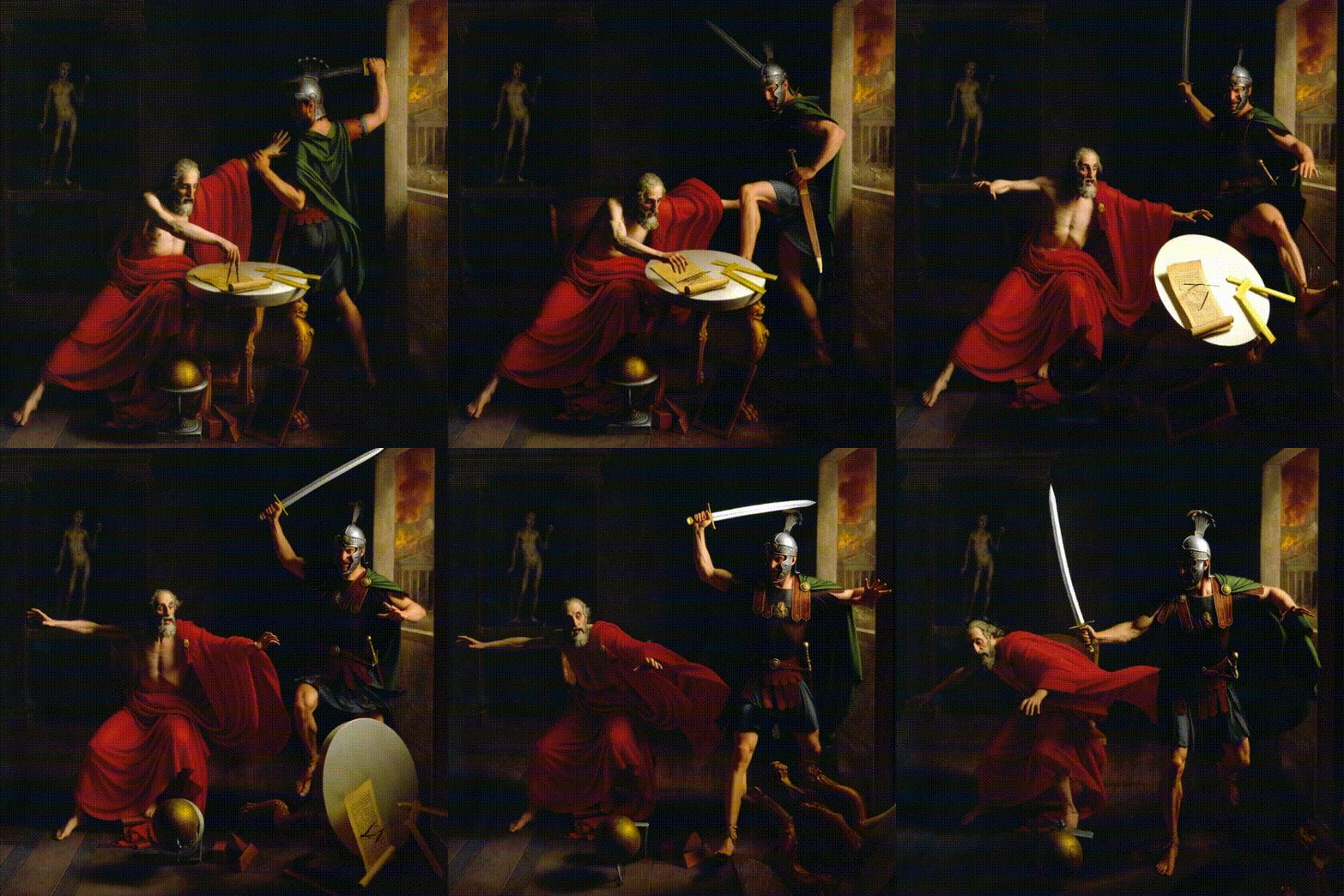
Others write, that a Roman soldier, running upon him with a drawn sword, offered to kill him; and that Archimedes, looking back, earnestly besought him to hold his hand a little while, that he might not leave what he was then at work upon inconclusive and imperfect; but the soldier, nothing moved by his entreaty, instantly killed him. Others again relate, that as Archimedes was carrying to Marcellus mathematical instruments, dials, spheres, and angles, by which the magnitude of the sun might be measured to the sight, some soldiers seeing him, and thinking that he carried gold in a vessel, slew him. Certain it is, that his death was very afflicting to Marcellus; and that Marcellus ever after regarded him that killed him as a murderer; and that he sought for his kindred and honored them with signal favors.
What’s the Lesson for Us?
Plato (~428–348 BC) condemned the application of geometry to practical mechanics as a corruption of pure intellectual inquiry. Philosophers of the period disdained engineering as servile and excluded it from serious theoretical study. Archimedes (~287–212 BC) was unmatched in mechanical ingenuity, yet Plutarch praises him for sharing Plato’s attitude and for refusing to write about his practical inventions. Plutarch’s report documents an early, influential separation between theory and practice, in which mathematical and philosophical understanding advanced in rigor but failed to generate a cumulative science of engineering. This hierarchy of knowledge shaped ancient and medieval science and delayed the mathematization of the physical world until the early modern period.
This excerpt warns us that when theory is prized for purity and elegance while practical engagement is disparaged, knowledge may advance yet remain sterile. Greek philosophy, mathematics, and science advanced, but the divorce of math from mechanics delayed the emergence of experimental, engineering-driven science.
The modern lesson is that theoretical physics risks a similar stagnation if it loses sustained feedback from experiment, instrumentation, and practical constraints, since it is precisely that interaction that turns abstract insight into cumulative scientific progress.
If you appreciate fine leather-bound books, as much as we do at The Society for Post-Quantum Research, you should check out Castalia Library. Their Plutarch’s Lives is sold out, but they have many other excellent offerings.


#/media/File:Eureka!_Archimede.jpg)


#/media/File:Archimedes_Directing_the_Defenses_of_Syracuse.jpg)


_by_Thomas_Degeorge.png)
That’s all for now. Remember always to keep calm, and make physics great again.
See you next year.
Hans
P.S. Pick up your copy of Fields & Energy Book I: Fundamentals and Origins of Electromagnetism, if you haven’t already:
You may sign up for my Fields & Energy Substack here:
Enjoyed the post, but maybe not quite enough to spring for a paid subscription?
Then click on the button below to buy me a coffee. Thanks!

Follow Online:
You may follow me online in other places as well:
Telegram: 𝔸𝕖𝕥𝕙𝕖𝕣𝕔𝕫𝕒𝕣’𝕤 𝔸𝕖𝕥𝕙𝕖𝕣𝕤𝕥𝕣𝕖𝕒𝕞
Gab: @aetherczar
Twitter: @aetherczar
Amazon: Hans G. Schantz