


Abstract: Modern physics has become increasingly dependent on mathematical sophistication at the expense of physical intuition and empirical understanding. Challenging Curt Jaimungal’s taxonomy of scientific dissent into the “cringe,” the “fringe,” and those who “impinge,” this essay argues that progress in fundamental physics requires revisiting neglected principles rather than pursuing ever-greater abstraction. As a case study, it examines Paul Dirac’s assertion that photons interfere only with themselves, showing how classical electromagnetic theory accounts for interference and energy conservation through the interplay of electric and magnetic fields. The resulting distinction between field propagation and energy transport reveals how electromagnetic interference can redistribute, slow, and redirect energy even as the constituent waves continue propagating at the speed of light. The essay identifies three contributors to persistent misunderstandings: questionable philosophical premises, the growing separation of theoretical physics from practical electromagnetism, and the obscuring effects of natural units. It concludes that a renewed emphasis on physical mechanisms and electromagnetic energy flow offers a promising route toward reconciling classical and quantum physics through a field-guided, pilot-wave-like interpretation. To advance beyond the stagnation of modern physics, physicists must first transcend the cringe.
If you want to impinge you must transcend the cringe. That’s my topic today.
One of my favorite physics Substackers, Curt Jaimungal, has done an excellent job calling out the many problems of modern physics. I think he’s gone astray, however, in his post from last month, “The Cringe vs. The Fringe vs. Those That Impinge.” Curt offers a taxonomy of scientific skepticism, that I argue merely reinforces what I’ll call “The Cringeworthiness of Modern Physics.”
If you are new to my Fields & Energy project, what you’ll discover in my essay may surprise you. Cringeworthy mistakes from otherwise brilliant and respected physicists. A demonstration that today’s physicists may be less grounded in empirical reality than those of eight decades past. And a preview of a novel interpretation of electromagnetism that bridges the divide between classical and quantum physics and points toward a pilot-wave like interpretation of quantum mechanics.
I argue that the solution to the stagnation we face in modern physics is not to achieve a more sophisticated level of mathematical abstraction, but instead to fix some rather cringeworthy misunderstandings in the foundations of fundamental science.
I’ll start by telling you a bit about Curt’s excellent work, and I’ll share a few of my favorite interviews he’s done. I’ll discuss the distinction he draws between the cringe, the fringe, and those who impinge. In full disclosure, my work and I fall comfortably into what Curt classifies as “cringe.” However as you’ll see, my expertise in this so-called “cringe” physics makes me uniquely well-qualified to call out the cringeworthiness of modern physics in general, and one of modern physics’ founding fathers, Paul Dirac, in particular. We’ll get to that in a moment.
My Favorite Curt Jaimungal Interviews
Interviews are Curt’s forté, and his YouTube channel offers a wealth of insightful conversations with brilliant thinkers. Here are four of my favorites, borrowing some of Curt’s own descriptions.
In this first episode, Curt speaks with Nobel laureate Gerard ’t Hooft, a theoretical physicist known for his work on the electroweak interaction and his radical ideas about quantum mechanics. To him, the universe is a cosmic pinball machine. Every ball follows a fixed path. No randomness. No mystery. We only invented quantum mechanics to cope with our ignorance. In his picture, there are no real numbers. No wave functions. No superposition. Just discrete states clicking forward, one after another, beneath everything we see.
In the second interview I share, Curt interviews Sir Roger Penrose, a renowned physicist and mathematician known for pioneering the theory of twistors and his contributions to differential geometry, which have significantly impacted our understanding of space-time. Roger’s work has been instrumental in advancing theories related to general relativity and quantum mechanics, including the Penrose-Hawking singularity theorems. Curt’s far-ranging discussion with him touches upon string theory, cosmology, quantum mechanics, and much more.
The first two interviews establish problems with the modern-day understanding of quantum physics. Where did physics go wrong? Opinions vary and Curt’s got us covered there, too.
The third interview is with Eric Weinstein, recorded a few days prior to Sean Carroll’s attack on Weinstein and his theories hosted by Piers Morgan. The ambush nature of the Piers Morgan interview prompted a great deal of discussion across the physicsverse, perhaps most notably from Sabine Hossenfelder who declared that “Physicists are afraid of Eric Weinstein, and they should be.”
Curt hosted the first technical conversation (with Eric Weinstein) in 40 years on Geometric Unity (GU). For the first time, Weinstein opened up fully in technical podcast form about dark matter, the missing generations, peer review, his GU theory — the theory he believes is the answer.
A few months earlier and in a different forum, Weinstein discussed the stagnation of physics, arguing that it was a deliberate act that began in 1973.
The problem is that the culmination of all human theory about the base reality stagnated abruptly and mysteriously in 1973. Imagine that physics stopped when “Crocodile Rock” was top of the charts. Everything we know about the physical universe at its deepest level is on this slide in front of you, and it hasn’t moved.
Now recently, many of you have seen that Marc Andreessen had a meeting at the White House, and at that meeting something fantastic was revealed. The Biden White House told him that they had stagnated deliberately fields of theoretical physics. Read that quote—it should send chills down your spine.
This graph shows the youngest living Nobel laureate in theory, in theoretical physics theory. That number is always below the age of 50 until this magical point where string theory enters the game as a theory of quantum gravity. And our youngest living Nobel laureate is now over the age of 70 because the field is not producing new results.
This is also terrible, but it turns wonderful, because if we can find the problem, we can make progress and reach the stars. Change “AI” to “physics,” “technology” to “science,” and “startups” to “alternative theories” in reading the following quote, and you will see what they did. They took a couple of theories, they cocooned them—string theory being preeminent among them—and they said all competitor theories will die. And in the field of physics, it’s called “the only game in town.” You try to do something else, your career comes to an abrupt end.
Now consider a different perspective. The final of Curt’s interviews I’ll call attention to is with Gregory Chaitin, a pioneering mathematician and computer scientist, renowned for founding algorithmic information theory. Gregory published his first groundbreaking paper at the age of 15 and has been a key figure at the Institute for Advanced Studies, contributing extensively to the fields of metabiology and complexity theory. Curt’s interview with him highlights the disturbing fact that there have been no fundamental conceptual innovations in physics since the 1920s.
There are many more where these came from on Curt’s Theories of Everything YouTube Channel.
My views align with Chaitin’s instead of Weinstein’s. Why have there been no fundamental conceptual innovations in physics since the 1920s?
I argue physics must first transcend the cringe before we can once again impinge.
A Taxonomy of Unorthodox Science
In his post, “The Cringe vs. The Fringe vs. Those That Impinge,” Curt defines his taxonomy of scientific skepticism by considering how would-be innovators answer the question, “what is a vector?”
The Cringe (or “crackpot”) would say “something with a magnitude and direction,” with position and “momentum” being an example.
The Fringe physicist may say “it’s an element of a vector space where a vector space is defined by satisfying the axioms of so‑and‑so,” and they’d still say position and momentum are examples.
Those That Impinge, however, will agree with the axiomatic definition of a vector space but note that position is a point in a manifold, and momentum is a covector defined via the fiber derivative (ie, Legendre map). If they’ve had enough wine, perhaps they’d say something fancy about the terminal object of Vect_k.
Historically, Curt’s premise that progress in physics always requires ever-greater layers of mathematical sophistication is hard to justify. Faraday (1791–1867), with little more than simple geometric sketches and hands-on experimentation, revolutionized physics with the field concept.
3.2 Michael Faraday

Normally, new Fields & Energy posts appear on Wednesday mornings. And yet, here we are, a day early, on Tuesday March 12, 2024. Why? Because today is the 192nd anniversary of what is arguably the single most important day in electromagnetic history. What happened on March 12, 1832? And why don’t more people know about it?
Yet, Faraday’s ideas were initially dismissed as “vague and varying” compared to the precise mathematical descriptions of action-at-a-distance approaches.
3.3 Potentials, Energy, & Fields

Potentials, energy, and fields: these concepts emerged from crowdfunded and self-published science. And despite Faraday’s success, many favored more mathematically elaborate approaches to electromagnetism. Read on!
Ohm (1789-1854) launched electrical engineering with his discovery that the ratio of voltage to current was constant, yet Ohm’s Law was dismissed as a “tissue of naked fantasies” by German devotees of Naturphilosophie convinced that physics required deep metaphysical models, not simple mathematical ratios.
3.4.1 Ohm's Law

“A Physicist Who Professed Such Heresies Was Unworthy to Teach Science.” How is it that Ohm’s Law, one of the most basic relationships in electromagnetism and the foundation of electrical theory could be regarded as a scientific heresy? Read on!
Einstein (1879–1955) built special relativity on the straightforward principles that the laws of physics are identical in all non-accelerating frames of reference, and that the speed of light (in a vacuum) is the same for all observers independent of the motion of the light source or observer.
5.2 Relativity

In this philosophic environment, an obscure German-born clerk working in the Swiss patent office had a clever idea. An enthusiastic reader of Poincaré’s 1902 treatise, Science and Hypothesis [[iii]], Albert Einstein (1879–1955) realized that the emerging discoveries in electrodynamics could be explained by two principles: first that the laws of physics …
In each case, the breakthroughs were conceptually simple, “cringe” by Curt’s standards, yet nevertheless profoundly transformative.
On the subject of general relativity, Hilbert declared, “Every boy in the streets of Göttingen understands more about four-dimensional geometry than Einstein. Yet, Einstein did the work and not the mathematicians.”
By contrast, recent decades have seen physics entangled in increasingly elaborate mathematical frameworks such as string theory, dazzling in formal sophistication but lacking empirical traction. The lesson is not that mathematics is unimportant. Indeed, it is indispensable for rigor and development. However physics advances most when guided by clear, physically-motivated ideas, with mathematics following as a language of expression and refinement rather than as the driver of discovery.
As statistician William Briggs quipped:
Love of theory is the root of all evil. Love of truth, on the other hand, is the root of all that is good… When and if a theory describes reality without error it is no longer a theory but truth. If a theory does not describe reality perfectly, then it is not true. To love a theory over truth is the mark of madness. Or of Enlightenment. Or, nowadays often, of tenure.
When physicists chase “impingeworthy” results but skip over awkwardly simple cringeworthy mistakes in the fundamentals, they lose their way, no matter how dazzling their mathematics or how great their genius. A telling example comes from Paul Dirac, one of the architects of quantum mechanics.
A Cringeworthy Mistake
Paul A.M. Dirac (1902-1984) made fundamental contributions to quantum mechanics and quantum electrodynamics. He was a respected arbiter on quantum theory and its meaning. Feynman quipped that physicists all read Schiff (a leading graduate textbook), but they all quote Dirac. In 1933, Dirac received the Nobel Prize in physics for his contributions to quantum physics, along with Werner Heisenberg and Erwin Schrödinger.
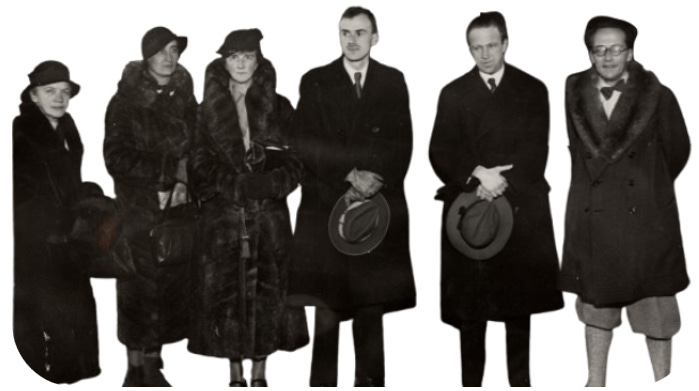
Let’s make Feynman proud of us and quote how Dirac explained interference on a quantum level:
“Suppose we have a beam of light consisting of a large number of photons split up into two components of equal intensity. On the assumption that the intensity of this beam is connected with the probable number of photons in it, we should have half the total number of photons going into each component. If the two components are now made to interfere, we should require a photon in one component to be able to interfere with one in the other. Sometimes these two photons would have to annihilate one another, and other times they would have to produce four photons. This would contradict the law of conservation of energy. The new theory, which connects the wave function with probabilities for one photon, gets over the difficulty by making each photon go partly into each of the two components. Each photon then interferes only with itself. Interference between two different photons never occurs.”
P.A.M. Dirac, The Principles of Quantum Mechanics, 4th ed. (revised), 1967, p. 9.
The energy of a field goes as the square of the field. Doubling the field intensity yields four times the energy. If the field intensity is zero, so also is the energy.
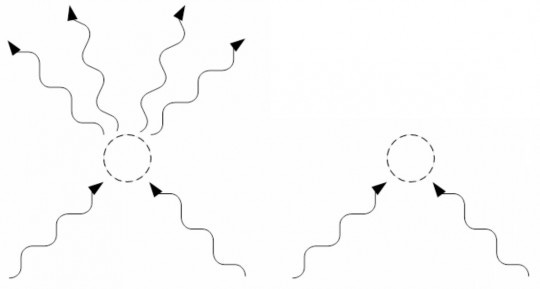
If two photons interfere constructively, their fields add together linearly to yield twice the field intensity. But that would mean four times the energy, or in other words, two photons interacting to yield four. If two photons interfere destructively, their fields cancel out, as do their energies. But that implies that two photons destructively interfere to yield none. Either result, depicted in the figure above, violates conservation of energy. Thus, in Dirac’s view, conservation of energy requires that photons can never interfere with each other, only with themselves. “No interaction takes place between different light quanta…” Heisenberg concurred in The Physical Principles of the Quantum Theory, 1930, p. 153.
How Those Pesky Cringeworthy Vectors Actually Work
From the Correspondence Principle, we know that the results of quantum mechanics must align with with the macroscopic, everyday observations we make of electromagnetic behavior: observations governed by classical electrodynamics. Let’s consider what classical electromagnetism has to say about energy conservation when electromagnetic waves interfere and see if there’s a lesson for quantum mechanics.
Consider two elemental waves under constructive interference. We may imagine these waves comprising unit electric (E) and magnetic (H) fields orthogonal to each other. The fields are transverse or orthogonal to the direction of travel given by the Poynting vector (S = E x H). The right-handed sense of E to H with respect to S is critical for understanding how waves interact with each other. Constructive interference is the co-parallel alignment of the electric field vectors. Assuming unit fields, this doubles the electric field intensity and yields four times the energy. We end up with more electric energy than that with which we started. But interference does not violate the law of conservation of energy. Interference merely converts one form of energy to another. Due to the right-handed sense of the fields described by the Poynting vector, when the E-fields align constructively in a head-on collision, the H-fields align destructively. Where we started with unit magnetic energy in each elemental wave, we now have no magnetic energy. The original magnetic energy has transformed entirely to electric energy. Conservation of total energy holds.
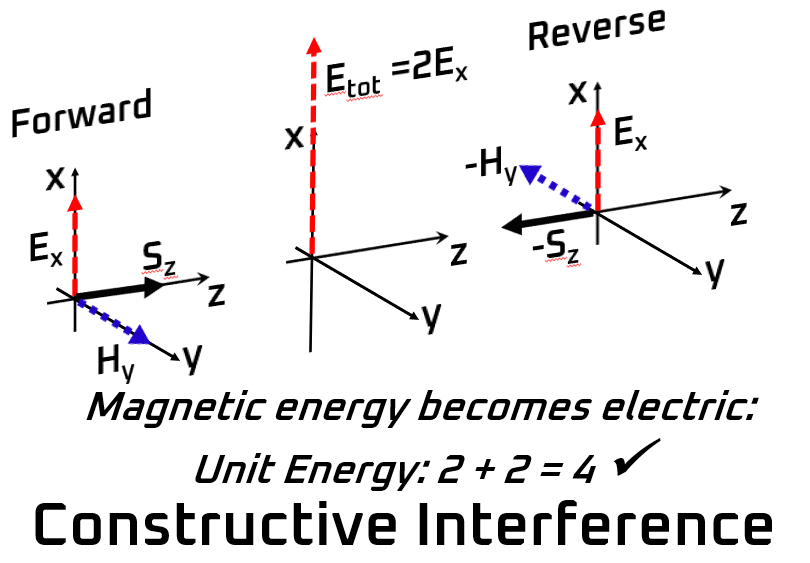
Destructive interference works similarly. In destructive interference, the electric fields cancel and the magnetic fields add constructively. The original balance of electric and magnetic energy present in the two propagating waves converts entirely to magnetic energy at the moment of destructive interference. Again, total energy is conserved.
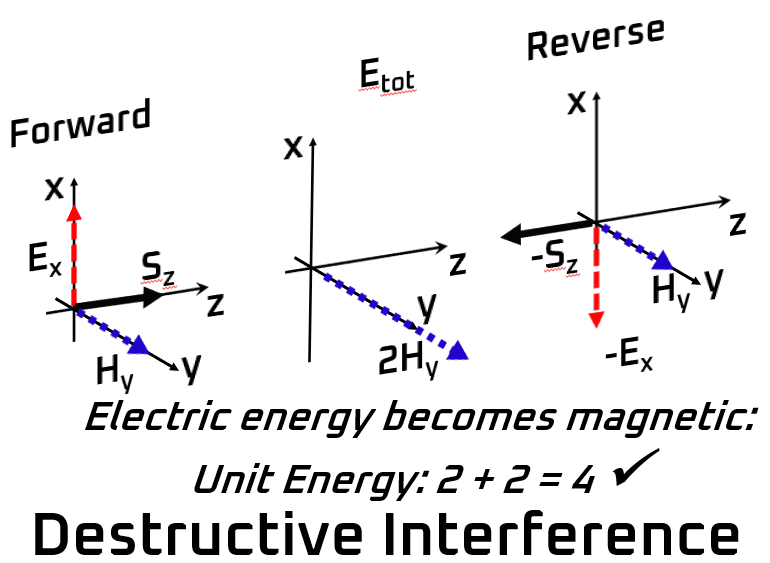
Princeton physics professor Kirk McDonald offers an excellent analysis (“Does Destructive Interference Destroy Energy?“).
And thus, the nature of Dirac’s big and cringeworthy mistake becomes obvious by reference to classical EM. Dirac implicitly assumed that photons were the quantized energy of a single field. Instead, they are the quantized energy of two closely coupled and related fields: electric and magnetic. This dual nature of electromagnetic fields means that electromagnetic waves can and do interact constructively or destructively without violation of the law of conservation of energy.
It turns out, I’m hardly the first to express skepticism with Dirac’s claim. The Skulls in the Stars blog has a great description of quantum optics experiments that disprove Dirac’s argument (H/T to Travis Norsen for bringing this to my attention). That blog post describes an experiment by Magyar and Mandel in which interference fringes from two independent lasers were observed.
Why Did Physicists Make This Cringeworthy Mistake?
Why did Dirac and Heisenberg both make such a cringeworthy mistake, and why have their modern-day successors failed to correct it? I see it as a confluence of three factors: bad philosophical premises, the theory-practice divide, and widespread adoption of “natural” units.
Bad Philosophical Premises
First, the error goes back to their fundamental premises. Einstein introduced Machian Positivism into physics with his insistence on explaining the electrodynamics of moving bodies based from the perspective of what an observer sees: that the speed of light is constant and that the laws of physics are the same in all inertial reference frames.
Einstein began to back away from the observer-centric, Positivistic worldview of Special Relativity after his work on General Relativity. The curvature of space ascribes properties to free space very much like an aether, and Einstein himself endorsed that perspective in a 1920 lecture.
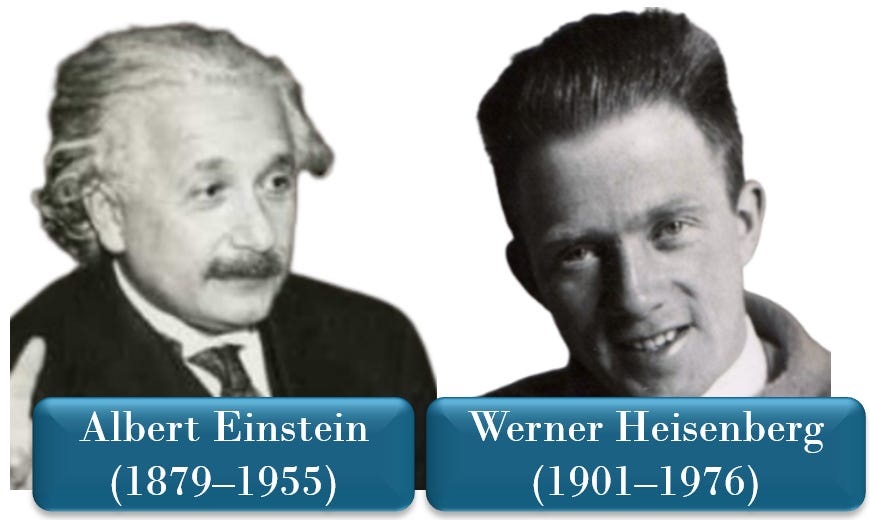
In his memoir, Physics and Beyond, Heisenberg described what happened in 1925, when he delivered his first lecture on quantum mechanics in Berlin. Einstein invited Heisenberg back to his apartment for further discussion. Heisenberg reports they had this conversation. Einstein began:
“What you have told us sounds extremely strange. You assume the existence of electrons inside the atom, and you are probably quite right to do so. But you refuse to consider their orbits, even though we can observe electron tracks in a cloud chamber. I should very much like to hear more about your reasons for making such strange assumptions.”
“We cannot observe electron orbits inside the atom,” I [Heisenberg] must have replied, “but the radiation discharges enables us to deduce the frequencies and corresponding amplitudes of its electrons. After all, even in the older physics wave numbers and amplitudes could be considered substitutes for electron orbits. Now, since a good theory must be based on directly observable magnitudes, I thought it more fitting to restrict myself to these, treating them, as it were, as representatives of the electron orbits.”
“But you don’t seriously believe,” Einstein protested; “that none but observable magnitudes must go into a physical theory?”
“Isn’t that precisely what you have done with relativity?” I asked in some surprise. “After all, you did stress the fact that it is impermissible to speak of absolute time, simply because absolute time cannot be observed; that only clock readings, be it in the moving reference system or in the system at rest, are relevant to the determination of time.”
“Possibly I did use this kind of reasoning,” Einstein admitted, “but it is nonsense all the same [emphasis added]. Perhaps I could put it more diplomatically by saying that it may be heuristically useful. to keep in mind what one has actually observed. But on principle, it is quite wrong to try founding a theory on observable magnitudes alone.”
Their entire discussion is well worth a read, because it lies at the heart of the fundamental problems of quantum theory. Ultimately, it was Einstein who pointed the way toward a possible resolution to quantum paradoxes in his so-called “EPR” paper, but physics left him behind and chose instead to follow the observer-centric Copenhagen Interpretation of quantum mechanics championed by Heisenberg and Niels Bohr.
“Niels Bohr brainwashed a generation of physicists…” was the assessment of Nobel Laureate particle physicist Murray Gell-Mann.
We’re still living with the consequences.
Physicists with the observer-centric mindset fixate on the starting point and the ending point of processes to the exclusion of what might be happening in between. I argue instead for “Interstitial Realism.” The middle matters if you want to understand how a physical process works. Worse, physicists take middle properties for granted and assume they are universally applicable. They assume implicitly that there exists a balance of electric and magnetic energy and that fields and energy move together at the speed of light (c). Those properties only hold true for isolated waves in free space, and they fall apart when two or more waves interfere with each other. In fact the electric and magnetic energies are NOT balanced during interference or during acts of emission or absorption. The fields may move at c, but the energy velocity is generally slower v: 0 ≤ v ≤ c.
In the conventional wisdom, physicists ignore the middle to focus on the beginning and the end of an electromagnetic process, and they falsely ascribe the properties of the middle to the beginning and the end. That’s one reason why they’ve overlooked some very simple and fundamental processes that should have been considered over a hundred years ago.
The Theory-Practice Divide
Another factor is the increasing divide between theory and practice. In 1941, the standard textbook used by Manhattan Project physicists and M.I.T. Radiation Lab electrical engineers alike was Stratton’s 1941 Electromagnetic Theory. Stratton included a host of practical applied electrical engineering topics.
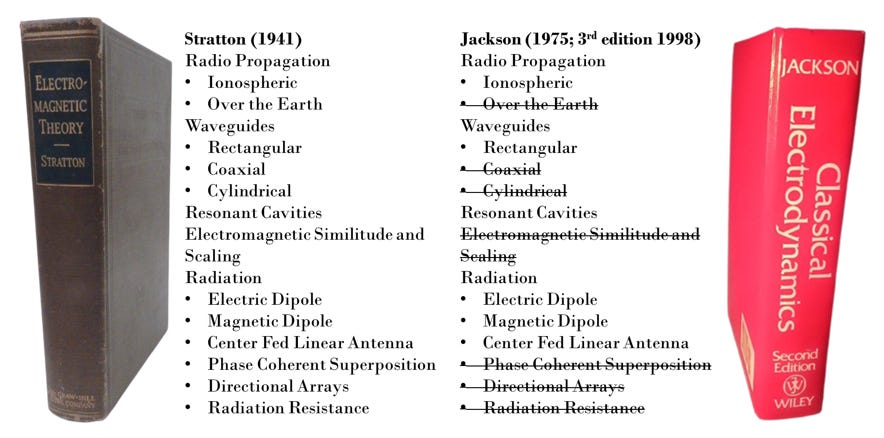
Fast forward fifty years to when I was studying electromagnetism in my physics doctoral program. My textbook was Jackson’s Classical Electrodynamics. Compare the topic coverage, and you will find that Jackson offers an atrophied or dumbed-down version of the practical applications discussed by Stratton. The third edition of Jackson is still being used to educate young physicists in electrodynamics today.
My jaw dropped when I first realized the implications. Today’s physicists — by and large — have a poorer understanding of practical electromagnetism than their predecessors of eighty years ago. And it’s even worse than that, because in the last eighty years electrical engineers have made enormous progress, developing link laws for wireless transmission and reception, understanding and applying impedance, and mastering the physics of electrically small antennas, just to name a few significant accomplishments.
Today’s physicists are simply out of touch with the experiential base that is necessary to understand electromagnetism. For them, electromagnetism is a sterile set of mathematical equations disconnected from physical reality.
Natural Units
A final factor in the cringeworthiness of modern physics is its propensity for using “natural units.” Curt argues that the fringe “…tend to dislike natural units and see that as concealing the ‘true’ physics.” If I may be granted the liberty of promoting myself from cringe on up to fringe, I’ll explain.

So-called “natural units” are systems of measurement in physics where fundamental physical constants are set equal to 1. Instead of carrying constants like the speed of light (c), Planck’s constant (ℏ), or the gravitational constant (G) around in every formula, they are absorbed into the choice of units. This simplifies equations and reduces the dimensional bookkeeping.
But using natural units comes at a cost.
A parity bit is an extra binary digit added to a data string to verify that the total number of 1’s is either even or odd (depending on the chosen convention). If the received data fail to meet this rule, an error is detected.
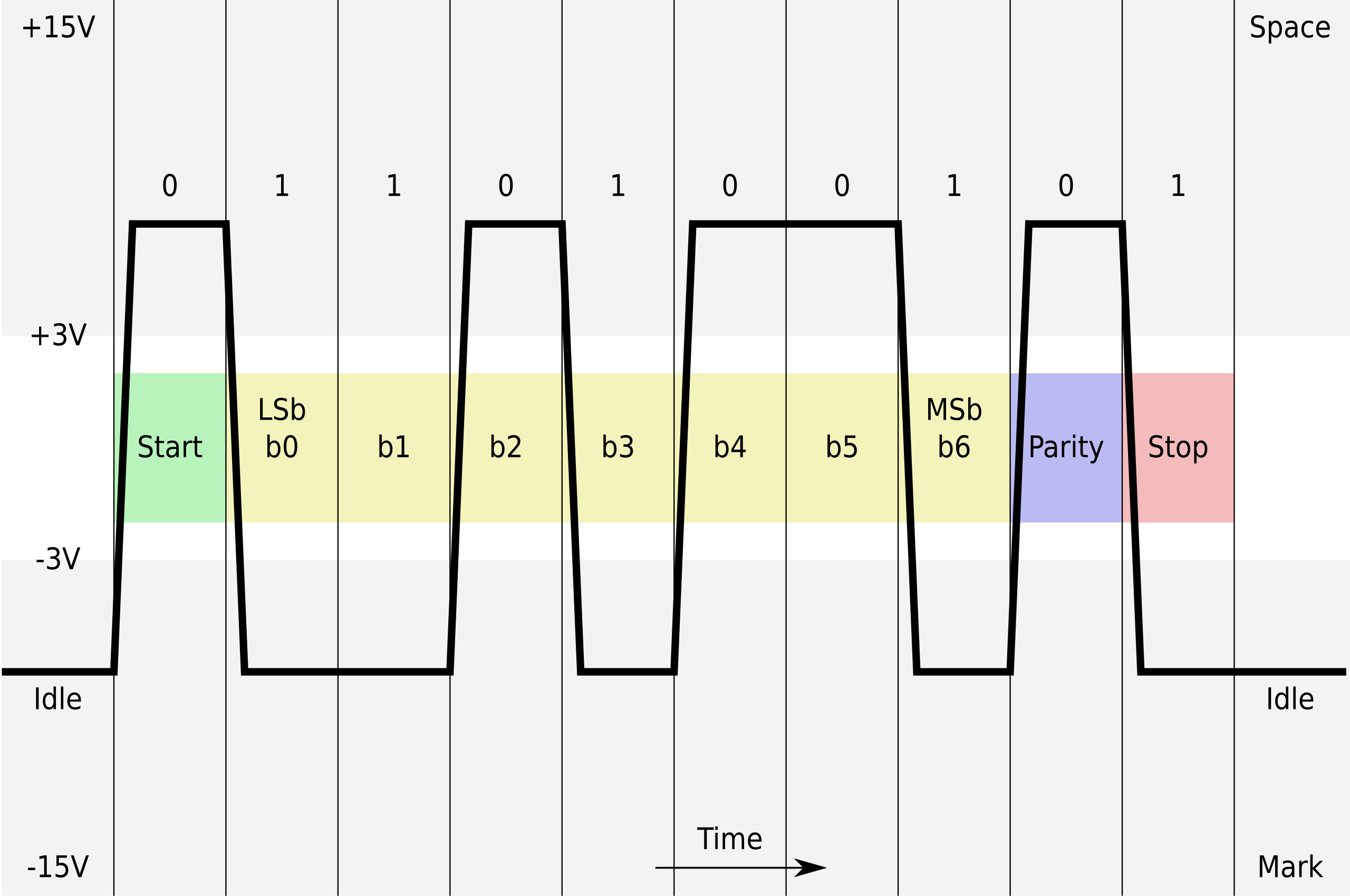
In physics, dimensional analysis performs a similar role by ensuring that equations balance in their fundamental dimensions like mass, length, time, and charge, so that a mismatch immediately reveals an algebraic or conceptual mistake. When using natural units, however, constants such as c and ℏ are set equal to one, collapsing distinctions between units like time and length or energy and frequency. While this simplifies equations, it also removes the dimensional “checksum” that allows such consistency checks, much as omitting the parity bit would make silent errors harder to detect in a data stream.
Further, the units have to be reinserted in your formulas anyway, if you hope to calculate any numerical result and compare it to an experimental value.
But there’s a more significant problem with natural units. When you set c = 1, you eliminate the distinction between E & H. It becomes easier to forget that there are two fields instead of just one.
I speculate this mindset may be part of why Dirac and others got electromagnetic interference so cringeworthily wrong.
What’s more, using natural units, the impedance or ratio of electric to magnetic field intensity is set to one. As we shall see, this obscures how interference works, because impedance actually tends toward infinity in a constructive interference and toward zero in a destructive interference.
How Fields Guide Energy
But these transformations of energy between electric and magnetic forms that Dirac and others misunderstood have additional fascinating implications for the flow or motion of energy. The unperturbed flow of energy relies upon a balance of electric and magnetic energy. This is a fundamental principle of electromagnetic wave propagation first discovered and applied by Oliver Heaviside in his “Telegrapher’s Equation.” Electromagnetic waves convey equal amounts of electric and magnetic energy at the speed of light. As that balance is disrupted by the process of interference, the energy slows down. In the limit where either the electric or magnetic fields go to zero, the Poynting vector and the energy flow go to zero. The energy becomes momentarily static.
And yet, the waves continue propagating through each other at the speed of light. How then can the energy associated with the waves come to a stop and catch up? The answer is that the waves exchange energy with each other. The energy in two interfering waves slows down, comes to a rest, and then changes direction.
Consider the destructive interference of two doublet waveforms as shown in the figure below. The figure below (right) shows a 1-D transmission line, but equivalently, these could be plane electromagnetic waves in free space. At time t = 0, the two waves destructively cancel at location z = 0. Physicists look at interactions like these in what are called “space-time diagrams.” The vertical axis denotes time t and the horizontal axis denotes distance z. We can plot the energy density of the two interacting waves using a color scale and plot the energy flow streamlines from the Poynting vector.
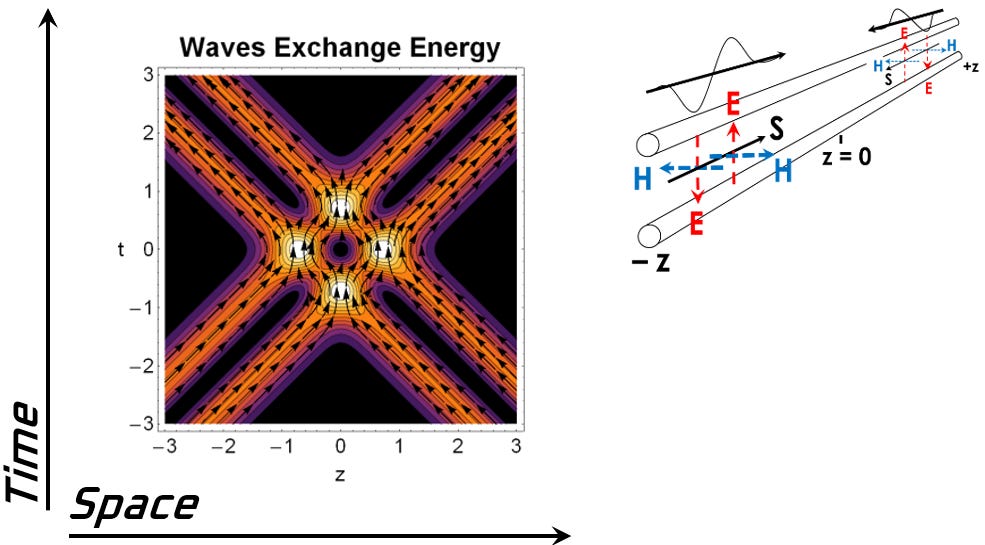
In the negative time portion or bottom of the space-time energy flow diagram (above, left), the two mirror-image doublet waves approach each other. At about t = -1, the leading edges interfere constructively yielding an electrostatic concentration of energy where the impedance (|E|/|H|) becomes infinite. At t = 0, the two waves superimpose destructively, yielding a pair of magnetostatic nodes of energy. The impedance (|E|/|H|) goes to zero. Then as the waves continue moving past each other, their trailing edges superimpose destructively at about time t = +1, yielding an electrostatic concentration of energy. Again impedance becomes infinite. At each of these two electrostatic and two magnetostatic nodes, the energy comes momentarily to a rest before changing direction. The impedance swings wildly from interaction to interaction, an effect that is obscured by natural units in which impedance is arbitrarily set to unity.
In 2001, Thilo Wünscher, Holger Hauptmann, and Friedrich Herrmann summarized the rules for electromagnetic energy flow asking, “which way does the light go?” [Wünscher, Hauptmann, and Herrmann, “Which way does the light go?” American Journal of Physics, Vol. 70, no. 4, April 2002].
A few of their qualitative conclusions are evident in the example of the interfering doublet waveforms.
Pure EM waves have a balance of electric and magnetic energy. A pure EM wave moving in isolation in free space exhibits a balance of electromagnetic energy – half electric energy and half magnetic energy. Wave interference upsets this balance and slows down energy flow. In the limit of constructive or destructive interference, the energy becomes purely electric or purely magnetic, respectively, and energy becomes momentarily stationary.
Waves exchange energy. Although waves interpenetrate and pass through each other without any apparent effect, the energy they contain slows down and reflects. At any given moment, there is an energy density associated with each field, electric and magnetic, but from moment to moment it is not necessarily the same energy as waves interact, interfere, and exchange energy.
Energy retains the same spatial order. In the 1-D case, note how the energy retains the same spatial order. For instance, the trailing edge energy of the reverse wave becomes the leading edge energy of the forward wave. The wave motion propagates through and guides different units of energy in the same way the wave motion in a Newton’s cradle transfers between different balls.

EM energy streams never cross. Another fundamental rule of EM energy flow is that the streams never cross. Where it appears as though the streams cross, what really happens is waves interfere with each other, energy stops, bounces or deflects, and changes direction. This has been dubbed Spengler’s Law (yes, I’m guilty of getting that name past the peer reviewers of a recent conference paper). I used electromagnetic simulation tools to calculate the energy flow in a wide variety of real-world interference examples, I shared the results in a conference paper a couple of years ago, and I recently reposted them to my Substack:
Energy Flow for Reflecting & Interacting Beams

How fields exchange energy and why a fundamental principle is don’t cross the beams!
In classical electromagnetic theory, fields guide the flow of energy in a manner reminiscent of how pilot waves guide particles in the Bohm-de Broglie Interpretation of quantum mechanics.
Fields behave like waves. They generate interference patterns between the two slits, throughout the region, ‘non-locally’, even when there is only enough energy for one photon to be moving through the slits. Energy behaves like particles, following a particular trajectory under the influence of the interacting waves. Each does its own thing. The quantum weirdness and confusion are gone. There is an interpretation of quantum mechanics that adopts a qualitatively similar perspective: the pilot wave theory of Louis de Broglie (1892–1987) and David Bohm (1917–1992). As de Broglie observed, ‘[a] photon coming from one laser or the other and arriving in the interference zone is guided – and this seems to us to be physically certain – by the superposition of the waves emitted by the two lasers…’ The results of this paper make clear that pilot wave theory is the natural and logical consequence of the need for quantum mechanics [to] correspond to the macroscopic results of the classical electromagnetic theory. Schantz, Hans G., “Energy velocity and reactive fields,” Philosophical Transactions of The Royal Society A Mathematical Physical and Engineering Sciences 376(2134):20170453 DOI: 10.1098/rsta.2017.0453
That’s the story I share in my Fields & Energy project: how the overlooked properties of classical electromagnetic energy flow lead inexorably to a fundamental physical model reminiscent of pilot-wave theory.
Summary
Curt has spoken with many brilliant physicists, absorbed their perspectives and prejudices, and distilled it down to his “cringe,” “fringe,” and “impinge” hierarchy. Never forget, however, that today’s thought leaders are the inheritors of those who drove physics into its present-day stagnation. Their ideas rest upon premises they may have taken for granted, premises that desperately need a thorough re-examination.
Physics does not advance by climbing a mathematical ladder of increasing abstraction from “cringe” to “fringe” and ultimately to “impinge.” The wise don’t climb Curt’s ladder. They realize that if we haven’t made progress in many decades, perhaps the ladder is leaning against the wrong wall. Physics will only advance when physicists ground the ladder on the bedrock of evidence and build a better wall to climb.
The solution to today’s problems is to step back and take a closer look at long accepted premises. If we want to impinge, we should first tackle and address the underlying cringe.
Here’s Curt’s piece again, if you’d like to consider his perspective. You can sign up to receive updates from him, there.

I recently delivered a lecture to the Rising Tide Foundation on “Fixing Physics with Fields [& Energy].” I copied the transcript and edited in images of the slides. This is a top-level overview of much of the material that will be in my three-volume Fields & Energy book (with the usual caveat about verbal quirks, transcription errors, and the like).
I’m going to begin by talking about... a little bit of history and background on the origins of electromagnetic science. I’ll talk about some of the different models we have for how electricity and magnetism work. I’ll discuss what went wrong in science going into the modern physics era. And I’ll talk finally about how fields and energy have the potential to fix some of the problems with our understanding of physics.
You can also watch the video, if you prefer.
Fixing Physics with Fields [& Energy]

The Riding Tide Foundation was kind enough to host me on Sunday October 5 for a lecture, Fixing Physics with Fields [& Energy]. You can watch the video over on their Substack.
And you may sign up for my Fields & Energy Substack here:
Enjoyed the post, but maybe not quite enough to spring for a paid subscription?
Then click on the button below to buy me a coffee. Thanks!

Note: a chunk of the material in this post originally appeared on my blog over ten years ago.
Follow Online:
You may follow me online in other places as well:
Telegram: 𝔸𝕖𝕥𝕙𝕖𝕣𝕔𝕫𝕒𝕣’𝕤 𝔸𝕖𝕥𝕙𝕖𝕣𝕤𝕥𝕣𝕖𝕒𝕞
Gab: @aetherczar
Twitter: @aetherczar
Amazon: Hans G. Schantz
The problem goes back to Maxwell who in the late 1800's incorrectly predicted that EM fields propagate at constant speed c. This is because he did not include the source terms that come from Gauss's law and Ampere's law in his wave equation, which are particularly important in the near field of the source, and also contribute to the far field. Modern analysis of the resulting in homogeneous wave equation, both mathematically and numerically, shows that the speed of light is not constant at all. It shows that it is dependent on the distance from the source, particularly in the near field, it shows that the speed of light is instantaneous in the near field, and reduces to only approximately speed c in the far field starting about one wavelength from the source, and never becomes exactly speed c, ever. Because Einstein assumed Maxwell's incorrect constant speed c solution in his second postulate of relativity, both his theories of special relativity and general relativity are wrong. Because QED is based on relativity, it is wrong as well. These results have been experimentally verified by many researchers arriving at the exact same results and conclusions. If the second postulate of relativity is wrong, then what remains is the first postulate: Galilean relativity where time and space are absolute, and causal action faster than speed c is possible without violating causality.
The following thought experiment will clarify these results. Assume you have a fast moving object, which is being observed with instantaneous near field light, then no relativistic effects will be observed. This can be seen by inserting c equal infinity into the Lorentz transformation, yielding the Galilean transformation where time and space are absolute. But if the frequency of the light source is changed such that farfield approximate speed c light is used, then relativistic effects will be observed. Because time and space for the moving object is real, it cannot depend on the frequency of the light source being used to observe it. So one must conclude that the effects of relativity such as time dilation and length contraction are not real, and are just a type of optical illusion created by how light propagates in the far field. What we see in the near field is real and follow the according to the law of Galilean relativity. What we see in the far field is not real and is subject to relativistic illusions such as time dilation and length contraction.
Many physicists try to argue that signals and energy do not propagate in the near field, and hence experimental evidence of these instantaneous fields in the near field is not proof against relativity. This is wrong because according to relativity all physical phenomena are embedded in space-time, and must abide by the rules of relativity. If any experiment whether near field or farfield shows a violation of relativity, relativity is wrong. The following thought experiment will clarify this even further and make it crystal clear. Assume you have a long box with a button on the front and a light at the other end of the box. If when the button is pressed, the light turns on faster than speed c, relativity is this proved. It does not matter what is in the box, how it works, why it works, or how physicists think it works. All that matters is that it works.
The effect is also predicted by quantum theory and can be shown to be due to the Heisenberg uncertainty principle. When a photon is emitted by a source, It's position is well known, consequently according to the Heisenberg uncertainty principle, the momentum and the velocity are instantaneous. After the photon propagates about one wavelength from the source, it's wavelength starts to become apparent such that the relation frequency X wavelength ~c. But according to Fourier theory, which is based on the Heisenberg uncertainly principle, infinite cycles of the wave are required for the wavelength to be exactly known. So the relation frequency X wavelength = c is only valid at infinite distance from the source, which is not possible in a finite size universe, so the speed of light never becomes exactly speed c, ever. The importance of this argument is that it is valid for all fields, including: gravity, EM, and quantum. It explains superluminal phenomena observed in quantum tunneling, and in quantum entanglement. It also explains the stability of the planets due to instantaneous near field gravity.
General activity and quantum mechanics are completely incompatible and scientists have been trying for over a hundred years without success. This research shows that the problem is relativity. But due to the dogma associated with relativity, scientists are not willing to even consider it. I am living proof that the scientific community not only prevents research against relativity from being published, but it also does not allow it to be discussed. In the 35 years that I've been researching this topic as a professional PhD physicist, I have literally had thousands of discussions with researchers, students, and the public, and no one has ever disproved this research. I have submitted my papers to physics journals, and they either do not reply, or they reply that they do not publish papers against relativity. Even physics archives like arXiv will not publish papers against relativity. And I have been banished from many physics discussion groups for presenting my research.
This is no longer science and has become a religion with its gods, priests, and devout followers that question nothing. Physics has now become more the belief in magic than science, which now believes that time and space are flexible, that time travel is possible, that past present and future all exist at the same time, that particles are not real unless observed, that multiple universes exist and come into existence with each quantum event, and the gravity is not a force. This nonsense has to stop. Science will not progress until it realizes relativity and all theories based on it are wrong.
For more information see: New interpretation of relativity by William Walker, and specifically see the papers in the description of the video.
"Natural units" would have meant being told to depart chemical engineering for something less rigorous. Dimensional analysis was taught first, middle, and end, to understand mass and energy balance or flows. The named numbers allowed easy graphical relation or examination of heat transfer, turbulence - is the trend correct and shaped right? Digital (everything) give precise-looking values but not the analog view of "plate 5 in the distillation column isn't working well. Check it."