

II 1.5.3 Case Study: Carthage
Carthage Must Be Destroyed. Do You Know Why?

Note: I accidentally published the first draft of this post back in January. Here is the updated and finalized version.
History is an archive of irreproducible and uncontrolled experiments performed within a perpetual replication crisis. Historians must ever guard against the “post hoc ergo propter hoc” (after this, therefore because of this) fallacy in their analysis. Social, political, and historical dynamics are complex, and many factors are at play, up to and including the whims of the principal actors and decision makers. According to Polybius (~200–~118 BC) for instance, the temporary successes of the Thebes city-state cannot be attributed to its constitution, but rather to the excellence of its leaders, as attested by the reversal of Thebes’ fortunes under the same constitution but later leaders [[i]].
Let’s consider the experience of Carthage through the lens of Polybius and Innis. Polybius reports the Carthaginian constitution was “originally well contrived” with a balance of power similar to that of the Roman Republic [[ii]]. From where did the Carthaginians arise? What factors contributed to their downfall?
The Carthaginian’s Phoenician forefathers were the original space-based colonizers. Their efficient script was developed in a context where papyrus from their Egyptian trading partners was readily available and the Phoenicians’ skill at writing enabled the growth of trading oligarchies [[iii]]. Phoenician colonies spanned the Mediterranean and beyond. They founded Carthage in 814 BC and Gades (present day Cadiz) on the Atlantic coast of Spain as early as the eight century BC [[iv], [v]].
An anecdote makes clear the Phoenicians’ maritime prowess. Herodotus records an intriguing event during the reign of Pharaoh Necho II (609–593 BC) of Egypt. Curious about the Southern Ocean, the Pharaoh commissioned a Phoenician fleet to sail south from Egypt along the eastern coast of Libya (Africa). Each autumn, the sailors went ashore, grew and harvested a crop of grain and continued their voyage. Three years later, the fleet entered the Mediterranean via the Pillars of Hercules (the Straits of Gibraltar) and returned home, having completed the circumnavigation of Africa. Herodotus doubted the story because the sailors reported the sun to their north, a detail that modern readers will recognize as consistent with southern-hemisphere navigation [[vi]].
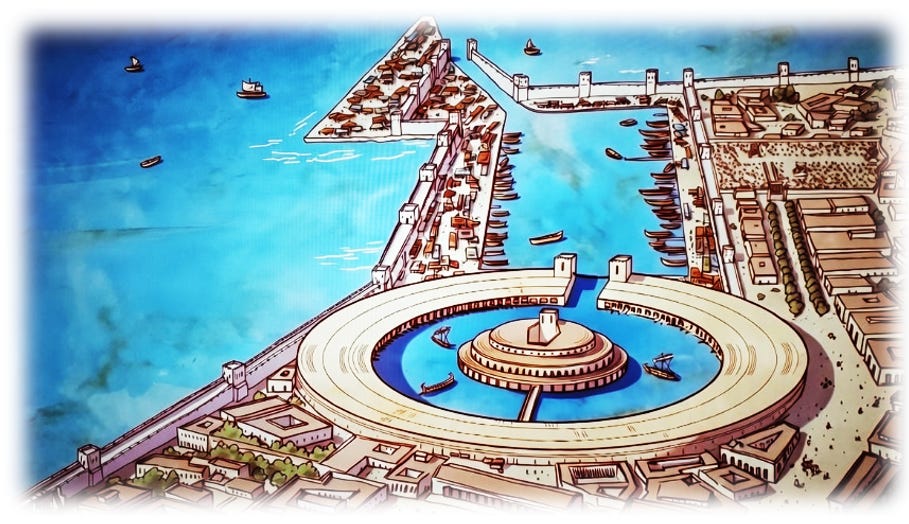
In 574 BC when Tyre fell to Nebuchadnezzar (~642–562 BC) and the Babylonians, Carthage, controlling the broad strait between the eastern and western halves of the Mediterranean, emerged as the dominant Phoenician power [[viii]].
From their great harbor at Carthage, the Carthaginians maintained a stranglehold on maritime trade. It was a rare exception when the Greek sailor and geographer, Pytheas (~350–304 BC) of Massalia (modern-day Marseilles) sailed north to the British Isles and beyond (possibly by taking an overland route to the Atlantic coast of Gaul, modern-day France) and engaging a ship from there. He returned to report such findings as the Arctic sea ice and the midnight sun of the northern latitudes in a work that has not survived, but was quoted by other authors [[ix]].
Canadian-American political philosopher Isabel Paterson (1886–1961) observed in her classic 1943 work, The God of the Machine:
Nations are not powerful because they possess wide lands, safe ports, large navies, huge armies, fortifications, stores, money, and credit. They acquire those advantages because they are powerful, having devised on correct principles the political structure which allows the flow of energy to take its proper course [[x]].
Strong moral standards and a high-trust environment reduce social friction and transactional costs, enabling the most productive application of social energy. By the time of their final war with Rome (the Third Punic War, 149–146 BC), Carthage, having reached their pinnacle of success and power earlier, had begun a moral decline. Polybius points out:
At Carthage nothing which results in profit is regarded as disgraceful; at Rome nothing is considered more so than to accept bribes and seek gain from improper channels. For no less strong than their approval of money-making is their condemnation of unscrupulous gain from forbidden sources. A proof of this is that at Carthage candidates for office practise open bribery, whereas at Rome death is the penalty for it [[xii]].
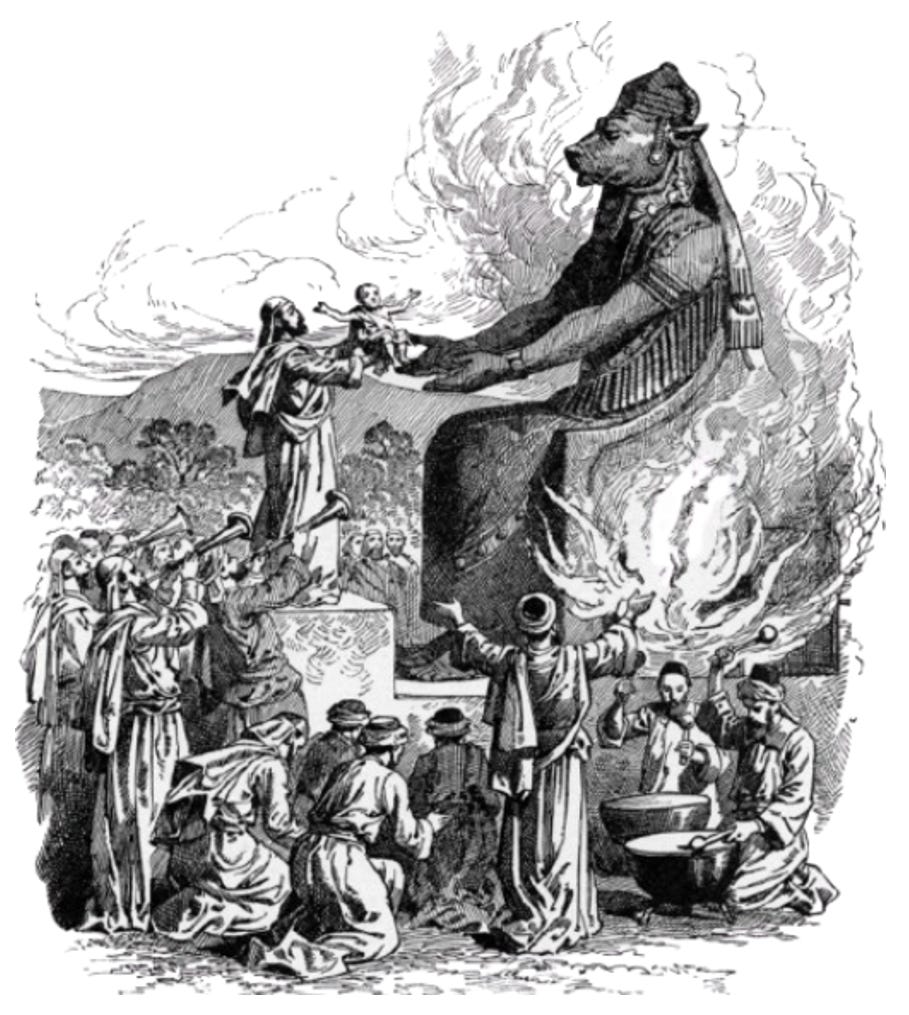
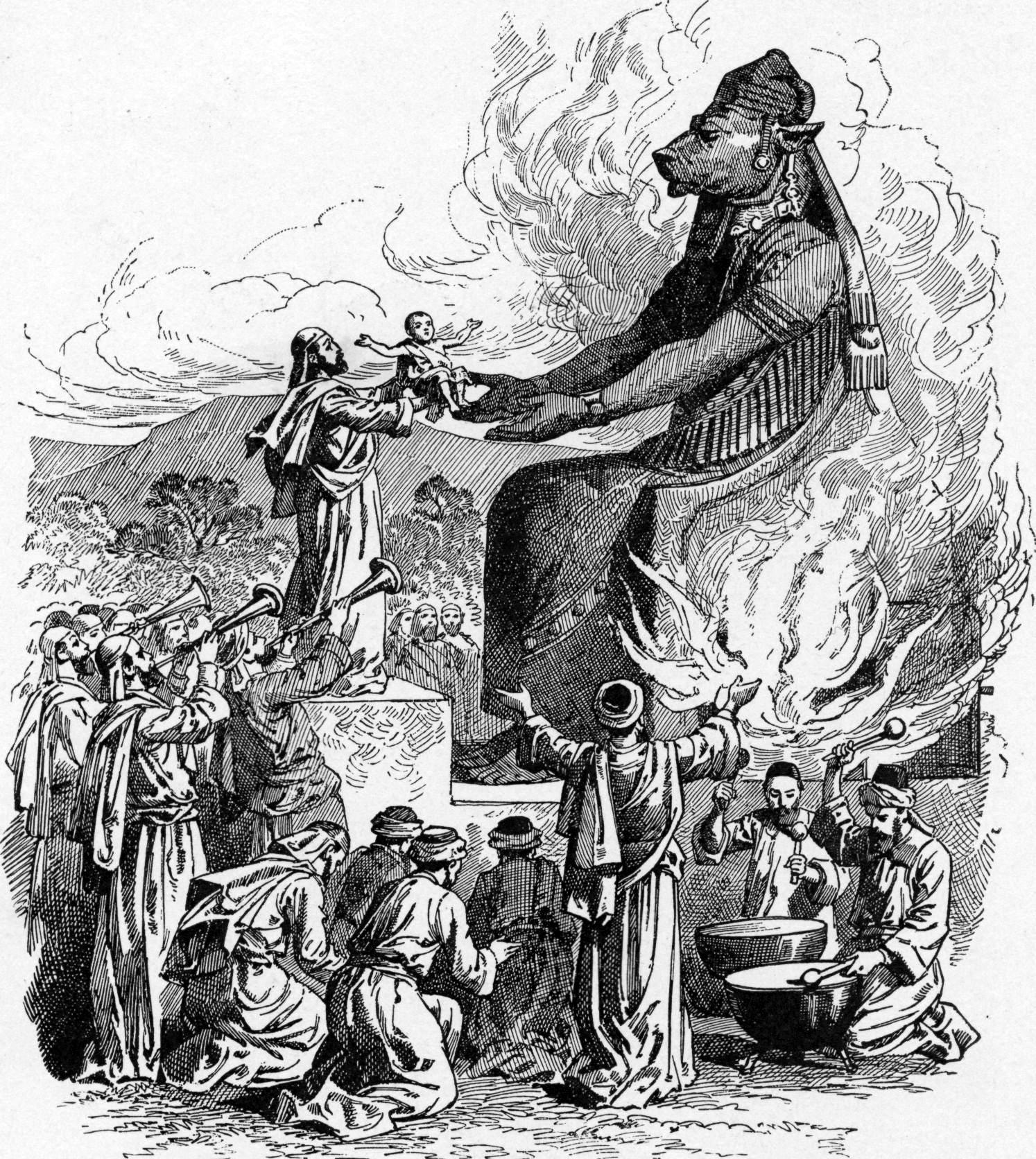
Carthaginian corruption went far beyond mere avarice. Archeologists have found the cremated remains of thousands of infants at Carthage, probably sacrificed in religious rituals [[xiii]]. Thousands of votive stellae exist there [[xiv]]. Inscriptions include explicit references to child sacrifice with the names of offerors, for instance, vowing to the pagan deities Tinnit and Ba’al “this child of his own flesh” [[xv]].
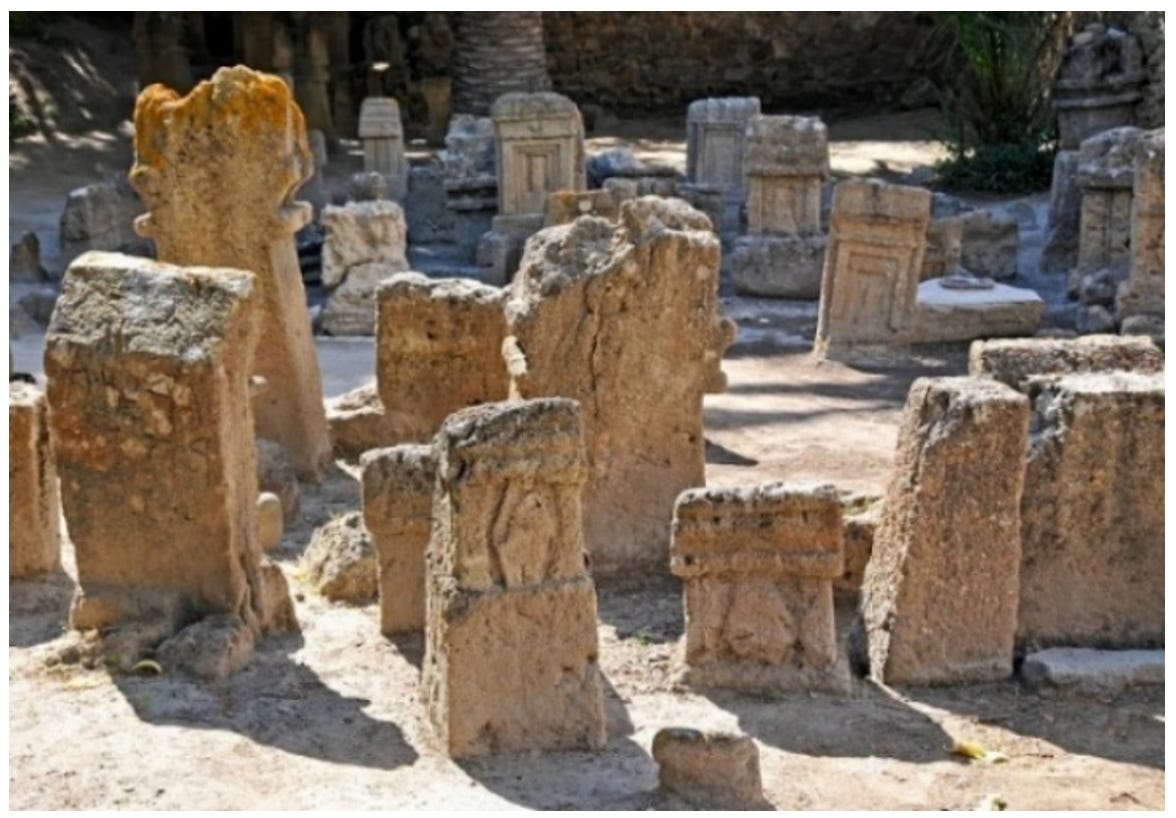
Plutarch (AD 46–119) describes the Carthaginian’s human sacrifices to “Cronos” (Roman equivalent for Moloch or Ba’al):
…they themselves offered up their own children, and those who had no children would buy little ones from poor people and cut their throats as if they were so many lambs or young birds; meanwhile the mother stood by without a tear or moan; but should she utter a single moan or let fall a single tear, she had to forfeit the money, and her child was sacrificed nevertheless; and the whole area before the statue was filled with a loud noise of flutes and drums that the cries of wailing should not reach the ears of the people… [[xvii]]
Looking past the obvious immorality of such practices, ritual child sacrifice is no substitute for deep and meaningful cultural traditions that can bind a society through time. Carthage left no enduring philosophical or scientific legacy other than an object lesson not to follow in the Carthaginians’ footsteps.
Carthage stands as a paradigmatic space-biased civilization: commercially brilliant, administratively efficient, and structurally fragile. Carthaginian power rested on ships, naval mastery, maritime trade, colonial networks, contracts, and rapid coordination across distance, forms of organization optimized for spatial control rather than temporal continuity.
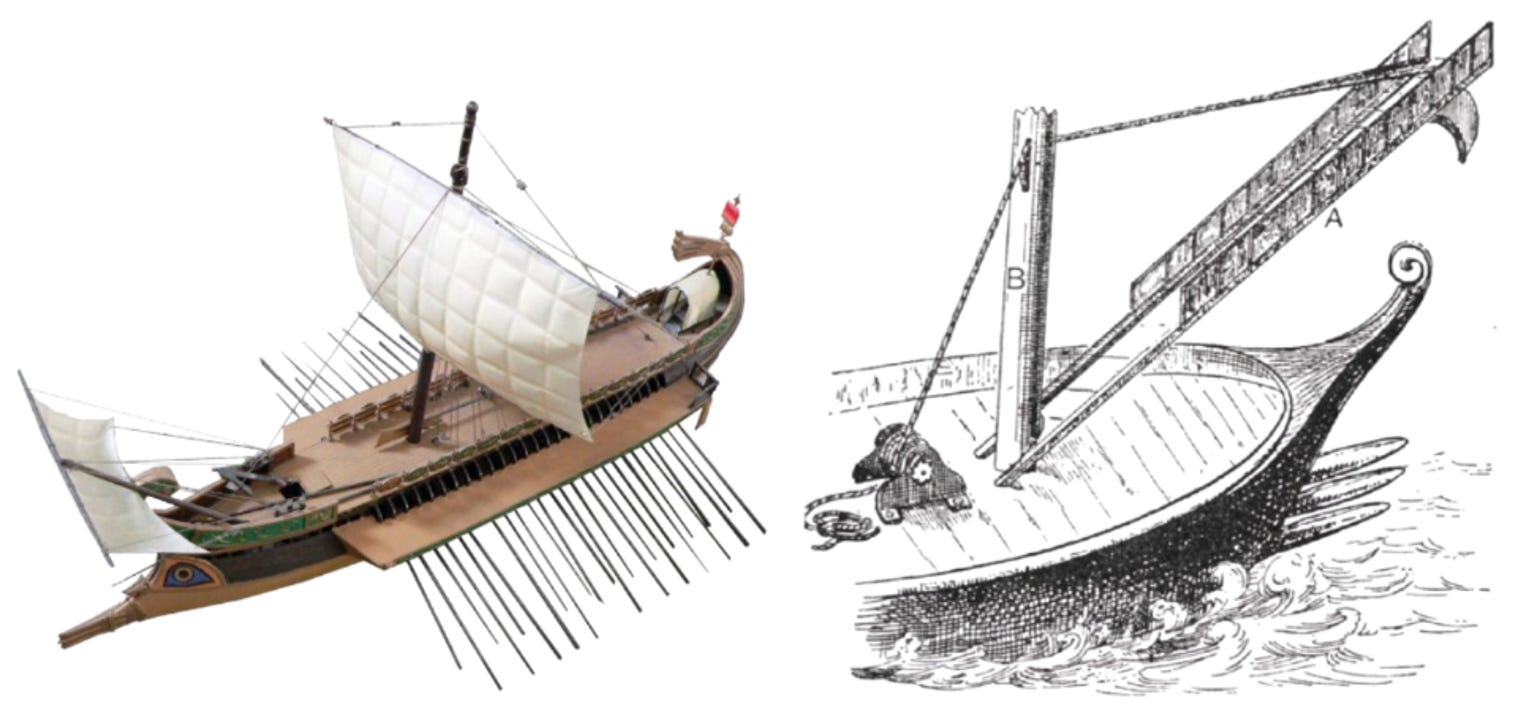
Before the Punic Wars with Rome, Carthage functioned as the dominant maritime power of the western Mediterranean. It developed what naval historian Alfred Thayer Mahan (1840–1914) would later call a classic example of sea power: a state whose prosperity and strategic reach rested on commerce, merchant shipping, naval bases, and a strong fleet [[xx]]. Carthage controlled key islands and trade routes like Sicily, Sardinia, Corsica, and parts of Iberia, allowing it to project influence across the western basin.
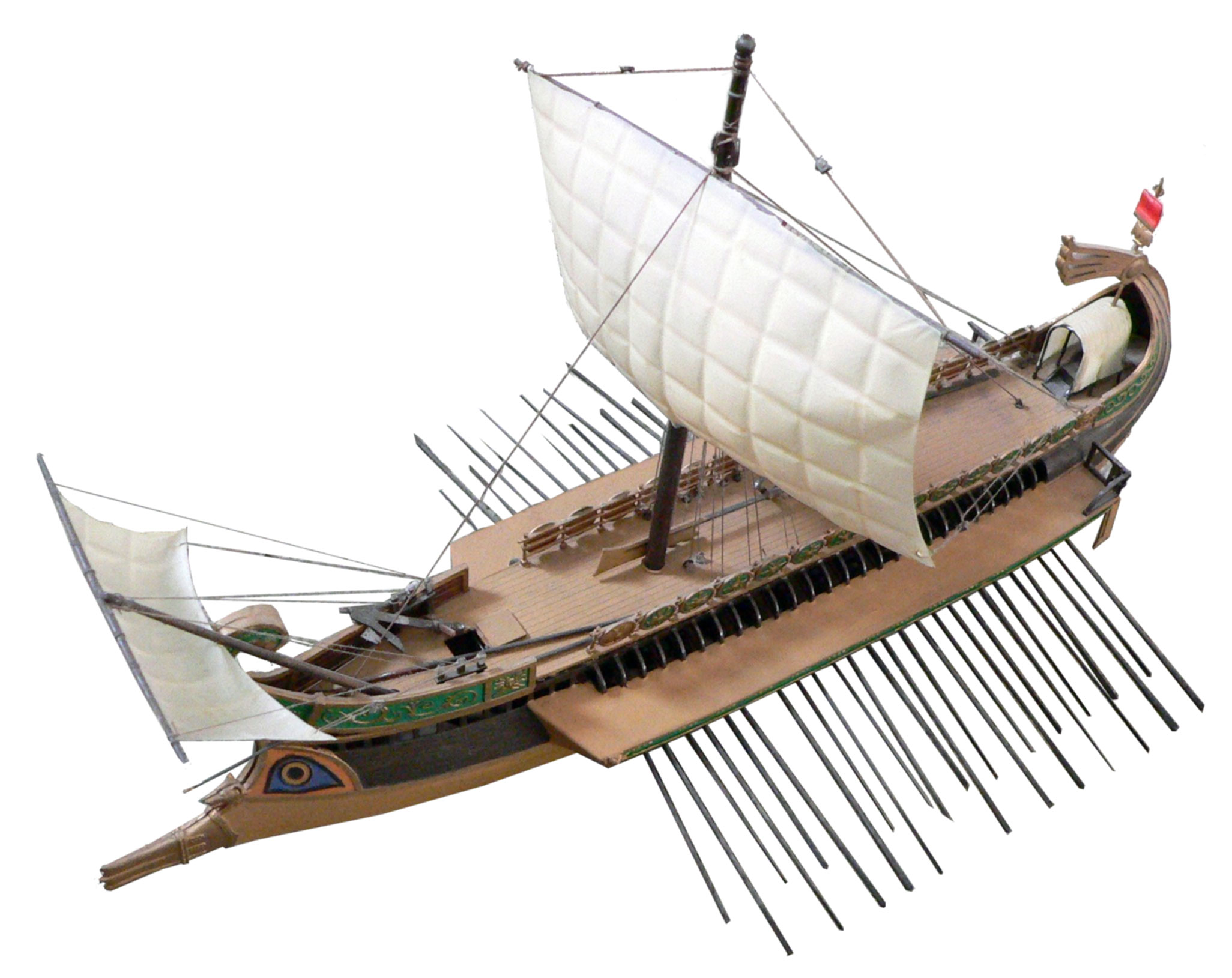
Rome, by contrast, emerged as a continental power. Its strength lay in disciplined legions and an expanding alliance network across the Italian peninsula, not in maritime commerce or naval tradition. Through the lens of Mahan’s theory, the conflict between the two states represented a clash between a maritime commercial empire and a rising territorial power that lacked command of the sea. The First Punic War (264–241 BC) forced Rome to confront this strategic imbalance. Recognizing that victory over Carthage required control of maritime communications, Rome rapidly built fleets, reportedly copying a captured Carthaginian quinquereme, and introduced devices such as the corvus boarding bridge to translate naval combat into infantry fighting, where Roman strengths lay [[xxi]]. After the Roman victory in the Second Punic War (218–201 BC), Rome stripped Carthage of its empire, forbade them to wage war without Roman permission, and forced them to pay a large indemnity.
The Phoenician script, mercantile institutions, and ritual religion supported expansion but did little to cultivate durable intellectual traditions, philosophical self-reflection, or long-lived canonical texts. Their toxic moral code, stressing such features as personal gain at any cost, up to and including child sacrifice, was their undoing. In Innis’s terms, Carthage mastered space at the expense of time, and was therefore vulnerable to a rival, Rome, that more successfully balanced spatial reach with durable institutions and collective memory. When Rome developed sea power to counter Carthage, the writing was on the wall.
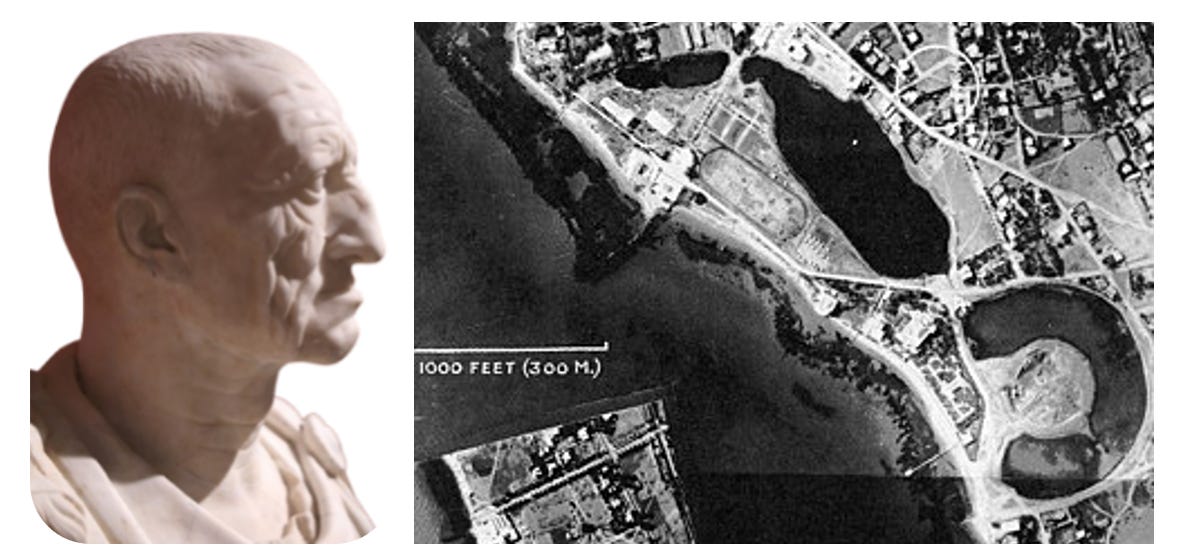
We have already met the Roman Senator Marcus Porcius Cato (234–149 BC), also known as Cato the Elder, who railed against the corrosive influence of Greek culture on Roman society. Toward the end of his life, he was sent on an embassy to Carthage. Finding Carthage “overflowing with enormous wealth” and “teeming with vigorous fighting men,” and convinced that for the Carthaginians “peace and treaty were mere names to cover their postponement of war until a fit occasion offered,” Cato the Elder, famously insisted “Cartago delenda est” (Carthage must be destroyed) [[xxiv]].
By ultimately defeating Carthage both at sea and on land, ending with the city’s destruction in the Third Punic War (149-146 BC), Rome transformed itself from a regional land power into the dominant imperial power of the Mediterranean basin. One can understand why the Romans, who famously tolerated a wide range of beliefs in their dominions, ultimately made Cato the Elder’s vision a reality.
That’s all for now. Remember always to keep calm, and make physics great again.
See you next week,
Hans
P.S. Pick up your copy of Fields & Energy Book I: Fundamentals and Origins of Electromagnetism, if you haven’t already:
Next time: II 1.6 Christianity and Science
Enjoyed the article, but maybe not quite enough to spring for a paid subscription?
Then click on the button below to buy me a coffee. Thanks!

Full Table of Contents [click here]
Follow Online:
You may follow me online in other places as well:
Telegram: 𝔸𝕖𝕥𝕙𝕖𝕣𝕔𝕫𝕒𝕣’𝕤 𝔸𝕖𝕥𝕙𝕖𝕣𝕤𝕥𝕣𝕖𝕒𝕞
Gab: @aetherczar
Twitter: @aetherczar
Amazon: Hans G. Schantz
References
[[i]] Polybius (~200-~118 BC), The Histories, Book VI, published in Vol. III of the Loeb Classical Library edition, 1923, p. 369. See: https://penelope.uchicago.edu/Thayer/E/Roman/Texts/Polybius/6*.html
[[ii]] Polybius (~200-~118 BC), The Histories, Book VI, published in Vol. III of the Loeb Classical Library edition, 1923, p. 385. See: https://penelope.uchicago.edu/Thayer/E/Roman/Texts/Polybius/6*.html
[[iii]] Innis, Harold A. (1894–1952), Empire and Communications, New York: Rowman & Littlefield, Publishers, 2007, originally published 1950, p. 76. See: https://amzn.to/48TEg1g.
[[iv]] Innis, Harold A. (1894–1952), Empire and Communications, New York: Rowman & Littlefield, Publishers, 2007, originally published 1950, p. 65. See: https://amzn.to/48TEg1g.
[[v]] Cunliffe, Barry, The Extraordinary Voyage of Pytheas the Greek, New York: Penguin Books, 2002, pp. 46-49. See: https://amzn.to/4rgcZgv.
[[vi]] Herodotus, The Histories of Herodotus, Translated into English by G. C. Macaulay, London & New York: MacMillan and Co., 1890. Book IV-42.
“…Libya furnishes proofs about itself that it is surrounded by sea, except so much of it as borders upon Asia; and this fact was shown by Necos king of the Egyptians first of all those about whom we have knowledge. He when he had ceased digging the channel which goes through from the Nile to the Arabian gulf, sent Phenicians with ships, bidding them sail and come back through the Pillars of Heracles [Straits of Gibraltar] to the Northern Sea and so to Egypt. The Phenicians therefore set forth from the Erythraian [Red] Sea and sailed through the Southern Sea; and when autumn came, they would put to shore and sow the land, wherever in Libya [Africa] they might happen to be as they sailed, and then they waited for the harvest: and having reaped the corn they would sail on, so that after two years had elapsed, in the third year they turned through the Pillars of Heracles and arrived again in Egypt. And they reported a thing which I cannot believe, but another man may, namely that in sailing round Libya they had the sun on their right hand.”
See: https://www.gutenberg.org/files/2707/2707-h/2707-h.htm#link4noteref-42.
[[vii]] Jamie Heath, “Map of Carthage Commerical Port,” 27 September 2019. See: https://commons.wikimedia.org/wiki/File:Carthago_exhibition_-_Map_of_Carthage_Commerical_Port_(49340668471).jpg
.jpg)
[[viii]] Cunliffe, Barry, The Extraordinary Voyage of Pytheas the Greek, New York: Penguin Books, 2002, pp. 49-50. See: https://amzn.to/4rgcZgv.
[[ix]] Cunliffe, Barry, The Extraordinary Voyage of Pytheas the Greek, New York: Penguin Books, 2002. See: https://amzn.to/4rgcZgv.
[[x]] Paterson, Isabel, The God of the Machine, Palto Alto, California: Palo Alto Book Service, 1943, p. 11. See: https://amzn.to/4rpwsvx.
[[xi]] Charles Foster, Offering to Molech, Bible Pictures and What They Teach Us, 1897. “This is an idol named Molech. A great many people used to pray to this idol. It had the head of a calf, and was made of brass, and it was hollow inside. There was a place in the side to make a fire in it. When it got very hot the wicked people used to put their little children in its arms. The little children were burned to death there. This man in the picture is just going to put a little child in the idol’s arms. Other men are blowing on trumpets and beating on drums, and making a great noise, so that no one can hear the poor little child cry.” See: https://upload.wikimedia.org/wikipedia/commons/8/89/Foster_Bible_Pictures_0074-1_Offering_to_Molech.jpg
[[xii]] Polybius (~200-~118 BC), The Histories, Book VI, published in Vol. III of the Loeb Classical Library edition, 1923. See: https://penelope.uchicago.edu/Thayer/E/Roman/Texts/Polybius/6*.html
[[xiii]] Wolff, Sam, with Lawrence E. Stager, “Child Sacrifice at Carthage: Religious Rite or Population Control?” Biblical Archeology Review, vol. 10, no. 1 (1984) pp. 30-51. “Key takeaways: The Tophet in Carthage served as a burial ground for children sacrificed to Ba’al Hammon and Tanit. Excavations revealed over 400 urns with charred remains, indicating ritual child sacrifice. Child sacrifice increased in frequency from the seventh to fourth centuries B.C., contradicting evolutionary theories of moral progress. Inscriptions indicate that sacrifices often fulfilled parental vows, not merely responses to civic crises. Demographic pressures may have motivated child sacrifice as a means of population control in Carthage.” See: https://www.academia.edu/2298111/Child_Sacrifice_at_Carthage_Religious_Rite_or_Population_Control_Biblical_Archaeology_Review_10_1_1984_30_51_with_Lawrence_E_Stager_
[[xiv]] Naveh, Joseph, Early history of the alphabet : an introduction to West Semitic epigraphy and palaeography, Jerusalem: Magnes Press, Hebrew University, 1982, p.3. See: https://archive.org/details/earlyhistoryofal0000nave/page/2/mode/2up
[[xv]] h. donner- w. rollig, kanaanaische und aramaische inschriften, 1966, pp. 16-17. See: https://archive.org/details/kanaanaischeunda0000hdon/page/16/mode/2up Note I used Grok for the translation.
[[xvi]] A section of the cemetery of ancient Carthage (modern Tunisia). Used between BC ~400 and 200, the grave stelae on the site were usually set up above an urn of cremated remains of the deceased. See: https://www.worldhistory.org/image/1037/tophet-of-carthage/
[[xvii]] Plutarch, On Superstition, 13.
Would it not then have been better for those Gauls and Scythians to have had absolutely no conception, no vision, no tradition, regarding the gods, than to believe in the existence of gods who take delight in the blood of human sacrifice Cand hold this to be the most perfect offering and holy rite? Again, would it not have been far better for the Carthaginians to have taken Critias or Diagoras to draw up their law-code at the very beginning, and so not to believe in any divine power or god, rather than to offer such sacrifices as they used to offer to Cronos? These were not in the manner that Empedocles describes in his attack on those who sacrifice living creatures:
Changed in form is the son beloved of his father so pious,
Who on the altar lays him and slays him. What folly!
No, but with full knowledge and understanding they themselves offered up their own children, and those who had no children would buy little ones from poor people and cut their throats as if they were so many lambs or young birds; meanwhile the mother stood by without a tear or moan; but should she utter a single moan or let fall a single tear, she had to forfeit the money, and her child was sacrificed nevertheless; and the whole area before the statue was filled with a loud noise of flutes and drums [“took;” I replaced with “that”] the cries of wailing should not reach the ears of the people.
Published in Vol. II of the Loeb Classical Library edition, 1928, pp. 493-495. See: https://penelope.uchicago.edu/Thayer/E/Roman/Texts/Plutarch/Moralia/De_superstitione*.html#ref55
See also an alternate translation, here: https://sacred-texts.com/cla/plu/pte/pte09.htm
[[xviii]] Rama, Model of Roman Trireme. See: https://upload.wikimedia.org/wikipedia/commons/6/6d/Trireme_1.jpg
[[xix]] Unknown author - https://runeberg.org/img/uppf/5/0086.1.jpg Roman corvus naval boarding device. See: https://en.wikipedia.org/wiki/Corvus_(boarding_device)#/media/File:Corvus_%C3%A4nterbrygga.png

#/media/File:Corvus_%C3%A4nterbrygga.png)
[[xx]] Mahan, Alfred Thayer (1840–1914), “The Influence of Sea Power Upon History 1660 – 1783, London: Sampson Low, Marston, and Company, 1892. See: https://archive.org/details/in.ernet.dli.2015.49912/page/n1/mode/2up
[[xxi]] Polybius (~200-~118 BC), The Histories, Book I (See in particular Chapter 20), published in Vol. I of the Loeb Classical Library edition, 1922. See: https://penelope.uchicago.edu/Thayer/E/Roman/Texts/Polybius/1*.html
[[xxii]] Sailko, Torlonia Collection, 15 May 2021. See: https://commons.wikimedia.org/wiki/File:Ritratto_maschile_detto_il_vecchio_di_otricoli,_50_ac_ca._%28busto_moderno%29,_da_otricoli_%28visconti%29,_MT533,_05.jpg

[[xxiii]] An aerial photograph of the remains of the naval base of the city of Carthage. The remains of the mercantile harbour are in the centre and those of the military harbour are bottom right. Before the war Carthage had the most powerful navy in the western Mediterranean. Unknown author - The Oxford History of the Classical World, 1986. See: https://en.wikipedia.org/wiki/First_Punic_War#/media/File:Carthage_view.jpg

[[xxiv]] Plutarch (AD 46–119), “The Life of Cato the Elder,” Plutarch’s Lives, vol. 1, Switzerland: Castalia Library, 2020, p. 268.
Thanks. I greatly enjoyed this.
What do you think, if anything, about the hypothesis that Phoenicians integrated into the Roman senate and are/were yhe families that fled to and developed Venice. Some conjecture that this is the origin of ‘The Black Nobility’ etc.?
Hmmm ... The deification of moneymaking, by implication also of moneymakers, and the use of diplomacy as prelude to war.
Where have we seen this lately?
🤔