

II 1.7 Logos Needs Logistics
The Catalysts of Science

A successful culture of scientific development and progress requires more than Logos and the right philosophical premises. Science thrives with stable political and economic conditions, institutional support, a suitable media and communication infrastructure, and a technical and craft ecosystem to support instrument making and experimentation.
That’s how the section will kick off, and then we’ll dive in to an in-depth discussion of the political and economic factors. But that’s awfully short. So, I’ll provide a sneak preview of where I’m going by way of helping myself organize my thoughts.
Logos & Logistics: A Preview
I thought I had a handle on the basic gist of this section: the classical world had the basic idea of science, but science required a special confluence of factors that didn’t come together until the early Middle Ages in the West. Modern scholarship like Seb Falk’s The Light Ages: The Surprising Story of Medieval Science, offers a study of medieval science and technology centered on the fourteenth-century monk and astronomer John Westwyk (c. 1350-c. 1400). God’s Philosophers: How the Medieval World Laid the Foundations of Modern Science by James Hannam argues that medieval Christian scholars laid much of the intellectual groundwork for the Scientific Revolution. Edward’s Grant’s (1926-2020) God and Reason in the Middle Ages argues that the medieval university system and the theological commitment to a rational, law-governed creation helped create the intellectual conditions necessary for the rise of modern science. The book particularly emphasizes the synthesis of Aristotelian philosophy with Christian theology in the Latin West and the institutional role of the medieval universities. And I discovered Father Stanley Jaki’s (1924-2009) amazing classic, Science & Creation: From Eternal Cycles to an Oscillating Universe, which advanced the thesis that science became self-sustaining only within the cultural framework of Latin Christendom.
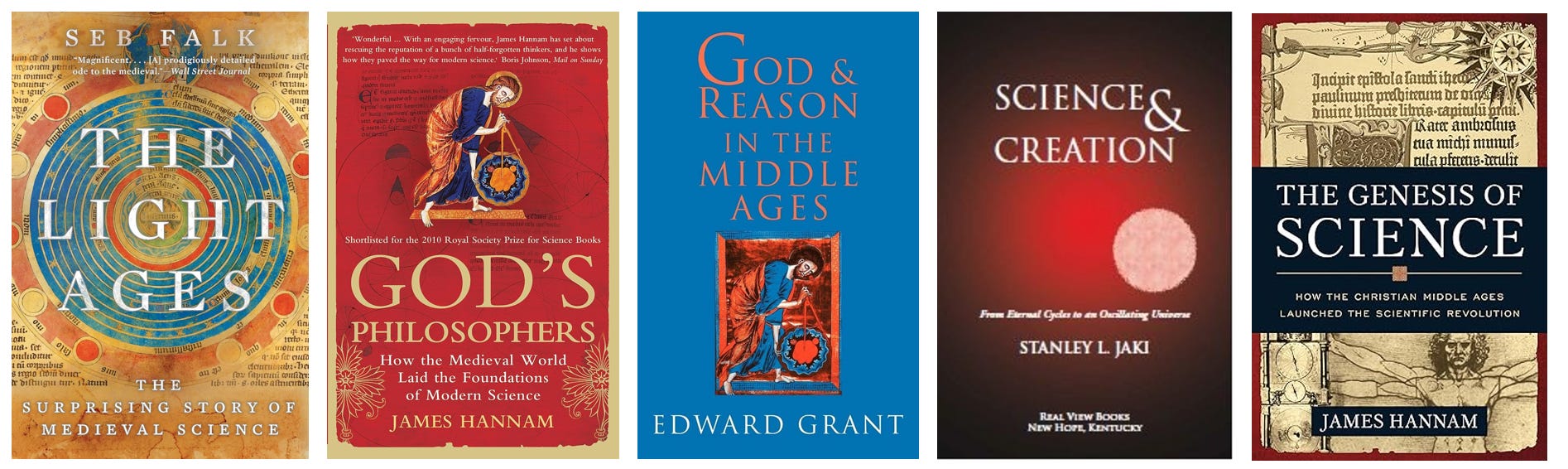
And, buyer beware, The Genesis of Science: How the Christian Middle Ages Launched the Scientific Revolution is the same book as God’s Philosophers, just with a different title.
That was a lot to read, and it was only the beginning. There was more there than I realized.
As usual, this has grown substantially from my original vision for this section. The current outline is:
1.7 Logos Needs Logistics: The Catalysts of Science
1.7.1 Political and Economic Stability
1.7.2 Institutional Support
1.7.2.1 The Library of Alexandria
1.7.2.2 Islam and Byzantium
1.7.2.3 Monasticism
1.7.3 Media & Communication Infrastructure
1.7.4 Technical & Craft Infrastructure
What will I be discussing?
A successful culture of scientific development requires more than an understanding and acceptance of Logos and the right philosophical premises. A civilization may adopt the belief that the universe is orderly, rational, and intelligible, yet still fail to generate sustained scientific progress. Science flourishes only when a broader constellation of conditions exists alongside those metaphysical foundations: stable political order, sufficient economic surplus, institutions capable of preserving and transmitting knowledge, media and communication systems that allow ideas to spread, and a technical culture of craftsmen, instrument makers, navigators, surveyors, and experimentalists capable of translating theory into practice.
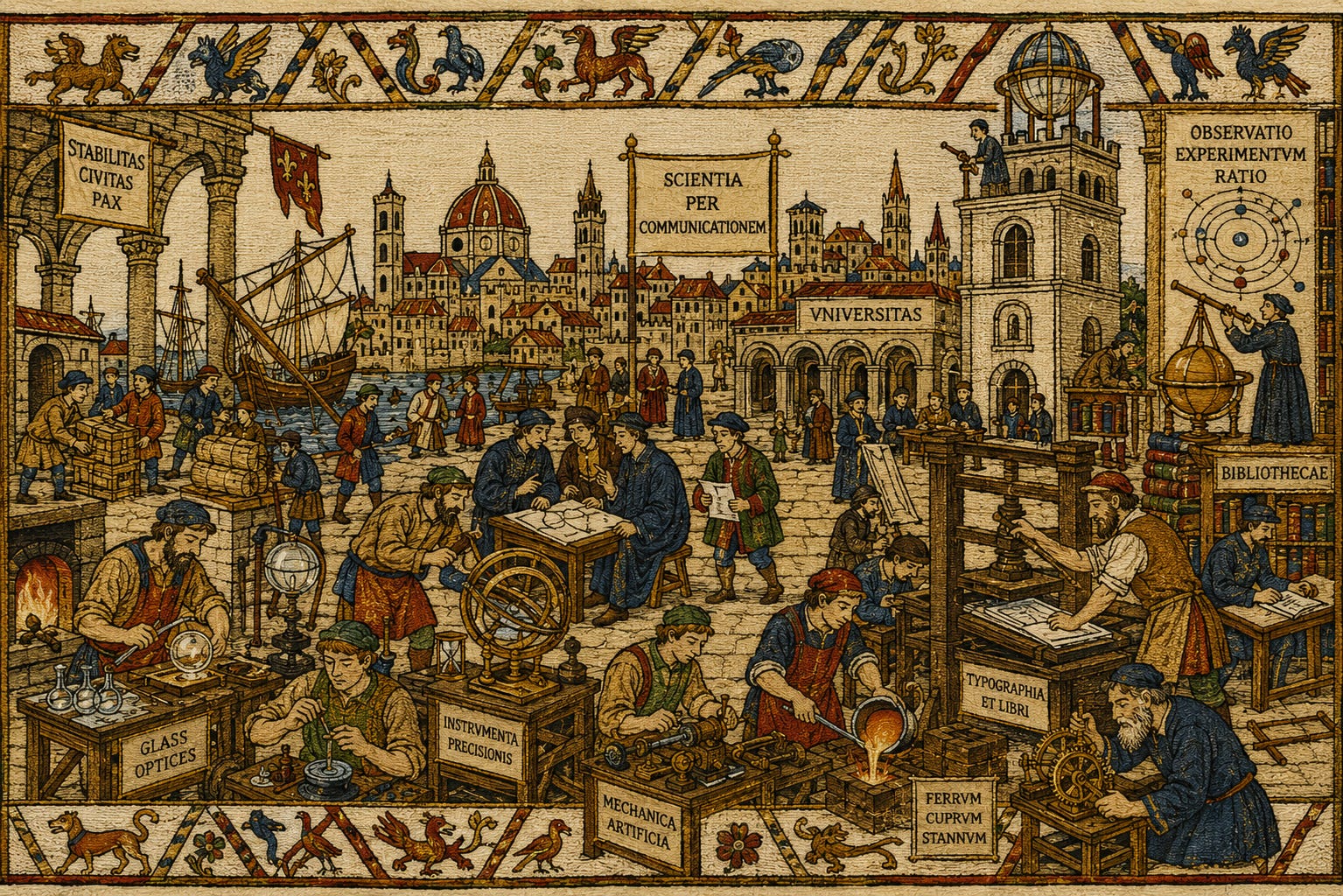
The history of science is not merely the history of ideas. It is the history of entire civilizations assembling the infrastructure necessary to support disciplined inquiry into nature.
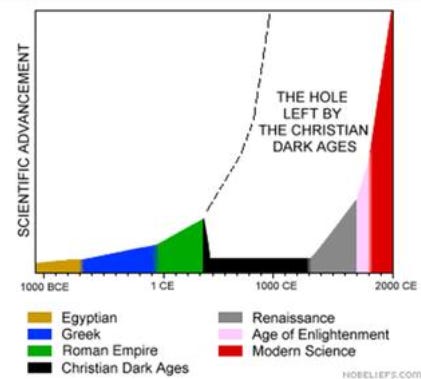
The fashionable claim that Christianity “killed science” collapses under even cursory historical scrutiny. Classical science and philosophy were already in decline centuries before Christianity became the dominant force in the Roman world. As we have already seen, the great age of Greek natural philosophy had largely exhausted itself by the late Hellenistic and Roman periods.
II 1.5 So, What Went Wrong?

The downfall of Classical Greece was not merely military or political, but civilizational. Prosperity led to demographic decline, internal weakness, and the erosion of the diversity and competitive vitality that had fueled Greek creativity. This offers us a broader lesson for scientific and cultural flourishing: successful civilizations can become victims of their own affluence and intellectual complacency. The Greek experience is a warning relevant to modern Western society and to the health of scientific innovation itself.
Political instability, economic contraction, demographic decline, institutional decay, and the collapse of urban life eroded the foundations upon which scientific culture depended. Christianity entered a civilization already in crisis.
The Byzantine and Islamic worlds preserved important portions of the classical inheritance and, at times, advanced them incrementally, but they largely continued along established intellectual lines inherited from antiquity rather than generating the self-sustaining experimental tradition that would later emerge in the West.
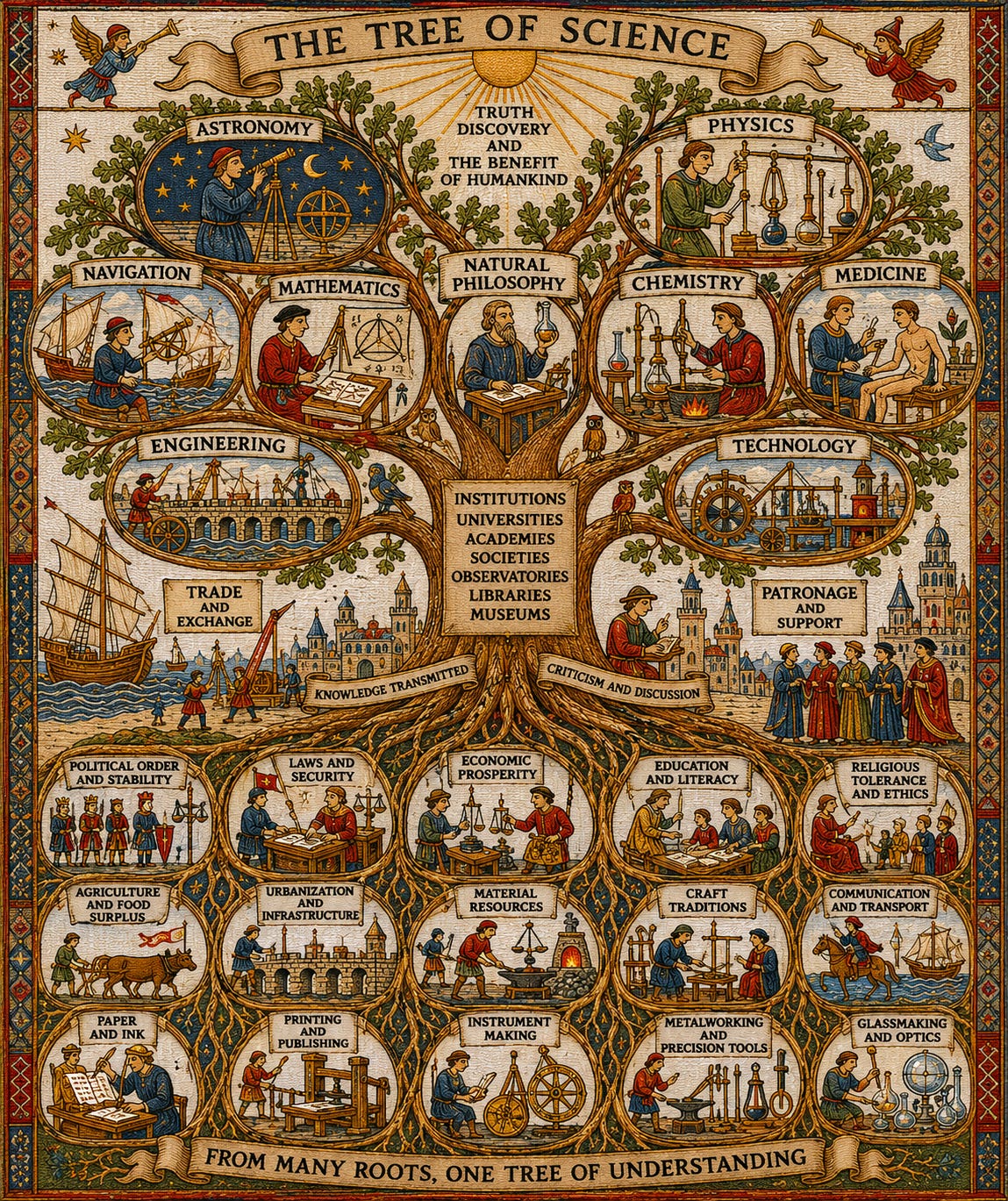
Only in the Middle Ages did the necessary conditions begin to converge in a durable and self-reinforcing way. Europe gradually developed a unique combination of decentralized political competition, growing commercial wealth, relatively autonomous universities, increasingly sophisticated legal and financial institutions, widespread manuscript and later print culture, and a thriving class of artisans and instrument makers. The mechanical clock, the lens grinder, the navigator, the architect, the metallurgist, and the natural philosopher all became participants in a common civilizational ecosystem. By the Renaissance and early modern period, this ecosystem had matured into something genuinely new: a culture capable not merely of preserving knowledge, but of systematically generating it.
What has become increasingly apparent to me is the profound fragility of this achievement. Science is not the inevitable product of intelligence or curiosity. It is a precarious cultural accomplishment dependent upon institutional trust, economic stability, continuity of education, freedom of inquiry, and a civilization confident enough to invest in long-term truth-seeking.
The collapse of classical science was not caused by a single emperor, religion, or invasion, but by the slow unraveling of the civilizational structures that sustained it. The ominous question for our own age is whether we are witnessing analogous forms of institutional decay beneath the surface of technological abundance. In the coming weeks, I intend to explore these parallels in detail: how science rose, how it stagnated, and how easily a civilization can lose the very conditions that once made discovery possible.
That’s all for now. Remember always to keep calm, and make physics great again.
See you next week,
Hans
P.S. Pick up your copy of Fields & Energy Book I: Fundamentals and Origins of Electromagnetism, if you haven’t already:
Next time: II 1.7.1 Political and Economic Stability
Enjoyed the article, but maybe not quite enough to spring for a paid subscription?
Then click on the button below to buy me a coffee. Thanks!

Full Table of Contents [click here]
Follow Online:
You may follow me online in other places as well:
Telegram: 𝔸𝕖𝕥𝕙𝕖𝕣𝕔𝕫𝕒𝕣’𝕤 𝔸𝕖𝕥𝕙𝕖𝕣𝕤𝕥𝕣𝕖𝕒𝕞
Gab: @aetherczar
Twitter: @aetherczar
Amazon: Hans G. Schantz