

II 1.7.2 Institutional Support
Another Catalyst of Science
The emergence of science ultimately required more than the right philosophical premises and an environment of political and economic stability. It also required stable institutions, reliable media for preserving and sharing knowledge, and a tradition of practical craftsmanship capable of turning theoretical insight into instruments and experiments.
From a modern perspective, writing and archives appear to have emerged simultaneously, since our evidence of the earliest writing comes from uncovering the earliest archives. Since at least the late fourth millennium BC, when writing first appeared at Uruk [[i]], temples and palaces maintained collections of clay tablets recording accounts, inventories, and administrative transactions. These were archives rather than libraries in the later scholarly sense: repositories created to manage economic and bureaucratic activity within temples and royal households.
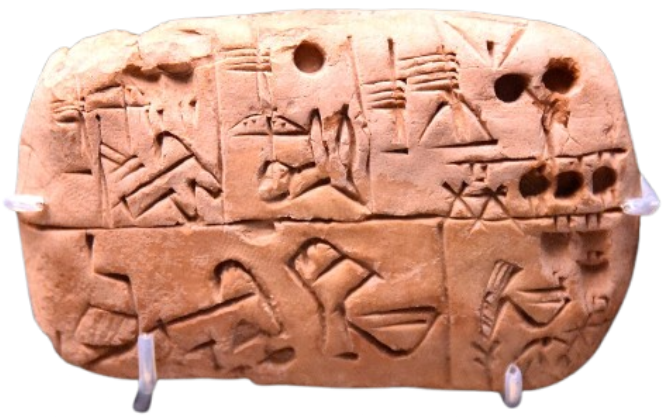
Yet over centuries these archival collections became increasingly structured. Tablets were sorted by genre and shape, stored on shelves or in niches, labeled with tags, and catalogued by series or opening lines. Alongside administrative records there appeared lexical lists, didactic exercises, and copied literary and ritual texts used in the education of scribes. By the second and first millennia BC some collections, such as those associated with temples and royal courts in Assyria and Babylonia, had grown into curated bodies of scholarly literature maintained by generations of trained scribes. These early institutions preserved and transmitted a continuous learned tradition, though their purpose remained closely tied to court, temple, and professional practice [[ii]].
Plato’s Academy was a teaching school. Aristotle’s Lyceum had a noteworthy library that did not long survive the demise of its founder [[iii]]. Only later, in Hellenistic Alexandria, would the idea emerge of a library conceived explicitly as a universal center of scholarship devoted to collecting, studying, and expanding the entire corpus of human knowledge [[iv]]. The Great Library of Alexandria has passed into legend, though, as we shall see, parts of that legend rest upon historical foundations. It became the model for great centers of learning for centuries thereafter.
That’s all for now. Remember always to keep calm, and make physics great again.
See you next week,
Hans
P.S. Pick up your copy of Fields & Energy Book I: Fundamentals and Origins of Electromagnetism, if you haven’t already:
Next time: II 1.7.2.1 The Great Library of Alexandria
Enjoyed the article, but maybe not quite enough to spring for a paid subscription?
Then click on the button below to buy me a coffee. Thanks!

Full Table of Contents [click here]
Follow Online:
You may follow me online in other places as well:
Telegram: 𝔸𝕖𝕥𝕙𝕖𝕣𝕔𝕫𝕒𝕣’𝕤 𝔸𝕖𝕥𝕙𝕖𝕣𝕤𝕥𝕣𝕖𝕒𝕞
Gab: @aetherczar
Twitter: @aetherczar
Amazon: Hans G. Schantz
Your opening paragraph might explain why the climate change cult manages to keep from being laughed off the world stage. The philosophical premises are in flux, along with political and economic stability. Unstable institutions, unreliable media, recipe for bad science.
with the confusion of the languages which could also mean the people scattered from the fall of Babylon & some few had to deal w/ teenagers & their hip hidden language aðustments.
What argues against that is the complete distinction from the writing sum total even how to letters aren't necessarily letters alone.
ºCherishº is the new love, be well.
`Blow more Bubbleºs even pets like those
*May God nod towards thee & thine!*