

II 1.7.2.2 Islamic Institutions
Squandering the Inheritance
Over the following centuries, particularly under the Abbasid caliphate (750–1258), Islamic rulers sponsored large-scale translation and scholarly activity [[ii]]. Institutions associated with Baghdad, most famously the House of Wisdom (Bayt al-Ḥikma) “where the cream of Greek science and philosophy were translated into Arabic. Scholars spread these works through the Islamic Empire, including Spain where western Christians first came across them” [[iii]]. The House of Wisdom, along with madrasa educational networks and later astronomical observatories, not only translated Greek works, but also extended upon them through new work in mathematics, astronomy, and optics by scholars such as Muhammad ibn Musa al-Khwarizmi (c. 780–c. 850) and Hasan ibn al-Haytham (c. 965–c. 1040) [[iv]]. So adept a job did al-Khwarizmi at explaining Hindu numerals and so useful did they prove to be in calculations that they became known as “Arabic” numerals in the West [[v], [vi], [vii]]. In al-Andalus — Muslim-occupied Spain — Al-Hakam II (915–976), the Umayyad Caliph of Córdoba who ruled 961–976 amassed a 300,000-volume library which even attracted Christian scholars [[viii], [ix]].
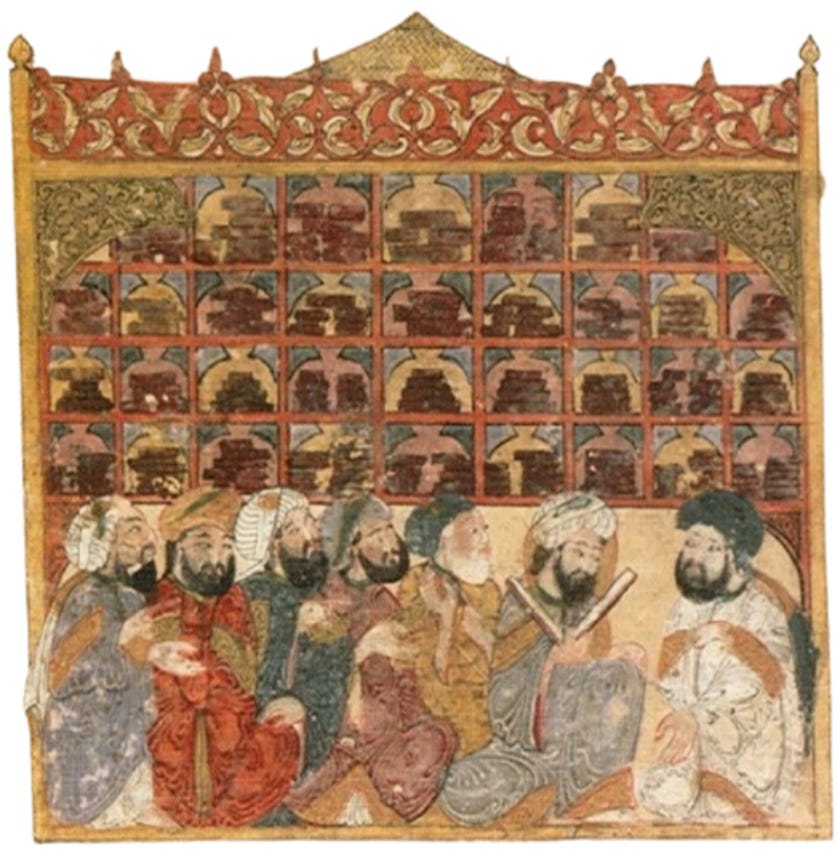
The Muʿtazilites (8th–10th centuries AD) promoted a rational theology in which God’s creation was orderly and intelligible, broadly compatible with a “Logos-like” view that nature operates according to consistent, discoverable principles. This orientation supported confidence in causality and reason as tools for understanding the world [[x]]. The later critique by Al-Ghazali (1058–1111), especially in Tahāfut al-Falāsifa, challenged this foundation by denying necessary causation. He claimed that all events result directly from God’s will (Occasionalism); natural regularities are habitual patterns, not true laws [[xi]].
Moslem influence on Western science and culture are evident in the many terms taken from Arabic: from alkali to zircon and from azure to zenith. Chemical terms: alembic (the upper part of a distilling vessel), camphor, borax, elixir, and talc, astronomical ideas like nadir and zenith, star names like Aldebaran, Altair, and Betelgeuse, mathematical concepts like zero, cipher, algebra, and algorithm, musical instruments like the lute and rebeck, foods and spices like the artichoke, coffee, jasmine, saffron, sherbet, and taraxacum — all these come from Arabic or Persian sources [[xii]].
This flourishing intellectual culture, often termed the “Islamic Golden Age,” was severely disrupted across the Islamic realm [[xiii]]. In the East, the Mongol invasions of the thirteenth century, culminated in the sack of Baghdad in 1258 by the forces of Hulegu Khan (1217–1265) [[xiv], [xv]]. Sicily, ruled by the Byzantines until the fall of Syracuse in 878, came under Islamic control until conquered in turn by a small band of Norman adventurers in 1060. Greeks, Latins, and Moslems lived together, creating ideal conditions for translations to occur [[xvi]]. In the West, the Christian polities of Iberia advanced inexorably southward in the relentless ordeal known as the Reconquista, seizing key cities such as Toledo (1085) and later Córdoba (1236) and Seville (1248), steadily reducing Muslim rule in al-Andalus, and capturing troves of literature [[xvii]].
Islam inherited and advanced Greek culture during their Golden Age, but ultimately squandered the opportunity for a scientific revolution. Replacing Logos with Occasionalism, political instability, and the lack of self-governing universities in which natural philosophy could develop independently, limited progress.
That’s all for now. Remember always to keep calm, and make physics great again.
See you next week,
Hans
P.S. Pick up your copy of Fields & Energy Book I: Fundamentals and Origins of Electromagnetism, if you haven’t already:
Next time: II 1.7.2.3 Byzantine Institutions: A Missed Opportunity
Enjoyed the article, but maybe not quite enough to spring for a paid subscription?
Then click on the button below to buy me a coffee. Thanks!

Full Table of Contents [click here]
Follow Online:
You may follow me online in other places as well:
Telegram: 𝔸𝕖𝕥𝕙𝕖𝕣𝕔𝕫𝕒𝕣’𝕤 𝔸𝕖𝕥𝕙𝕖𝕣𝕤𝕥𝕣𝕖𝕒𝕞
Gab: @aetherczar
Twitter: @aetherczar
Amazon: Hans G. Schantz
References
[[i]] Illustration by Yahyá al-Wasiti from 1237 depicting scholars at an Abbasid library in Baghdad. Found in the Maqama of Hariri located at the Bibliotheque Nationale de France. See: https://commons.wikimedia.org/wiki/File:Maqamat_hariri.jpg

[[ii]] Gutas, Dimitri, Greek Thought, Arabic Culture: The Graeco-Arabic Translation Movement in Baghdad and Early ʿAbbasid Society, London: Routledge, 1998. See: https://amzn.to/48w5awO.
[[iii]] Hannam, James, The Genesis of Science: How the Christian Middle Ages Launched the Scientific Revolution, Washington: Regnery, 2011, p. 12.
[[iv]] Jaki, Stanley L. (1924–2009), Science & Creation, New Hope, KY: Real View Books, 2016, p. 195. See: https://amzn.to/4dkoGiy.
[[v]] Boyer, Carl B., and Uta C. Merzbach, A History of Mathematics, 2nd ed. New York: John Wiley & Sons, Inc., 1991, pp. 227-228. See: https://amzn.to/4n3Du8E
[[vi]] Kline, Morris, Mathematical Thought from Ancient to Modern Times, New York, Oxford: Oxford University Press, 1972, vol. 1, pp. 183-184. See: https://amzn.to/3QHhcNS.
[[vii]] Falk, Seb, The Light Ages: The Surprising Story of Medieval Science, New York: W.W. Norton, 2020, p. 74. See: https://amzn.to/4vo2omo.
[[viii]] Jaki, Stanley L. (1924–2009), Science & Creation, New Hope, KY: Real View Books, 2016, p. 193. See: https://amzn.to/4dkoGiy.
[[ix]] Grant, Edward, God & Reason in the Middle Ages, Cambridge University Press, 2004, pp. 86-87. See: https://amzn.to/3Pc20rv.
[[x]] Jaki, Stanley L. (1924–2009), Science & Creation, New Hope, KY: Real View Books, 2016, pp. 205-206. See: https://amzn.to/4dkoGiy.
[[xi]] Jaki, Stanley L. (1924–2009), Science & Creation, New Hope, KY: Real View Books, 2016, pp. 206-207. See: https://amzn.to/4dkoGiy.
[[xii]] Crombie, A.C., Augustine to Galileo, vol. I, Cambridge, Massachusetts: Harvard University Press, 1961, p. 35.
[[xiii]] Jaki, Stanley L. (1924–2009), Science & Creation, New Hope, KY: Real View Books, 2016, p. 215. See: https://amzn.to/4dkoGiy.
[[xiv]] Garraty, John A. and Peter Gay, eds., The Columbia History of the World, New York: Harper & Row, 1972, pp. 61-64. See: https://amzn.to/3QUjdpU.
[[xv]] Morgan, David, The Mongols (The Peoples of Europe), Malden, MA: Blackwell Publishers, 1986. See: https://amzn.to/4tnztxu.
[[xvi]] Crombie, A.C., Augustine to Galileo, vol. I, Cambridge, Massachusetts: Harvard University Press, 1961, p. 35.
[[xvii]] O’Callaghan, Joseph F., Reconquest and Crusade in Medieval Spain, Philadelphia: University of Pennsylvania Press, 2004. See: https://amzn.to/4usrC2p.
I never heard of Occasionalism before! Very interesting. Sounds like like my relationship with going to the gym. 🤨
Did you miss Avicenna (c. 980 – 22 June 1037) or I did I miss it? "Often described as the father of early modern medicine, Avicenna's most famous works are The Book of Healing, a philosophical and scientific encyclopedia, and The Canon of Medicine, a medical encyclopedia that became a standard medical text at many medieval European universities and remained in use as late as 1650." Many early scientists were doctors.
It is highly probable that the "Islamic Golden Age" is an historical fiction. Read
Emmet Scott: Mohammed and Charlemagne Revisited, https://www.amazon.com/Mohammed-Charlemagne-Revisited-History-Controversy