


Why subscribe?
Is electromagnetism due to one thing: a photon which is somehow simultaneously a localized point particle and a non-localized wave? Or is it two different yet complimentary things: non-local fields guiding localized energy? Alex Macris over at the Contemplations on the Tree of Woe Substack provides a good summary.
Hans argues that conventional thinking on electromagnetism, as currently taught and understood, is based on false premises, and that a return to the original, physically grounded formulations of the 19th century (especially those of Faraday, Maxwell, Heaviside, and Hertz) can provide a clearer, more coherent foundation for physics. Underlying this is a broader critique of modern scientific culture: that it has become overly formalistic, dismissive of alternative interpretations, and hostile to foundational questioning. Hans’s goal is to reinvigorate scientific inquiry by recovering lost insights and re-centering electromagnetic theory on physical understanding rather than abstract calculation.
Scientist, inventor, and author, Hans G. Schantz draws upon a wealth of historical analysis, emerging discoveries, and his own original research to argue that electromagnetism requires a dualistic interpretation: that fields and energy are two different phenomena that follow different paths. This perspective resolves a host of outstanding puzzles and paradoxes including radiation reaction, wave-particle duality, and “vacuum” energy. The Correspondence Principle demands quantum mechanics must agree with classical electromagnetic results. These emerging results lead quantum mechanics toward the long-neglected pilot-wave interpretation and toward the physical reality of what Einstein called gespensterfeld or “ghost fields.”
The Fields & Energy project has grown from the originally envisioned single tome into a three-volume trilogy:
Book I: Fundamentals & Origins of Electromagnetism
Book II: Where Physics Went Wrong
Book III: How Electromagnetism & Quantum Mechanics Work
As of Fall 2026, Book I is complete. All the content from Book I and most of the content from Book II are already available in post format here at the Fields & Energy Substack.

Check out the introductory post for more information.
Subscribe to get full access to the newsletter and website. Never miss an update. Most material is free, but occasionally paid subscribers will receive bonus material.
Stay up-to-date
You won’t have to worry about missing anything. Every new edition of the newsletter goes directly to your inbox.
Join the crew
Be part of a community of people who share your interests.
To find out more about the company that provides the tech for this newsletter, visit Substack.com.
About Hans G. Schantz
Hans G. Schantz, Ph.D., is a physicist, electromagnetic scientist, inventor, entrepreneur, author, and lecturer whose work spans antenna theory, ultrawideband technology, electrically small antennas, near-field electromagnetic systems, electromagnetic energy flow, and the history and foundations of physics.
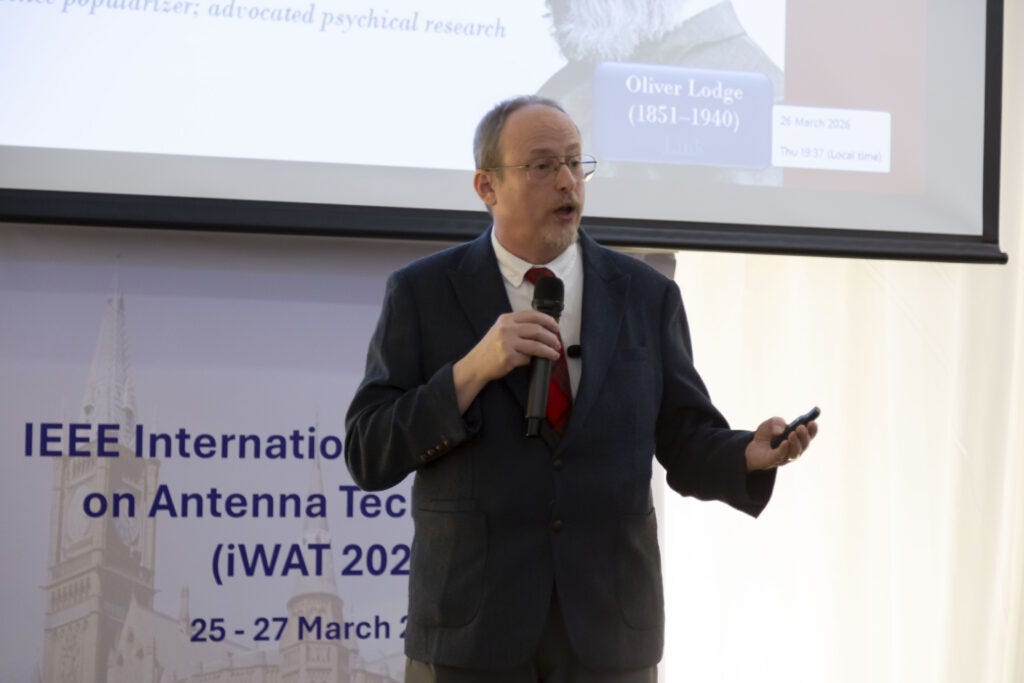
Dr. Schantz earned his Ph.D. in theoretical physics from the University of Texas at Austin in 1995, where his doctoral research examined how oscillating electric dipoles transform bound or reactive electromagnetic energy into radiation. He is the author of The Art and Science of Ultrawideband Antennas, as well as numerous technical papers and patents in electromagnetics and antenna engineering.
Over three decades of research and engineering, his work has ranged from fundamental electromagnetic theory to practical antennas, propagation, localization, radar, and radio-frequency systems. He currently serves as Senior Principal Technical Staff at nou Systems, Inc., and is Founder and Principal Scientist of The Society for Post-Quantum Research.
His current Fields & Energy project brings together theoretical physics, engineering, and the history and philosophy of science to reconsider fundamental questions about fields, energy, radiation, and quantum mechanics. His historical research focuses particularly on Michael Faraday, James Clerk Maxwell, Oliver Heaviside, Heinrich Hertz, and the development of electromagnetic field theory during the nineteenth and early twentieth centuries.
Dr. Schantz lectures on electromagnetics, antenna theory, near-field physics, electromagnetic energy flow, the history of electromagnetism, Maxwell and Heaviside, the foundations of quantum mechanics, and the history and philosophy of science. His talks combine technical analysis with historical context to examine not only how our physical theories work, but how they developed, what assumptions underlie them, and where experimentally testable alternatives remain possible.
He is also a science-fiction author whose fiction draws on his interests in physics, engineering, history, philosophy, and the relationship between scientific ideas and civilization.
